

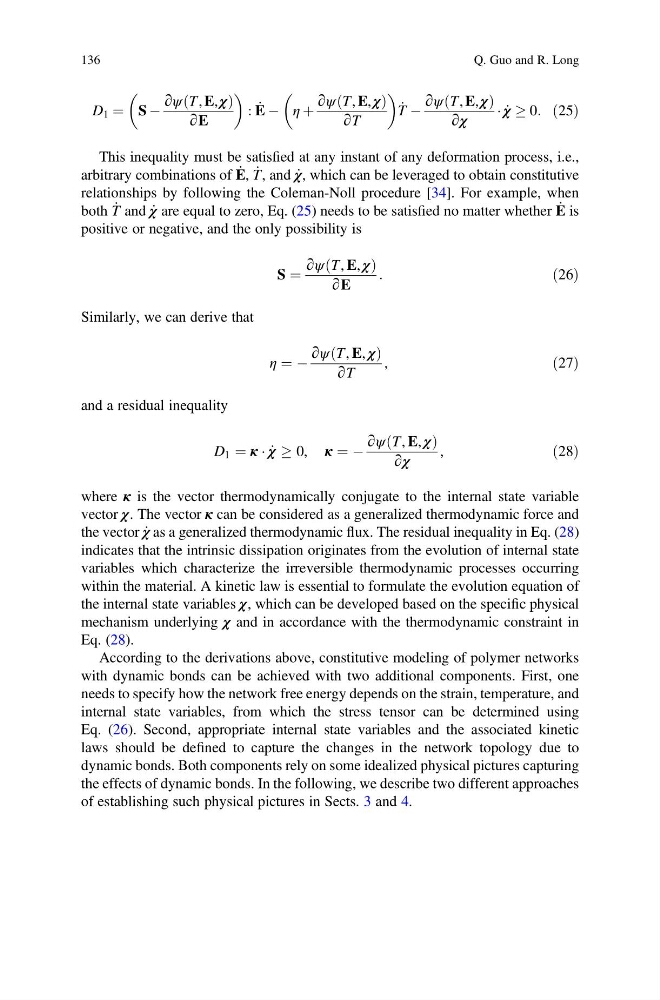
D 1 ¼ S À
∂ψ T, E, χ
ð
Þ
∂E
: _
E À η þ
∂ψ T, E, χ
ð
Þ
∂T
_
T À
∂ψ T, E, χ
ð
Þ
∂χ
Á _
χ ! 0: ð25Þ
This inequality must be satisfied at any instant of any deformation process, i.e.,
arbitrary combinations of _
E, _
T, and _
χ , which can be leveraged to obtain constitutive
relationships by following the Coleman-Noll procedure [34]. For example, when
both _
T and _
χ are equal to zero, Eq. (25) needs to be satisfied no matter whether _
E is
positive or negative, and the only possibility is
S ¼
∂ψ T, E, χ
ð
Þ
∂E
:
ð26Þ
Similarly, we can derive that
η ¼ À
∂ψ T, E, χ
ð
Þ
∂T
,
ð27Þ
and a residual inequality
D 1 ¼ κ Á _
χ ! 0, κ ¼ À
∂ψ T, E, χ
ð
Þ
∂χ
,
ð28Þ
where κ is the vector thermodynamically conjugate to the internal state variable
vector χ . The vector κ can be considered as a generalized thermodynamic force and
the vector _
χ as a generalized thermodynamic flux. The residual inequality in Eq. (28)
indicates that the intrinsic dissipation originates from the evolution of internal state
variables which characterize the irreversible thermodynamic processes occurring
within the material. A kinetic law is essential to formulate the evolution equation of
the internal state variables χ , which can be developed based on the specific physical
mechanism underlying χ and in accordance with the thermodynamic constraint in
Eq. (28).
According to the derivations above, constitutive modeling of polymer networks
with dynamic bonds can be achieved with two additional components. First, one
needs to specify how the network free energy depends on the strain, temperature, and
internal state variables, from which the stress tensor can be determined using
Eq. (26). Second, appropriate internal state variables and the associated kinetic
laws should be defined to capture the changes in the network topology due to
dynamic bonds. Both components rely on some idealized physical pictures capturing
the effects of dynamic bonds. In the following, we describe two different approaches
of establishing such physical pictures in Sects. 3 and 4.
136
Q. Guo and R. Long
∂ψ T, E, χ
ð
Þ
∂E
: _
E À η þ
∂ψ T, E, χ
ð
Þ
∂T
_
T À
∂ψ T, E, χ
ð
Þ
∂χ
Á _
χ ! 0: ð25Þ
This inequality must be satisfied at any instant of any deformation process, i.e.,
arbitrary combinations of _
E, _
T, and _
χ , which can be leveraged to obtain constitutive
relationships by following the Coleman-Noll procedure [34]. For example, when
both _
T and _
χ are equal to zero, Eq. (25) needs to be satisfied no matter whether _
E is
positive or negative, and the only possibility is
S ¼
∂ψ T, E, χ
ð
Þ
∂E
:
ð26Þ
Similarly, we can derive that
η ¼ À
∂ψ T, E, χ
ð
Þ
∂T
,
ð27Þ
and a residual inequality
D 1 ¼ κ Á _
χ ! 0, κ ¼ À
∂ψ T, E, χ
ð
Þ
∂χ
,
ð28Þ
where κ is the vector thermodynamically conjugate to the internal state variable
vector χ . The vector κ can be considered as a generalized thermodynamic force and
the vector _
χ as a generalized thermodynamic flux. The residual inequality in Eq. (28)
indicates that the intrinsic dissipation originates from the evolution of internal state
variables which characterize the irreversible thermodynamic processes occurring
within the material. A kinetic law is essential to formulate the evolution equation of
the internal state variables χ , which can be developed based on the specific physical
mechanism underlying χ and in accordance with the thermodynamic constraint in
Eq. (28).
According to the derivations above, constitutive modeling of polymer networks
with dynamic bonds can be achieved with two additional components. First, one
needs to specify how the network free energy depends on the strain, temperature, and
internal state variables, from which the stress tensor can be determined using
Eq. (26). Second, appropriate internal state variables and the associated kinetic
laws should be defined to capture the changes in the network topology due to
dynamic bonds. Both components rely on some idealized physical pictures capturing
the effects of dynamic bonds. In the following, we describe two different approaches
of establishing such physical pictures in Sects. 3 and 4.
136
Q. Guo and R. Long