

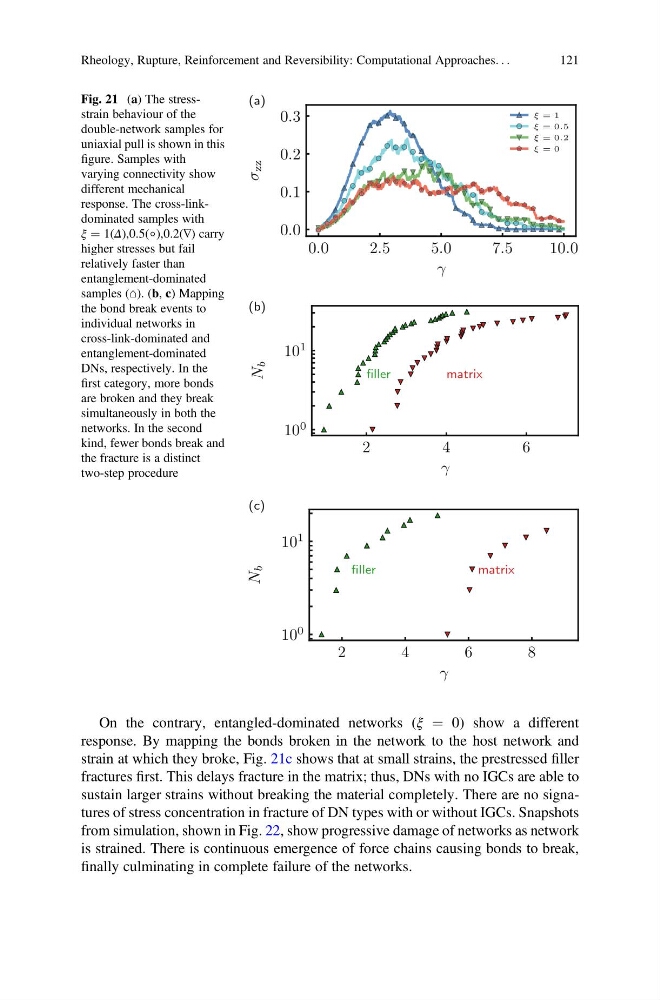
On the contrary, entangled-dominated networks (ξ ¼ 0) show a different
response. By mapping the bonds broken in the network to the host network and
strain at which they broke, Fig. 21c shows that at small strains, the prestressed filler
fractures first. This delays fracture in the matrix; thus, DNs with no IGCs are able to
sustain larger strains without breaking the material completely. There are no signatures of stress concentration in fracture of DN types with or without IGCs. Snapshots
from simulation, shown in Fig. 22, show progressive damage of networks as network
is strained. There is continuous emergence of force chains causing bonds to break,
finally culminating in complete failure of the networks.
0.0
2.5
5.0
7.5
10.0
γ
0.0
0.1
0.2
0.3
σ
zz
(a)
ξ = 1
ξ = 0.5
ξ = 0.2
ξ = 0
2
4
6
γ
10
0
10
1
N
b
(b)
filler
matrix
2
4
6
8
γ
10
0
10
1
N
b
(c)
filler
matrix
Fig. 21 (a) The stressstrain behaviour of the
double-network samples for
uniaxial pull is shown in this
figure. Samples with
varying connectivity show
different mechanical
response. The cross-linkdominated samples with
ξ ¼ 1(Δ),0.5(∘),0.2(∇) carry
higher stresses but fail
relatively faster than
entanglement-dominated
samples (⌂). (b, c) Mapping
the bond break events to
individual networks in
cross-link-dominated and
entanglement-dominated
DNs, respectively. In the
first category, more bonds
are broken and they break
simultaneously in both the
networks. In the second
kind, fewer bonds break and
the fracture is a distinct
two-step procedure
Rheology, Rupture, Reinforcement and Reversibility: Computational Approaches. . .
121
response. By mapping the bonds broken in the network to the host network and
strain at which they broke, Fig. 21c shows that at small strains, the prestressed filler
fractures first. This delays fracture in the matrix; thus, DNs with no IGCs are able to
sustain larger strains without breaking the material completely. There are no signatures of stress concentration in fracture of DN types with or without IGCs. Snapshots
from simulation, shown in Fig. 22, show progressive damage of networks as network
is strained. There is continuous emergence of force chains causing bonds to break,
finally culminating in complete failure of the networks.
0.0
2.5
5.0
7.5
10.0
γ
0.0
0.1
0.2
0.3
σ
zz
(a)
ξ = 1
ξ = 0.5
ξ = 0.2
ξ = 0
2
4
6
γ
10
0
10
1
N
b
(b)
filler
matrix
2
4
6
8
γ
10
0
10
1
N
b
(c)
filler
matrix
Fig. 21 (a) The stressstrain behaviour of the
double-network samples for
uniaxial pull is shown in this
figure. Samples with
varying connectivity show
different mechanical
response. The cross-linkdominated samples with
ξ ¼ 1(Δ),0.5(∘),0.2(∇) carry
higher stresses but fail
relatively faster than
entanglement-dominated
samples (⌂). (b, c) Mapping
the bond break events to
individual networks in
cross-link-dominated and
entanglement-dominated
DNs, respectively. In the
first category, more bonds
are broken and they break
simultaneously in both the
networks. In the second
kind, fewer bonds break and
the fracture is a distinct
two-step procedure
Rheology, Rupture, Reinforcement and Reversibility: Computational Approaches. . .
121