

4.6 Fracture of Double Networks
As previously described we generate double-network samples with varying degree
of intergeneration cross-links (IGCs). The network generation protocol produces two
distinct categories of double-network samples: cross-link-dominated (0 < ξ < 1) and
entanglement-dominated (ξ ¼ 0). Double-network systems are underconstrained
solids as per Maxwell’s rigidity rule [130], which states that a network in ddimensions with N sites is rigid if z
C
N ¼ 2d À 2
d
N % 6 . Double networks are
coarse-grained such that each polymer bridge is an effective spring, which brings
z close to 4. Thus, the networks are submarginal and entropic elasticity dominates the
mechanics.
The initial network configuration is relaxed off-lattice using molecular dynamics
on LAMMPS [75]. Once the pressure and temperature have reached equilibrium
values of 0.0 and 1.0 with the Nosé-Hoover thermostat and barostat, the network is
uniaxially pulled along the Z-axis at a constant strain rate _
λ ¼ 0:0001. Thus the box
length (L ) changes as a function of time step (t): L t
ð Þ ¼ L 0 1 þ _
λ Á dt
À
Á
and L0 is the
edge length of the box after equilibration.
The network is deformed in steps between which the network is allowed to relax
the temperature and lateral pressure. Bonds are allowed to rupture when the forces
exceed a critical stress.
The very first observation is that the density of IGCs controls the nonlinear
fracture behaviour of double-network elastomers, as shown in Fig. 21a. They do
that by facilitating stress transfer between the networks. The presence of more IGCs
acts as additional cross-links, which makes the network stiff.
Figure 21b shows that in cross-link-dominated samples (ξ > 0), bonds break
simultaneously in the filler and matrix, even though there is an initial preference in
bond breaks in the prestressed filler. The networks fail almost one after the other,
triggering an avalanche-like failure.
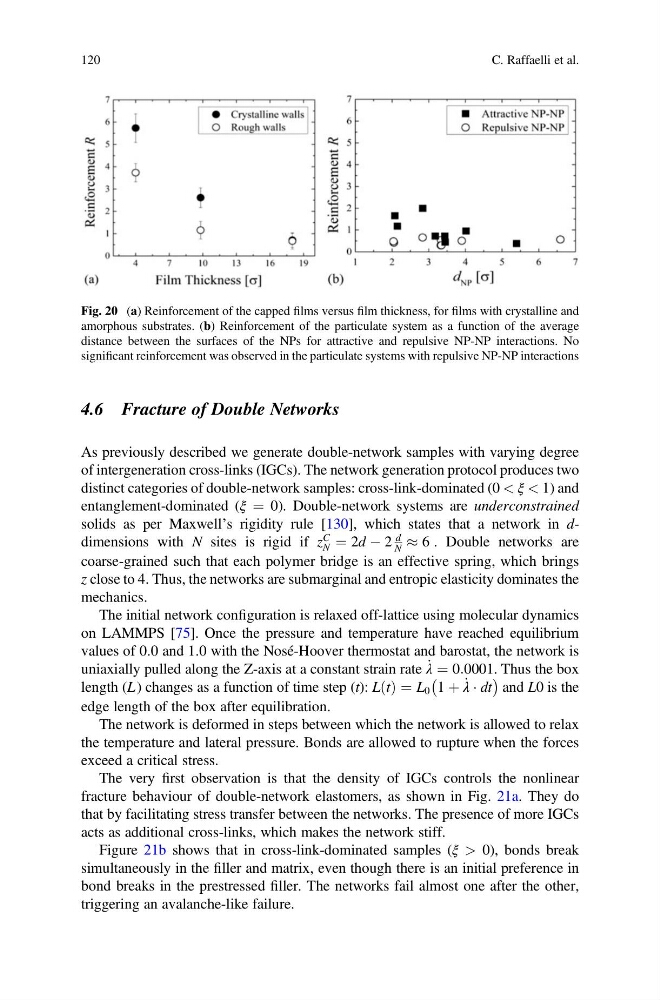
Fig. 20 (a) Reinforcement of the capped films versus film thickness, for films with crystalline and
amorphous substrates. (b) Reinforcement of the particulate system as a function of the average
distance between the surfaces of the NPs for attractive and repulsive NP-NP interactions. No
significant reinforcement was observed in the particulate systems with repulsive NP-NP interactions
120
C. Raffaelli et al.
As previously described we generate double-network samples with varying degree
of intergeneration cross-links (IGCs). The network generation protocol produces two
distinct categories of double-network samples: cross-link-dominated (0 < ξ < 1) and
entanglement-dominated (ξ ¼ 0). Double-network systems are underconstrained
solids as per Maxwell’s rigidity rule [130], which states that a network in ddimensions with N sites is rigid if z
C
N ¼ 2d À 2
d
N % 6 . Double networks are
coarse-grained such that each polymer bridge is an effective spring, which brings
z close to 4. Thus, the networks are submarginal and entropic elasticity dominates the
mechanics.
The initial network configuration is relaxed off-lattice using molecular dynamics
on LAMMPS [75]. Once the pressure and temperature have reached equilibrium
values of 0.0 and 1.0 with the Nosé-Hoover thermostat and barostat, the network is
uniaxially pulled along the Z-axis at a constant strain rate _
λ ¼ 0:0001. Thus the box
length (L ) changes as a function of time step (t): L t
ð Þ ¼ L 0 1 þ _
λ Á dt
À
Á
and L0 is the
edge length of the box after equilibration.
The network is deformed in steps between which the network is allowed to relax
the temperature and lateral pressure. Bonds are allowed to rupture when the forces
exceed a critical stress.
The very first observation is that the density of IGCs controls the nonlinear
fracture behaviour of double-network elastomers, as shown in Fig. 21a. They do
that by facilitating stress transfer between the networks. The presence of more IGCs
acts as additional cross-links, which makes the network stiff.
Figure 21b shows that in cross-link-dominated samples (ξ > 0), bonds break
simultaneously in the filler and matrix, even though there is an initial preference in
bond breaks in the prestressed filler. The networks fail almost one after the other,
triggering an avalanche-like failure.
Fig. 20 (a) Reinforcement of the capped films versus film thickness, for films with crystalline and
amorphous substrates. (b) Reinforcement of the particulate system as a function of the average
distance between the surfaces of the NPs for attractive and repulsive NP-NP interactions. No
significant reinforcement was observed in the particulate systems with repulsive NP-NP interactions
120
C. Raffaelli et al.