

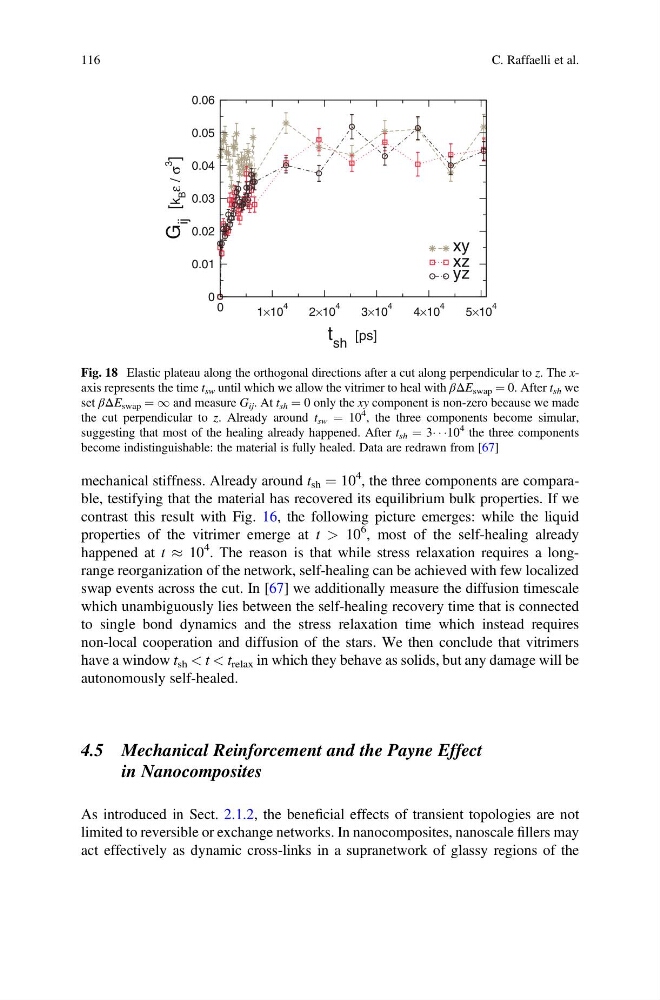
mechanical stiffness. Already around t sh ¼ 10
4 , the three components are comparable, testifying that the material has recovered its equilibrium bulk properties. If we
contrast this result with Fig. 16, the following picture emerges: while the liquid
properties of the vitrimer emerge at t > 10
6 , most of the self-healing already
happened at t % 10
4 . The reason is that while stress relaxation requires a longrange reorganization of the network, self-healing can be achieved with few localized
swap events across the cut. In [67] we additionally measure the diffusion timescale
which unambiguously lies between the self-healing recovery time that is connected
to single bond dynamics and the stress relaxation time which instead requires
non-local cooperation and diffusion of the stars. We then conclude that vitrimers
have a window t sh < t < t relax in which they behave as solids, but any damage will be
autonomously self-healed.
4.5 Mechanical Reinforcement and the Payne Effect
in Nanocomposites
As introduced in Sect. 2.1.2, the beneficial effects of transient topologies are not
limited to reversible or exchange networks. In nanocomposites, nanoscale fillers may
act effectively as dynamic cross-links in a supranetwork of glassy regions of the
0
1×10
4
2×10
4
3×10
4
4×10
4
5×10
4
t sh
[ps]
0
0.01
0.02
0.03
0.04
0.05
0.06
G
ij
[k
B
ε /
σ
3
]
xy
xz
yz
Fig. 18 Elastic plateau along the orthogonal directions after a cut along perpendicular to z. The xaxis represents the time t sw until which we allow the vitrimer to heal with βΔE swap ¼ 0. After t sh we
set βΔE swap ¼ 1 and measure G ij . At t sh ¼ 0 only the xy component is non-zero because we made
the cut perpendicular to z. Already around t sw ¼ 10
4 , the three components become simular,
suggesting that most of the healing already happened. After t sh ¼ 3Á Á Á10
4 the three components
become indistinguishable: the material is fully healed. Data are redrawn from [67]
116
C. Raffaelli et al.
4 , the three components are comparable, testifying that the material has recovered its equilibrium bulk properties. If we
contrast this result with Fig. 16, the following picture emerges: while the liquid
properties of the vitrimer emerge at t > 10
6 , most of the self-healing already
happened at t % 10
4 . The reason is that while stress relaxation requires a longrange reorganization of the network, self-healing can be achieved with few localized
swap events across the cut. In [67] we additionally measure the diffusion timescale
which unambiguously lies between the self-healing recovery time that is connected
to single bond dynamics and the stress relaxation time which instead requires
non-local cooperation and diffusion of the stars. We then conclude that vitrimers
have a window t sh < t < t relax in which they behave as solids, but any damage will be
autonomously self-healed.
4.5 Mechanical Reinforcement and the Payne Effect
in Nanocomposites
As introduced in Sect. 2.1.2, the beneficial effects of transient topologies are not
limited to reversible or exchange networks. In nanocomposites, nanoscale fillers may
act effectively as dynamic cross-links in a supranetwork of glassy regions of the
0
1×10
4
2×10
4
3×10
4
4×10
4
5×10
4
t sh
[ps]
0
0.01
0.02
0.03
0.04
0.05
0.06
G
ij
[k
B
ε /
σ
3
]
xy
xz
yz
Fig. 18 Elastic plateau along the orthogonal directions after a cut along perpendicular to z. The xaxis represents the time t sw until which we allow the vitrimer to heal with βΔE swap ¼ 0. After t sh we
set βΔE swap ¼ 1 and measure G ij . At t sh ¼ 0 only the xy component is non-zero because we made
the cut perpendicular to z. Already around t sw ¼ 10
4 , the three components become simular,
suggesting that most of the healing already happened. After t sh ¼ 3Á Á Á10
4 the three components
become indistinguishable: the material is fully healed. Data are redrawn from [67]
116
C. Raffaelli et al.