

elastomer. To better understand, and perhaps someday to be able to design for
desired properties, we have focused [15–17] on the study of the filler-polymer
interfaces, under both equilibrium and non-equilibrium conditions. For this to
succeed, it is essential to study also the glass transition temperature of the polymer
matrix, since it is well known that the mechanical properties of a polymeric material
are contingent on its glass transition temperature T g , as well as on the underlining
local segmental mobility of the polymer chains. Those properties are, at least locally,
altered by the interfaces which are developed after the addition of the filler particles
to the polymer matrix.
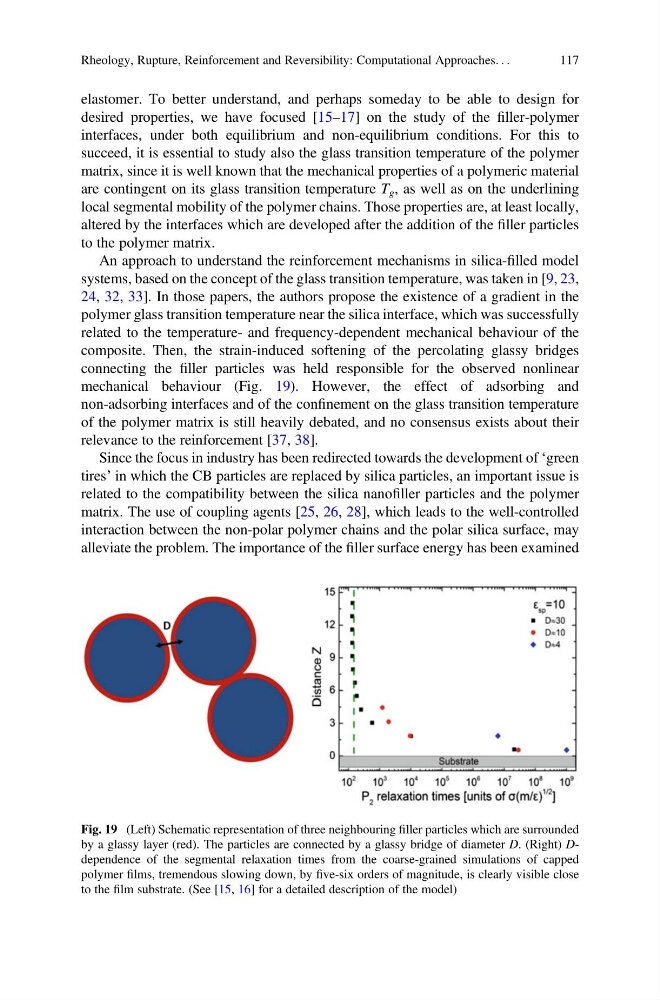
An approach to understand the reinforcement mechanisms in silica-filled model
systems, based on the concept of the glass transition temperature, was taken in [9, 23,
24, 32, 33]. In those papers, the authors propose the existence of a gradient in the
polymer glass transition temperature near the silica interface, which was successfully
related to the temperature- and frequency-dependent mechanical behaviour of the
composite. Then, the strain-induced softening of the percolating glassy bridges
connecting the filler particles was held responsible for the observed nonlinear
mechanical behaviour (Fig. 19). However, the effect of adsorbing and
non-adsorbing interfaces and of the confinement on the glass transition temperature
of the polymer matrix is still heavily debated, and no consensus exists about their
relevance to the reinforcement [37, 38].
Since the focus in industry has been redirected towards the development of ‘green
tires’ in which the CB particles are replaced by silica particles, an important issue is
related to the compatibility between the silica nanofiller particles and the polymer
matrix. The use of coupling agents [25, 26, 28], which leads to the well-controlled
interaction between the non-polar polymer chains and the polar silica surface, may
alleviate the problem. The importance of the filler surface energy has been examined
Fig. 19 (Left) Schematic representation of three neighbouring filler particles which are surrounded
by a glassy layer (red). The particles are connected by a glassy bridge of diameter D. (Right) Ddependence of the segmental relaxation times from the coarse-grained simulations of capped
polymer films, tremendous slowing down, by five-six orders of magnitude, is clearly visible close
to the film substrate. (See [15, 16] for a detailed description of the model)
Rheology, Rupture, Reinforcement and Reversibility: Computational Approaches. . .
117
desired properties, we have focused [15–17] on the study of the filler-polymer
interfaces, under both equilibrium and non-equilibrium conditions. For this to
succeed, it is essential to study also the glass transition temperature of the polymer
matrix, since it is well known that the mechanical properties of a polymeric material
are contingent on its glass transition temperature T g , as well as on the underlining
local segmental mobility of the polymer chains. Those properties are, at least locally,
altered by the interfaces which are developed after the addition of the filler particles
to the polymer matrix.
An approach to understand the reinforcement mechanisms in silica-filled model
systems, based on the concept of the glass transition temperature, was taken in [9, 23,
24, 32, 33]. In those papers, the authors propose the existence of a gradient in the
polymer glass transition temperature near the silica interface, which was successfully
related to the temperature- and frequency-dependent mechanical behaviour of the
composite. Then, the strain-induced softening of the percolating glassy bridges
connecting the filler particles was held responsible for the observed nonlinear
mechanical behaviour (Fig. 19). However, the effect of adsorbing and
non-adsorbing interfaces and of the confinement on the glass transition temperature
of the polymer matrix is still heavily debated, and no consensus exists about their
relevance to the reinforcement [37, 38].
Since the focus in industry has been redirected towards the development of ‘green
tires’ in which the CB particles are replaced by silica particles, an important issue is
related to the compatibility between the silica nanofiller particles and the polymer
matrix. The use of coupling agents [25, 26, 28], which leads to the well-controlled
interaction between the non-polar polymer chains and the polar silica surface, may
alleviate the problem. The importance of the filler surface energy has been examined
Fig. 19 (Left) Schematic representation of three neighbouring filler particles which are surrounded
by a glassy layer (red). The particles are connected by a glassy bridge of diameter D. (Right) Ddependence of the segmental relaxation times from the coarse-grained simulations of capped
polymer films, tremendous slowing down, by five-six orders of magnitude, is clearly visible close
to the film substrate. (See [15, 16] for a detailed description of the model)
Rheology, Rupture, Reinforcement and Reversibility: Computational Approaches. . .
117