

further event by setting βΔE swap ¼ 1, and then we measure the elasticity of the
healed system. In Fig. 18 we measure the elastic plateau along the three orthogonal
directions, as a function of the self-healing time t sh after which we stop any
swapping. While the xy component is not affected by the cut and thus does not
significantly change with t sh , both xz and yz components manifest a rapid recovery of
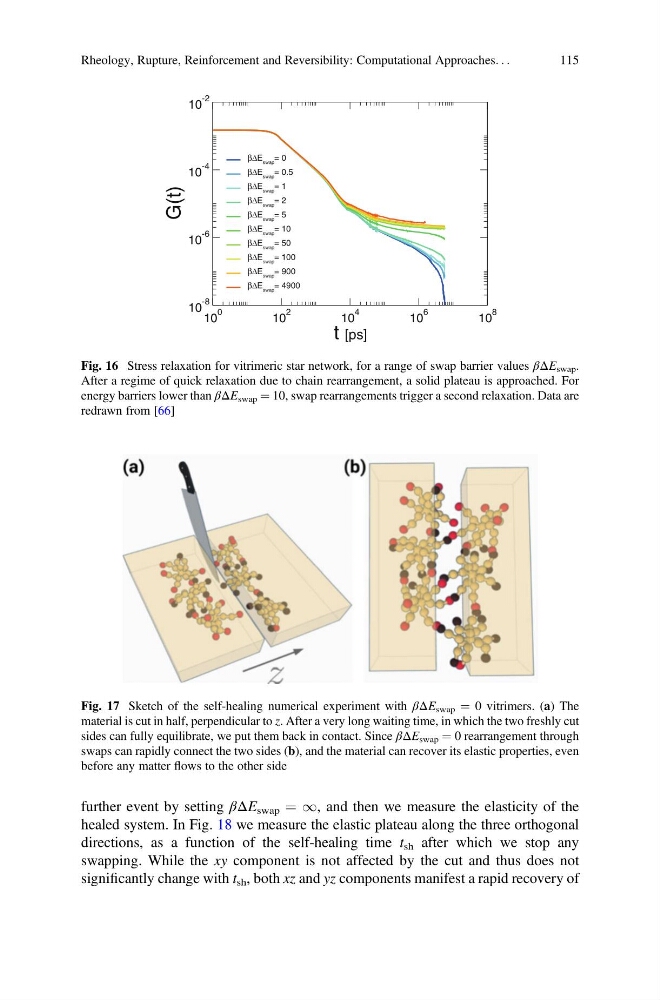
Fig. 17 Sketch of the self-healing numerical experiment with βΔE swap ¼ 0 vitrimers. (a) The
material is cut in half, perpendicular to z. After a very long waiting time, in which the two freshly cut
sides can fully equilibrate, we put them back in contact. Since βΔE swap ¼ 0 rearrangement through
swaps can rapidly connect the two sides (b), and the material can recover its elastic properties, even
before any matter flows to the other side
10
0
10
2
10
4
10
6
10
8
t [ps]
10
-8
10
-6
10
-4
10
-2
G(t)
βΔE swap = 0
βΔE swap = 0.5
βΔE swap = 1
βΔE swap = 2
βΔE swap = 5
βΔE swap = 10
βΔE swap = 50
βΔE swap = 100
βΔE swap = 900
βΔE swap = 4900
Fig. 16 Stress relaxation for vitrimeric star network, for a range of swap barrier values βΔE swap .
After a regime of quick relaxation due to chain rearrangement, a solid plateau is approached. For
energy barriers lower than βΔE swap ¼ 10, swap rearrangements trigger a second relaxation. Data are
redrawn from [66]
Rheology, Rupture, Reinforcement and Reversibility: Computational Approaches. . .
115
healed system. In Fig. 18 we measure the elastic plateau along the three orthogonal
directions, as a function of the self-healing time t sh after which we stop any
swapping. While the xy component is not affected by the cut and thus does not
significantly change with t sh , both xz and yz components manifest a rapid recovery of
Fig. 17 Sketch of the self-healing numerical experiment with βΔE swap ¼ 0 vitrimers. (a) The
material is cut in half, perpendicular to z. After a very long waiting time, in which the two freshly cut
sides can fully equilibrate, we put them back in contact. Since βΔE swap ¼ 0 rearrangement through
swaps can rapidly connect the two sides (b), and the material can recover its elastic properties, even
before any matter flows to the other side
10
0
10
2
10
4
10
6
10
8
t [ps]
10
-8
10
-6
10
-4
10
-2
G(t)
βΔE swap = 0
βΔE swap = 0.5
βΔE swap = 1
βΔE swap = 2
βΔE swap = 5
βΔE swap = 10
βΔE swap = 50
βΔE swap = 100
βΔE swap = 900
βΔE swap = 4900
Fig. 16 Stress relaxation for vitrimeric star network, for a range of swap barrier values βΔE swap .
After a regime of quick relaxation due to chain rearrangement, a solid plateau is approached. For
energy barriers lower than βΔE swap ¼ 10, swap rearrangements trigger a second relaxation. Data are
redrawn from [66]
Rheology, Rupture, Reinforcement and Reversibility: Computational Approaches. . .
115