

can be increased continuously, slowing down this relaxation due to topological
rearrangements. Above a certain limit (that depends on the experimental timescale;
in our example, it is around βΔE swap % 10), the material ceases to be a liquid and
retains some of its original shape, as proven by the non-zero plateau of G(t).
For our second numerical experiment in which we aim to expose the self-healing
capabilities of vitrimers, we focus on the βΔE swap ¼ 0 phase. We damage this
material by cutting it perpendicular to the z direction as sketched in Fig. 17a. We then
let the two halves equilibrate separately for a very long time, in order to mimic the
worst-case scenario for self-healing. Lastly, we put them back in contact, allowing
stars to diffuse around and swaps to reconnect the two halves as depicted in Fig. 17b.
After a self-healing time t sh in which the bonds can effortlessly swap, we prevent any
1.0
0.8
0.6
0.4
0.2
0.0
0.0 0.1 0.2 0.3 0.4 0.5 0.6 0.7 0.8 0.9 1.0
irreversible + reversible
irreversible
probability
10 0
10 –1
10 –1
10 –2
10 –3
10 –4
10 –5
10 0
10 –2
10 –3
10 –4
10 –5
10 0
10 1
10 2
10 3
10 4
10 5
10 0
10 1
10 2
10 3
10 4
10 5
G(t)/G(t=0)
G(t)/G(t=0)
G(t)
G(t)
t
t
1.0
0.9
0.7
0.5
0.3
0.0
fraction irreversible bonds
1.0
0.9
0.7
0.5
0.3
0.0
fraction irreversible bonds
η
a
b
c
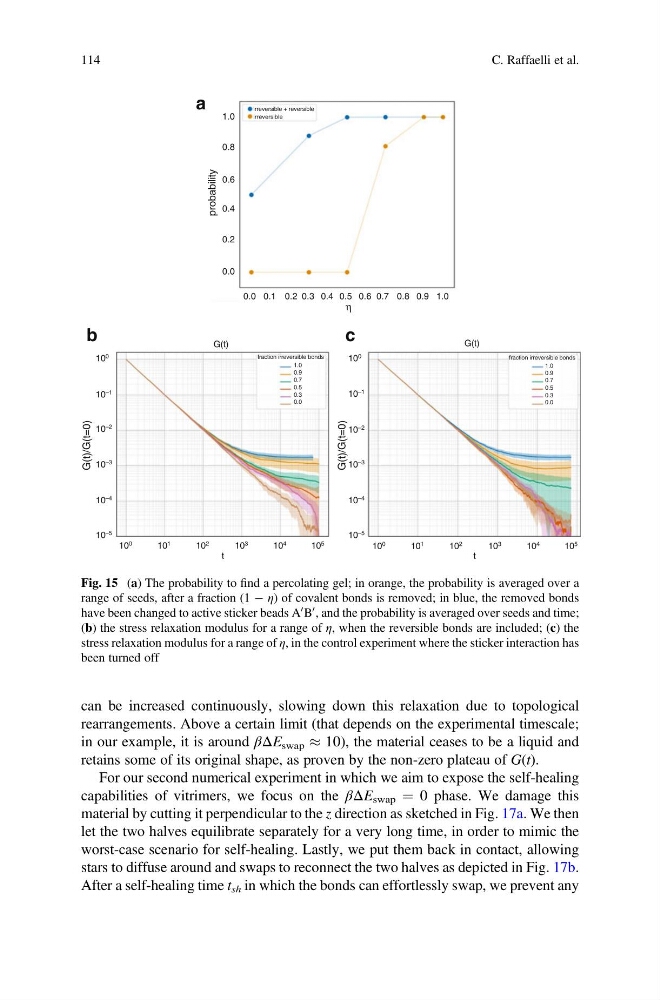
Fig. 15 (a) The probability to find a percolating gel; in orange, the probability is averaged over a
range of seeds, after a fraction (1 À η) of covalent bonds is removed; in blue, the removed bonds
have been changed to active sticker beads A
0 B
0 , and the probability is averaged over seeds and time;
(b) the stress relaxation modulus for a range of η, when the reversible bonds are included; (c) the
stress relaxation modulus for a range of η, in the control experiment where the sticker interaction has
been turned off
114
C. Raffaelli et al.
rearrangements. Above a certain limit (that depends on the experimental timescale;
in our example, it is around βΔE swap % 10), the material ceases to be a liquid and
retains some of its original shape, as proven by the non-zero plateau of G(t).
For our second numerical experiment in which we aim to expose the self-healing
capabilities of vitrimers, we focus on the βΔE swap ¼ 0 phase. We damage this
material by cutting it perpendicular to the z direction as sketched in Fig. 17a. We then
let the two halves equilibrate separately for a very long time, in order to mimic the
worst-case scenario for self-healing. Lastly, we put them back in contact, allowing
stars to diffuse around and swaps to reconnect the two halves as depicted in Fig. 17b.
After a self-healing time t sh in which the bonds can effortlessly swap, we prevent any
1.0
0.8
0.6
0.4
0.2
0.0
0.0 0.1 0.2 0.3 0.4 0.5 0.6 0.7 0.8 0.9 1.0
irreversible + reversible
irreversible
probability
10 0
10 –1
10 –1
10 –2
10 –3
10 –4
10 –5
10 0
10 –2
10 –3
10 –4
10 –5
10 0
10 1
10 2
10 3
10 4
10 5
10 0
10 1
10 2
10 3
10 4
10 5
G(t)/G(t=0)
G(t)/G(t=0)
G(t)
G(t)
t
t
1.0
0.9
0.7
0.5
0.3
0.0
fraction irreversible bonds
1.0
0.9
0.7
0.5
0.3
0.0
fraction irreversible bonds
η
a
b
c
Fig. 15 (a) The probability to find a percolating gel; in orange, the probability is averaged over a
range of seeds, after a fraction (1 À η) of covalent bonds is removed; in blue, the removed bonds
have been changed to active sticker beads A
0 B
0 , and the probability is averaged over seeds and time;
(b) the stress relaxation modulus for a range of η, when the reversible bonds are included; (c) the
stress relaxation modulus for a range of η, in the control experiment where the sticker interaction has
been turned off
114
C. Raffaelli et al.