

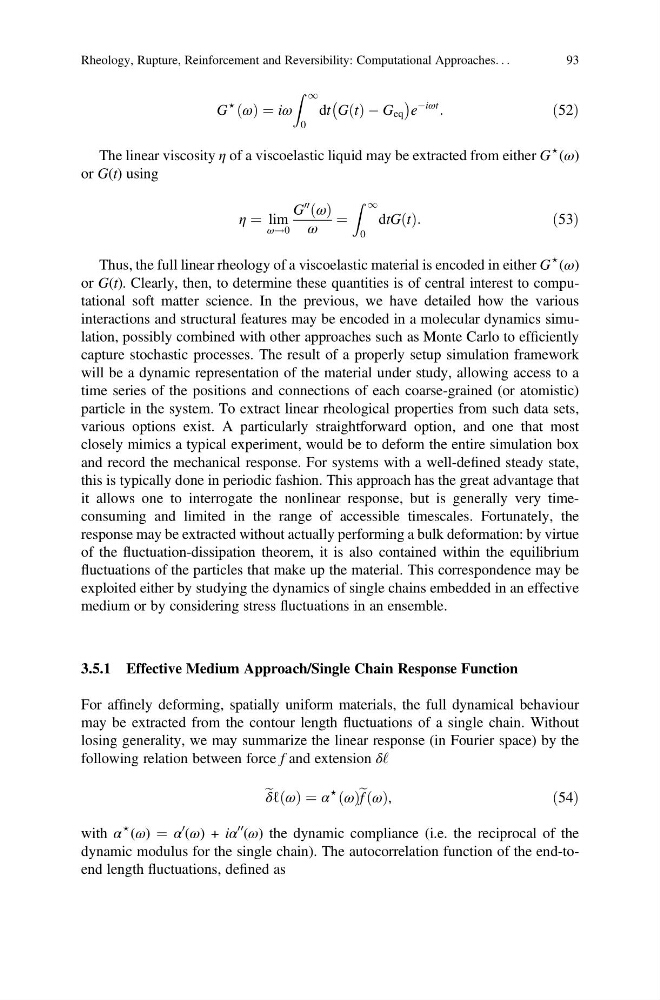
G
⋆
ω
ð Þ ¼ iω
Z 1
0
dt G t
ð Þ À G eq
À
Á
e
Àiωt
:
ð52Þ
The linear viscosity η of a viscoelastic liquid may be extracted from either G
⋆
(ω)
or G(t) using
η ¼ lim
ω!0
G
00
ω
ð Þ
ω
¼
Z 1
0
dtG t
ð Þ:
ð53Þ
Thus, the full linear rheology of a viscoelastic material is encoded in either G
⋆
(ω)
or G(t). Clearly, then, to determine these quantities is of central interest to computational soft matter science. In the previous, we have detailed how the various
interactions and structural features may be encoded in a molecular dynamics simulation, possibly combined with other approaches such as Monte Carlo to efficiently
capture stochastic processes. The result of a properly setup simulation framework
will be a dynamic representation of the material under study, allowing access to a
time series of the positions and connections of each coarse-grained (or atomistic)
particle in the system. To extract linear rheological properties from such data sets,
various options exist. A particularly straightforward option, and one that most
closely mimics a typical experiment, would be to deform the entire simulation box
and record the mechanical response. For systems with a well-defined steady state,
this is typically done in periodic fashion. This approach has the great advantage that
it allows one to interrogate the nonlinear response, but is generally very timeconsuming and limited in the range of accessible timescales. Fortunately, the
response may be extracted without actually performing a bulk deformation: by virtue
of the fluctuation-dissipation theorem, it is also contained within the equilibrium
fluctuations of the particles that make up the material. This correspondence may be
exploited either by studying the dynamics of single chains embedded in an effective
medium or by considering stress fluctuations in an ensemble.
3.5.1 Effective Medium Approach/Single Chain Response Function
For affinely deforming, spatially uniform materials, the full dynamical behaviour
may be extracted from the contour length fluctuations of a single chain. Without
losing generality, we may summarize the linear response (in Fourier space) by the
following relation between force f and extension δ‘
e δℓ ω
ð Þ ¼ α
⋆
ω
ð Þ e f ω
ð Þ,
ð54Þ
with α
⋆ (ω) ¼ α
0 (ω) + iα
00
(ω) the dynamic compliance (i.e. the reciprocal of the
dynamic modulus for the single chain). The autocorrelation function of the end-toend length fluctuations, defined as
Rheology, Rupture, Reinforcement and Reversibility: Computational Approaches. . .
93
⋆
ω
ð Þ ¼ iω
Z 1
0
dt G t
ð Þ À G eq
À
Á
e
Àiωt
:
ð52Þ
The linear viscosity η of a viscoelastic liquid may be extracted from either G
⋆
(ω)
or G(t) using
η ¼ lim
ω!0
G
00
ω
ð Þ
ω
¼
Z 1
0
dtG t
ð Þ:
ð53Þ
Thus, the full linear rheology of a viscoelastic material is encoded in either G
⋆
(ω)
or G(t). Clearly, then, to determine these quantities is of central interest to computational soft matter science. In the previous, we have detailed how the various
interactions and structural features may be encoded in a molecular dynamics simulation, possibly combined with other approaches such as Monte Carlo to efficiently
capture stochastic processes. The result of a properly setup simulation framework
will be a dynamic representation of the material under study, allowing access to a
time series of the positions and connections of each coarse-grained (or atomistic)
particle in the system. To extract linear rheological properties from such data sets,
various options exist. A particularly straightforward option, and one that most
closely mimics a typical experiment, would be to deform the entire simulation box
and record the mechanical response. For systems with a well-defined steady state,
this is typically done in periodic fashion. This approach has the great advantage that
it allows one to interrogate the nonlinear response, but is generally very timeconsuming and limited in the range of accessible timescales. Fortunately, the
response may be extracted without actually performing a bulk deformation: by virtue
of the fluctuation-dissipation theorem, it is also contained within the equilibrium
fluctuations of the particles that make up the material. This correspondence may be
exploited either by studying the dynamics of single chains embedded in an effective
medium or by considering stress fluctuations in an ensemble.
3.5.1 Effective Medium Approach/Single Chain Response Function
For affinely deforming, spatially uniform materials, the full dynamical behaviour
may be extracted from the contour length fluctuations of a single chain. Without
losing generality, we may summarize the linear response (in Fourier space) by the
following relation between force f and extension δ‘
e δℓ ω
ð Þ ¼ α
⋆
ω
ð Þ e f ω
ð Þ,
ð54Þ
with α
⋆ (ω) ¼ α
0 (ω) + iα
00
(ω) the dynamic compliance (i.e. the reciprocal of the
dynamic modulus for the single chain). The autocorrelation function of the end-toend length fluctuations, defined as
Rheology, Rupture, Reinforcement and Reversibility: Computational Approaches. . .
93