

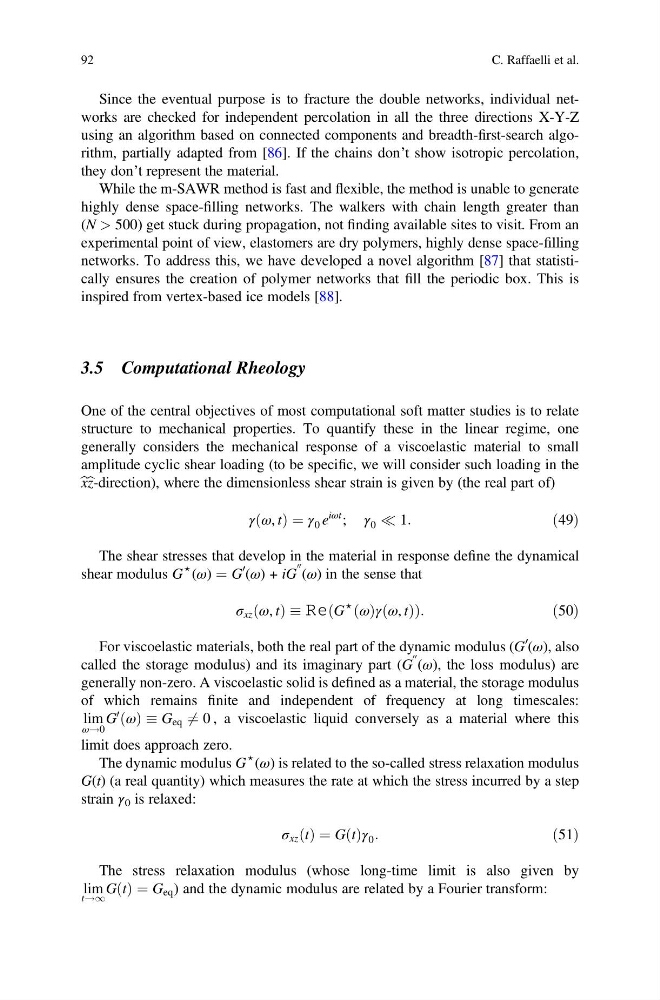
Since the eventual purpose is to fracture the double networks, individual networks are checked for independent percolation in all the three directions X-Y-Z
using an algorithm based on connected components and breadth-first-search algorithm, partially adapted from [86]. If the chains don’t show isotropic percolation,
they don’t represent the material.
While the m-SAWR method is fast and flexible, the method is unable to generate
highly dense space-filling networks. The walkers with chain length greater than
(N > 500) get stuck during propagation, not finding available sites to visit. From an
experimental point of view, elastomers are dry polymers, highly dense space-filling
networks. To address this, we have developed a novel algorithm [87] that statistically ensures the creation of polymer networks that fill the periodic box. This is
inspired from vertex-based ice models [88].
3.5 Computational Rheology
One of the central objectives of most computational soft matter studies is to relate
structure to mechanical properties. To quantify these in the linear regime, one
generally considers the mechanical response of a viscoelastic material to small
amplitude cyclic shear loading (to be specific, we will consider such loading in the
b xb z-direction), where the dimensionless shear strain is given by (the real part of)
γ ω, t
ð Þ ¼ γ 0 e
iωt ; γ 0 ( 1:
ð49Þ
The shear stresses that develop in the material in response define the dynamical
shear modulus G
⋆ (ω) ¼ G
0 (ω) + iG
00
(ω) in the sense that
σ xz ω, t
ð Þ Re G
⋆
ω
ð Þγ ω, tÞ
ð
Þ:
ð
ð 50Þ
For viscoelastic materials, both the real part of the dynamic modulus (G
0
(ω), also
called the storage modulus) and its imaginary part (G
00
(ω), the loss modulus) are
generally non-zero. A viscoelastic solid is defined as a material, the storage modulus
of which remains finite and independent of frequency at long timescales:
lim
ω!0
G
0
ω
ð Þ G eq 6 ¼ 0 , a viscoelastic liquid conversely as a material where this
limit does approach zero.
The dynamic modulus G
⋆ (ω) is related to the so-called stress relaxation modulus
G(t) (a real quantity) which measures the rate at which the stress incurred by a step
strain γ 0 is relaxed:
σ xz t
ð Þ ¼ G t
ð Þγ 0 :
ð51Þ
The stress relaxation modulus (whose long-time limit is also given by
lim
t!1
G t
ð Þ ¼ G eq ) and the dynamic modulus are related by a Fourier transform:
92
C. Raffaelli et al.
using an algorithm based on connected components and breadth-first-search algorithm, partially adapted from [86]. If the chains don’t show isotropic percolation,
they don’t represent the material.
While the m-SAWR method is fast and flexible, the method is unable to generate
highly dense space-filling networks. The walkers with chain length greater than
(N > 500) get stuck during propagation, not finding available sites to visit. From an
experimental point of view, elastomers are dry polymers, highly dense space-filling
networks. To address this, we have developed a novel algorithm [87] that statistically ensures the creation of polymer networks that fill the periodic box. This is
inspired from vertex-based ice models [88].
3.5 Computational Rheology
One of the central objectives of most computational soft matter studies is to relate
structure to mechanical properties. To quantify these in the linear regime, one
generally considers the mechanical response of a viscoelastic material to small
amplitude cyclic shear loading (to be specific, we will consider such loading in the
b xb z-direction), where the dimensionless shear strain is given by (the real part of)
γ ω, t
ð Þ ¼ γ 0 e
iωt ; γ 0 ( 1:
ð49Þ
The shear stresses that develop in the material in response define the dynamical
shear modulus G
⋆ (ω) ¼ G
0 (ω) + iG
00
(ω) in the sense that
σ xz ω, t
ð Þ Re G
⋆
ω
ð Þγ ω, tÞ
ð
Þ:
ð
ð 50Þ
For viscoelastic materials, both the real part of the dynamic modulus (G
0
(ω), also
called the storage modulus) and its imaginary part (G
00
(ω), the loss modulus) are
generally non-zero. A viscoelastic solid is defined as a material, the storage modulus
of which remains finite and independent of frequency at long timescales:
lim
ω!0
G
0
ω
ð Þ G eq 6 ¼ 0 , a viscoelastic liquid conversely as a material where this
limit does approach zero.
The dynamic modulus G
⋆ (ω) is related to the so-called stress relaxation modulus
G(t) (a real quantity) which measures the rate at which the stress incurred by a step
strain γ 0 is relaxed:
σ xz t
ð Þ ¼ G t
ð Þγ 0 :
ð51Þ
The stress relaxation modulus (whose long-time limit is also given by
lim
t!1
G t
ð Þ ¼ G eq ) and the dynamic modulus are related by a Fourier transform:
92
C. Raffaelli et al.