

The swelling is introduced in a statistical fashion, by having the walkers in the
first generation take steps of size bα, where α is an integer larger than 1. The steps
themselves are not stretched, as we map each step onto a sequence of α consecutive
bonds of length b, but the resulting conformations are statistically stretched because
a random walk of N/α steps of length bα gives a mean square end-to-end length of
R
2
¼ bα
ð Þ
2 N
α
¼ αNb
2
ð48Þ
which is a factor α larger than the equilibrium value R
2
0
. Thus, the first generation
is constructed to represent a sample that was swollen by a linear factor
ffiffiffi
α
p
after
polymerization. At the same time, it still lives on the lattice of lattice constant b,
allowing to generate the second network on the same lattice, with the option of
having intergenerational cross-links.
The swelling procedure can in principle be iterated, introducing another swelling
factor α i for each generation i, allowing to make multinetworks with more than two
generations. Naturally, at the end of the procedure, the geometric constraint of
having all the particles sit on the sites of a cubic lattice can be relaxed by performing
off-lattice equilibration within a Monte Carlo or molecular dynamics simulation.
3.4.3 Double-Network Parameters
Having introduced the double-network generation procedure in general terms, we
will now specify how we employ the procedure to make the starting configurations
for the simulations we present in this chapter.
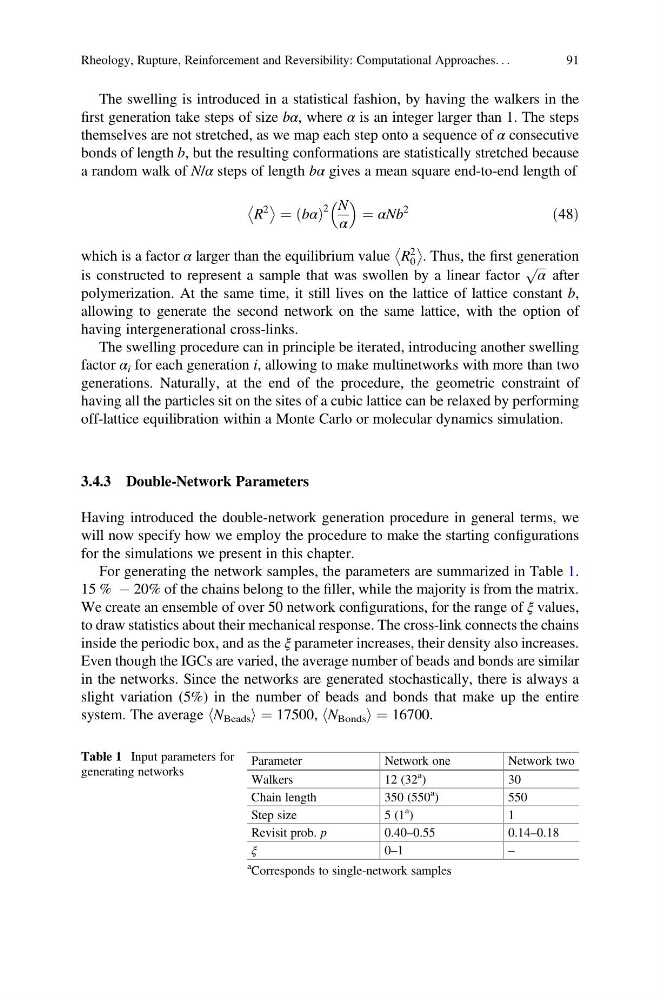
For generating the network samples, the parameters are summarized in Table 1.
15 % À 20% of the chains belong to the filler, while the majority is from the matrix.
We create an ensemble of over 50 network configurations, for the range of ξ values,
to draw statistics about their mechanical response. The cross-link connects the chains
inside the periodic box, and as the ξ parameter increases, their density also increases.
Even though the IGCs are varied, the average number of beads and bonds are similar
in the networks. Since the networks are generated stochastically, there is always a
slight variation (5%) in the number of beads and bonds that make up the entire
system. The average hN Beads i ¼ 17500, hN Bonds i ¼ 16700.
Table 1 Input parameters for
generating networks
Parameter
Network one
Network two
Walkers
12 (32
a )
3 0
Chain length
350 (550
a )
550
Step size
5 (1
a )
1
Revisit prob. p
0.40–0.55
0.14–0.18
ξ
0–1
–
a Corresponds to single-network samples
Rheology, Rupture, Reinforcement and Reversibility: Computational Approaches. . .
91
first generation take steps of size bα, where α is an integer larger than 1. The steps
themselves are not stretched, as we map each step onto a sequence of α consecutive
bonds of length b, but the resulting conformations are statistically stretched because
a random walk of N/α steps of length bα gives a mean square end-to-end length of
R
2
¼ bα
ð Þ
2 N
α
¼ αNb
2
ð48Þ
which is a factor α larger than the equilibrium value R
2
0
. Thus, the first generation
is constructed to represent a sample that was swollen by a linear factor
ffiffiffi
α
p
after
polymerization. At the same time, it still lives on the lattice of lattice constant b,
allowing to generate the second network on the same lattice, with the option of
having intergenerational cross-links.
The swelling procedure can in principle be iterated, introducing another swelling
factor α i for each generation i, allowing to make multinetworks with more than two
generations. Naturally, at the end of the procedure, the geometric constraint of
having all the particles sit on the sites of a cubic lattice can be relaxed by performing
off-lattice equilibration within a Monte Carlo or molecular dynamics simulation.
3.4.3 Double-Network Parameters
Having introduced the double-network generation procedure in general terms, we
will now specify how we employ the procedure to make the starting configurations
for the simulations we present in this chapter.
For generating the network samples, the parameters are summarized in Table 1.
15 % À 20% of the chains belong to the filler, while the majority is from the matrix.
We create an ensemble of over 50 network configurations, for the range of ξ values,
to draw statistics about their mechanical response. The cross-link connects the chains
inside the periodic box, and as the ξ parameter increases, their density also increases.
Even though the IGCs are varied, the average number of beads and bonds are similar
in the networks. Since the networks are generated stochastically, there is always a
slight variation (5%) in the number of beads and bonds that make up the entire
system. The average hN Beads i ¼ 17500, hN Bonds i ¼ 16700.
Table 1 Input parameters for
generating networks
Parameter
Network one
Network two
Walkers
12 (32
a )
3 0
Chain length
350 (550
a )
550
Step size
5 (1
a )
1
Revisit prob. p
0.40–0.55
0.14–0.18
ξ
0–1
–
a Corresponds to single-network samples
Rheology, Rupture, Reinforcement and Reversibility: Computational Approaches. . .
91