

Multi-step Direct Reaction Models and Collectivity
67
we have already shown in Ref. [15], the sum becomes incoherent at energies above
those of the underlying collective states. Here, we focus the study on the amplitudes
of p-h excitations for the lower energy part of the RPA spectra. The full cross-section
calculation will be addressed in future works.
2.1 Strength Function
We employ the self-consistent RPA code by Colò and collaborators [16] to obtain the
necessary excited states and amplitudes. Single particle states are obtained solving
the Hartree–Fock equations (we have used the Skyrme interaction SLy5 [17]) and
the excited states are calculated for a given angular momentum and parity J π . The
RPA equations are [18]
A B
−B −A
X x
Y x
= E x
X x
Y x
with the matrix elements given by
A mi,nj = (E m − E i )δ mn δ ij + (mj |V |in)
B mi,nj = (mn|V |ij )
nj
A mi,nj X
x
nj
+
nj
B mi,nj Y
x
nj = E x X
x
mi ,
where the indices m, n are reserved for states above (particles) while i, j for states
below (holes) the Fermi level.
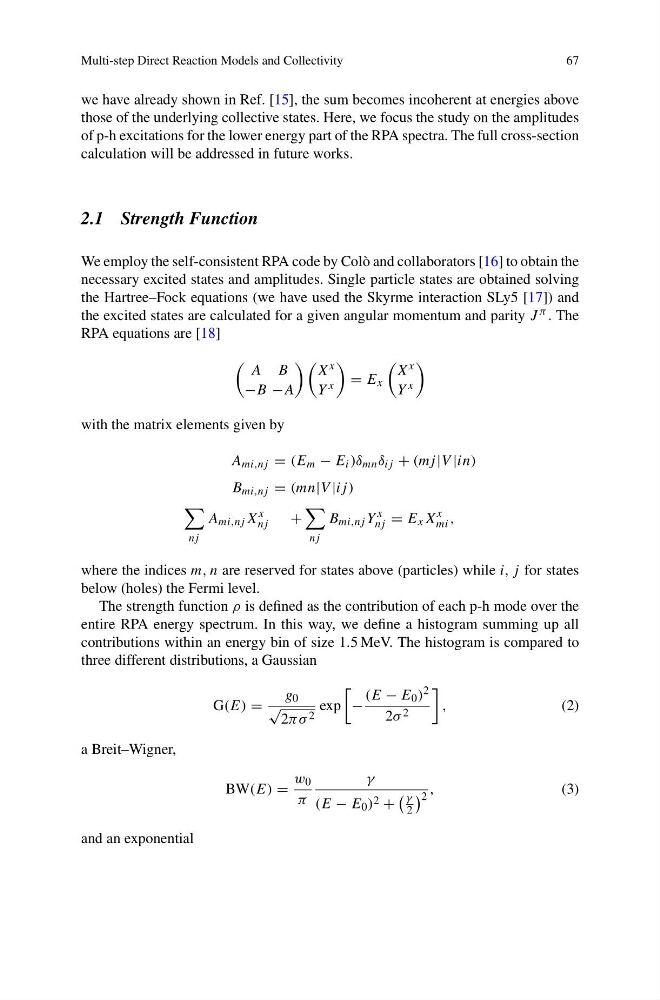
The strength function ρ is defined as the contribution of each p-h mode over the
entire RPA energy spectrum. In this way, we define a histogram summing up all
contributions within an energy bin of size 1.5 MeV. The histogram is compared to
three different distributions, a Gaussian
G(E) =
g 0
√
2πσ 2
exp
−
(E − E 0 ) 2
2σ 2
,
(2)
a Breit–Wigner,
BW(E) =
w 0
π
γ
(E − E 0 ) 2 +
γ
2
2 ,
(3)
and an exponential
67
we have already shown in Ref. [15], the sum becomes incoherent at energies above
those of the underlying collective states. Here, we focus the study on the amplitudes
of p-h excitations for the lower energy part of the RPA spectra. The full cross-section
calculation will be addressed in future works.
2.1 Strength Function
We employ the self-consistent RPA code by Colò and collaborators [16] to obtain the
necessary excited states and amplitudes. Single particle states are obtained solving
the Hartree–Fock equations (we have used the Skyrme interaction SLy5 [17]) and
the excited states are calculated for a given angular momentum and parity J π . The
RPA equations are [18]
A B
−B −A
X x
Y x
= E x
X x
Y x
with the matrix elements given by
A mi,nj = (E m − E i )δ mn δ ij + (mj |V |in)
B mi,nj = (mn|V |ij )
nj
A mi,nj X
x
nj
+
nj
B mi,nj Y
x
nj = E x X
x
mi ,
where the indices m, n are reserved for states above (particles) while i, j for states
below (holes) the Fermi level.
The strength function ρ is defined as the contribution of each p-h mode over the
entire RPA energy spectrum. In this way, we define a histogram summing up all
contributions within an energy bin of size 1.5 MeV. The histogram is compared to
three different distributions, a Gaussian
G(E) =
g 0
√
2πσ 2
exp
−
(E − E 0 ) 2
2σ 2
,
(2)
a Breit–Wigner,
BW(E) =
w 0
π
γ
(E − E 0 ) 2 +
γ
2
2 ,
(3)
and an exponential