

66
E. V. Chimanski et al.
ends after a few interactions, or steps, with the number small enough so that the
incident particle will retain some memory of its initial energy and direction.
Particle–hole excitations of the target states in the MSD theory can be taken in the
so-called independent particle model [12], with no interaction between the excited
modes involved, or in a slightly mixing p-h energies approach [13, 14]. Under
certain statistical assumptions, the excitations can be represented by a response or
strength function with a well-defined distribution. At low excitation energies, the
collective nature of these states imposes obstacles to the statistical approach and the
distributions become non-trivial functions of the energy.
In this work we analyze the particle–hole strength function for a collective
excited state of the target nucleus. Different distributions are adjusted to it and a
general fit is proposed. In addition, we also present a simplified particle–hole model
we intend to employ for the transition matrix element calculations in the future.
This work is organized as follows: In the next section the theoretical formalism for
the one-step process is given. The two subsections are devoted for the descriptions
of the methods employed. Results and Conclusions are presented in the last two
sections.
2 One-Step Processes
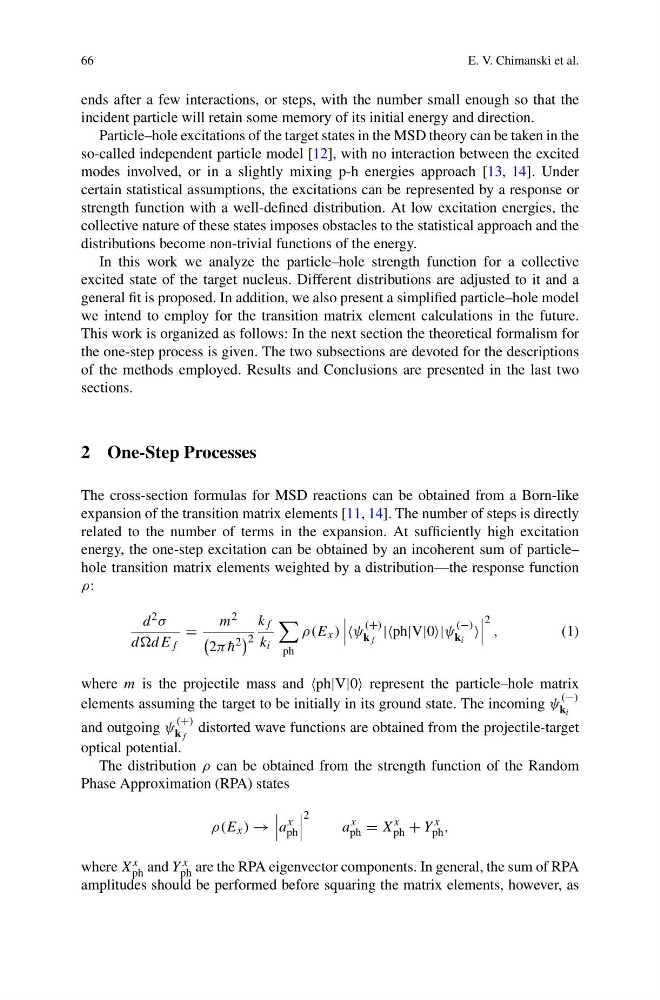
The cross-section formulas for MSD reactions can be obtained from a Born-like
expansion of the transition matrix elements [11, 14]. The number of steps is directly
related to the number of terms in the expansion. At sufficiently high excitation
energy, the one-step excitation can be obtained by an incoherent sum of particle–
hole transition matrix elements weighted by a distribution—the response function
ρ:
d 2 σ
dddE f
=
m 2
2π ¯
h 2 2
k f
k i
ph
ρ(E x )
ψ
(+)
k f
||ph|V|0|ψ
(−)
k i
2
,
(1)
where m is the projectile mass and ph|V|0 represent the particle–hole matrix
elements assuming the target to be initially in its ground state. The incoming ψ
(−)
k i
and outgoing ψ
(+)
k f
distorted wave functions are obtained from the projectile-target
optical potential.
The distribution ρ can be obtained from the strength function of the Random
Phase Approximation (RPA) states
ρ(E x ) →
a
x
ph
2
a
x
ph = X
x
ph + Y
x
ph ,
where X x
ph and Y x
ph are the RPA eigenvector components. In general, the sum of RPA
amplitudes should be performed before squaring the matrix elements, however, as
E. V. Chimanski et al.
ends after a few interactions, or steps, with the number small enough so that the
incident particle will retain some memory of its initial energy and direction.
Particle–hole excitations of the target states in the MSD theory can be taken in the
so-called independent particle model [12], with no interaction between the excited
modes involved, or in a slightly mixing p-h energies approach [13, 14]. Under
certain statistical assumptions, the excitations can be represented by a response or
strength function with a well-defined distribution. At low excitation energies, the
collective nature of these states imposes obstacles to the statistical approach and the
distributions become non-trivial functions of the energy.
In this work we analyze the particle–hole strength function for a collective
excited state of the target nucleus. Different distributions are adjusted to it and a
general fit is proposed. In addition, we also present a simplified particle–hole model
we intend to employ for the transition matrix element calculations in the future.
This work is organized as follows: In the next section the theoretical formalism for
the one-step process is given. The two subsections are devoted for the descriptions
of the methods employed. Results and Conclusions are presented in the last two
sections.
2 One-Step Processes
The cross-section formulas for MSD reactions can be obtained from a Born-like
expansion of the transition matrix elements [11, 14]. The number of steps is directly
related to the number of terms in the expansion. At sufficiently high excitation
energy, the one-step excitation can be obtained by an incoherent sum of particle–
hole transition matrix elements weighted by a distribution—the response function
ρ:
d 2 σ
dddE f
=
m 2
2π ¯
h 2 2
k f
k i
ph
ρ(E x )
ψ
(+)
k f
||ph|V|0|ψ
(−)
k i
2
,
(1)
where m is the projectile mass and ph|V|0 represent the particle–hole matrix
elements assuming the target to be initially in its ground state. The incoming ψ
(−)
k i
and outgoing ψ
(+)
k f
distorted wave functions are obtained from the projectile-target
optical potential.
The distribution ρ can be obtained from the strength function of the Random
Phase Approximation (RPA) states
ρ(E x ) →
a
x
ph
2
a
x
ph = X
x
ph + Y
x
ph ,
where X x
ph and Y x
ph are the RPA eigenvector components. In general, the sum of RPA
amplitudes should be performed before squaring the matrix elements, however, as