

CoH 3 : The Hauser-Feshbach Code
31
CN
(z,p)
(z,n)
(z,2n)
(z,np)
(z,2np)
(z,d)
(z,t)
(z,nd)
(z,nt)
Z,A+1
Z-1,A
Z,A-1
Z-1,A-1
Z-1,A-2
Z,A
Z-1
p
d
t
d
t
GNASH
CoH
n
p
n
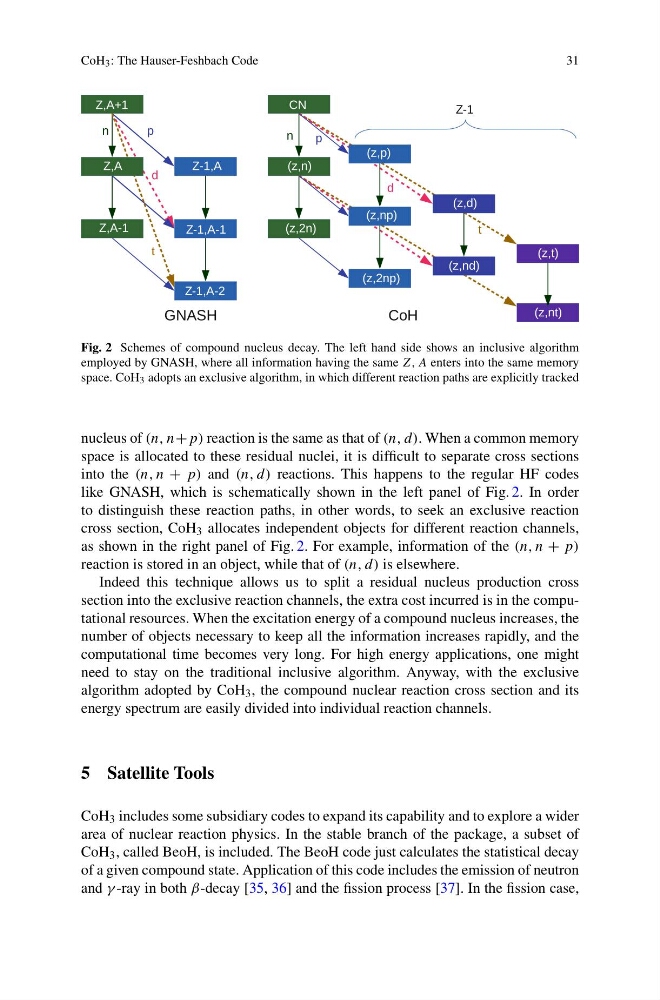
Fig. 2 Schemes of compound nucleus decay. The left hand side shows an inclusive algorithm
employed by GNASH, where all information having the same Z, A enters into the same memory
space. CoH 3 adopts an exclusive algorithm, in which different reaction paths are explicitly tracked
nucleus of (n, n+p) reaction is the same as that of (n, d). When a common memory
space is allocated to these residual nuclei, it is difficult to separate cross sections
into the (n, n + p) and (n, d) reactions. This happens to the regular HF codes
like GNASH, which is schematically shown in the left panel of Fig. 2. In order
to distinguish these reaction paths, in other words, to seek an exclusive reaction
cross section, CoH 3 allocates independent objects for different reaction channels,
as shown in the right panel of Fig. 2. For example, information of the (n, n + p)
reaction is stored in an object, while that of (n, d) is elsewhere.
Indeed this technique allows us to split a residual nucleus production cross
section into the exclusive reaction channels, the extra cost incurred is in the computational resources. When the excitation energy of a compound nucleus increases, the
number of objects necessary to keep all the information increases rapidly, and the
computational time becomes very long. For high energy applications, one might
need to stay on the traditional inclusive algorithm. Anyway, with the exclusive
algorithm adopted by CoH 3 , the compound nuclear reaction cross section and its
energy spectrum are easily divided into individual reaction channels.
5 Satellite Tools
CoH 3 includes some subsidiary codes to expand its capability and to explore a wider
area of nuclear reaction physics. In the stable branch of the package, a subset of
CoH 3 , called BeoH, is included. The BeoH code just calculates the statistical decay
of a given compound state. Application of this code includes the emission of neutron
and γ -ray in both β-decay [35, 36] and the fission process [37]. In the fission case,
31
CN
(z,p)
(z,n)
(z,2n)
(z,np)
(z,2np)
(z,d)
(z,t)
(z,nd)
(z,nt)
Z,A+1
Z-1,A
Z,A-1
Z-1,A-1
Z-1,A-2
Z,A
Z-1
p
d
t
d
t
GNASH
CoH
n
p
n
Fig. 2 Schemes of compound nucleus decay. The left hand side shows an inclusive algorithm
employed by GNASH, where all information having the same Z, A enters into the same memory
space. CoH 3 adopts an exclusive algorithm, in which different reaction paths are explicitly tracked
nucleus of (n, n+p) reaction is the same as that of (n, d). When a common memory
space is allocated to these residual nuclei, it is difficult to separate cross sections
into the (n, n + p) and (n, d) reactions. This happens to the regular HF codes
like GNASH, which is schematically shown in the left panel of Fig. 2. In order
to distinguish these reaction paths, in other words, to seek an exclusive reaction
cross section, CoH 3 allocates independent objects for different reaction channels,
as shown in the right panel of Fig. 2. For example, information of the (n, n + p)
reaction is stored in an object, while that of (n, d) is elsewhere.
Indeed this technique allows us to split a residual nucleus production cross
section into the exclusive reaction channels, the extra cost incurred is in the computational resources. When the excitation energy of a compound nucleus increases, the
number of objects necessary to keep all the information increases rapidly, and the
computational time becomes very long. For high energy applications, one might
need to stay on the traditional inclusive algorithm. Anyway, with the exclusive
algorithm adopted by CoH 3 , the compound nuclear reaction cross section and its
energy spectrum are easily divided into individual reaction channels.
5 Satellite Tools
CoH 3 includes some subsidiary codes to expand its capability and to explore a wider
area of nuclear reaction physics. In the stable branch of the package, a subset of
CoH 3 , called BeoH, is included. The BeoH code just calculates the statistical decay
of a given compound state. Application of this code includes the emission of neutron
and γ -ray in both β-decay [35, 36] and the fission process [37]. In the fission case,