

32
T. Kawano
0
0.2
0.4
0.6
0.8
1
1.2
1.4
0.1
1
10
Ratio to Maxwellian (T=1.32 MeV)
Secondary Neutron Energy [MeV]
Vorobyev (2009)
Kornilov (2010)
ENDF/B-VIII
JENDL-4.0
HF
3 D
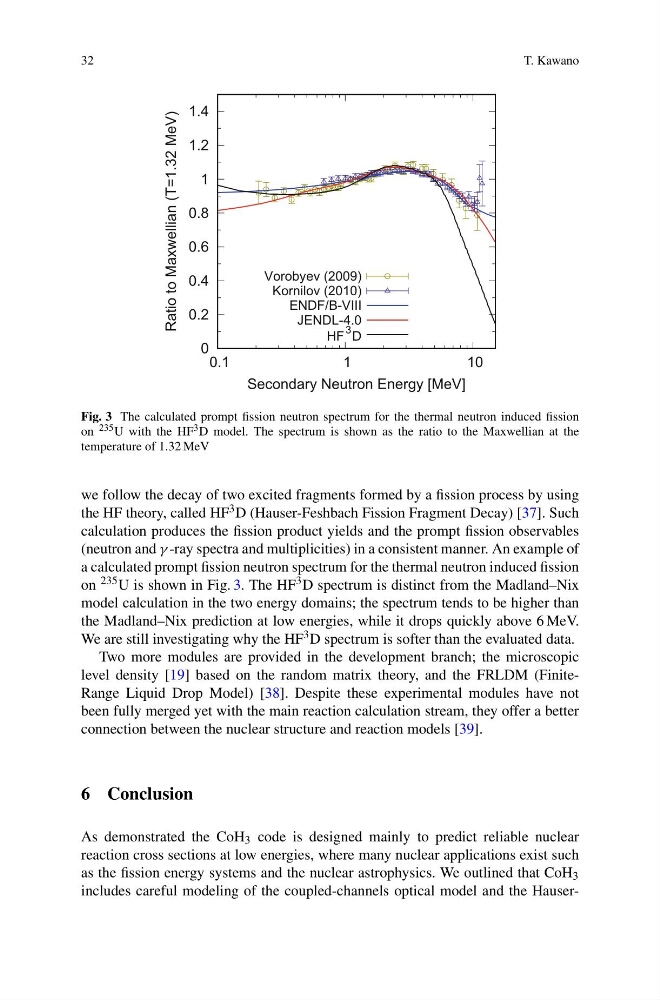
Fig. 3 The calculated prompt fission neutron spectrum for the thermal neutron induced fission
on 235 U with the HF 3 D model. The spectrum is shown as the ratio to the Maxwellian at the
temperature of 1.32 MeV
we follow the decay of two excited fragments formed by a fission process by using
the HF theory, called HF 3 D (Hauser-Feshbach Fission Fragment Decay) [37]. Such
calculation produces the fission product yields and the prompt fission observables
(neutron and γ -ray spectra and multiplicities) in a consistent manner. An example of
a calculated prompt fission neutron spectrum for the thermal neutron induced fission
on 235 U is shown in Fig. 3. The HF 3 D spectrum is distinct from the Madland–Nix
model calculation in the two energy domains; the spectrum tends to be higher than
the Madland–Nix prediction at low energies, while it drops quickly above 6 MeV.
We are still investigating why the HF 3 D spectrum is softer than the evaluated data.
Two more modules are provided in the development branch; the microscopic
level density [19] based on the random matrix theory, and the FRLDM (FiniteRange Liquid Drop Model) [38]. Despite these experimental modules have not
been fully merged yet with the main reaction calculation stream, they offer a better
connection between the nuclear structure and reaction models [39].
6 Conclusion
As demonstrated the CoH 3 code is designed mainly to predict reliable nuclear
reaction cross sections at low energies, where many nuclear applications exist such
as the fission energy systems and the nuclear astrophysics. We outlined that CoH 3
includes careful modeling of the coupled-channels optical model and the Hauser-
T. Kawano
0
0.2
0.4
0.6
0.8
1
1.2
1.4
0.1
1
10
Ratio to Maxwellian (T=1.32 MeV)
Secondary Neutron Energy [MeV]
Vorobyev (2009)
Kornilov (2010)
ENDF/B-VIII
JENDL-4.0
HF
3 D
Fig. 3 The calculated prompt fission neutron spectrum for the thermal neutron induced fission
on 235 U with the HF 3 D model. The spectrum is shown as the ratio to the Maxwellian at the
temperature of 1.32 MeV
we follow the decay of two excited fragments formed by a fission process by using
the HF theory, called HF 3 D (Hauser-Feshbach Fission Fragment Decay) [37]. Such
calculation produces the fission product yields and the prompt fission observables
(neutron and γ -ray spectra and multiplicities) in a consistent manner. An example of
a calculated prompt fission neutron spectrum for the thermal neutron induced fission
on 235 U is shown in Fig. 3. The HF 3 D spectrum is distinct from the Madland–Nix
model calculation in the two energy domains; the spectrum tends to be higher than
the Madland–Nix prediction at low energies, while it drops quickly above 6 MeV.
We are still investigating why the HF 3 D spectrum is softer than the evaluated data.
Two more modules are provided in the development branch; the microscopic
level density [19] based on the random matrix theory, and the FRLDM (FiniteRange Liquid Drop Model) [38]. Despite these experimental modules have not
been fully merged yet with the main reaction calculation stream, they offer a better
connection between the nuclear structure and reaction models [39].
6 Conclusion
As demonstrated the CoH 3 code is designed mainly to predict reliable nuclear
reaction cross sections at low energies, where many nuclear applications exist such
as the fission energy systems and the nuclear astrophysics. We outlined that CoH 3
includes careful modeling of the coupled-channels optical model and the Hauser-