

30
T. Kawano
(a)
)
b
(
0
0.1
0.2
0.3
0.4
0.5
0.6
0.7
0
0.5
1
1.5
2
Transmission Coefficient, L=0
C.M. Energy [MeV]
1st level, J=1/2
shifted GS
0
0.1
0.2
0.3
0.4
0.5
0.6
0.7
0
0.5
1
1.5
2
Transmission Coefficient, L=1
C.M. Energy [MeV]
1st level, J=3/2
J=1/2
shifted GS, J=3/2
J=1/2
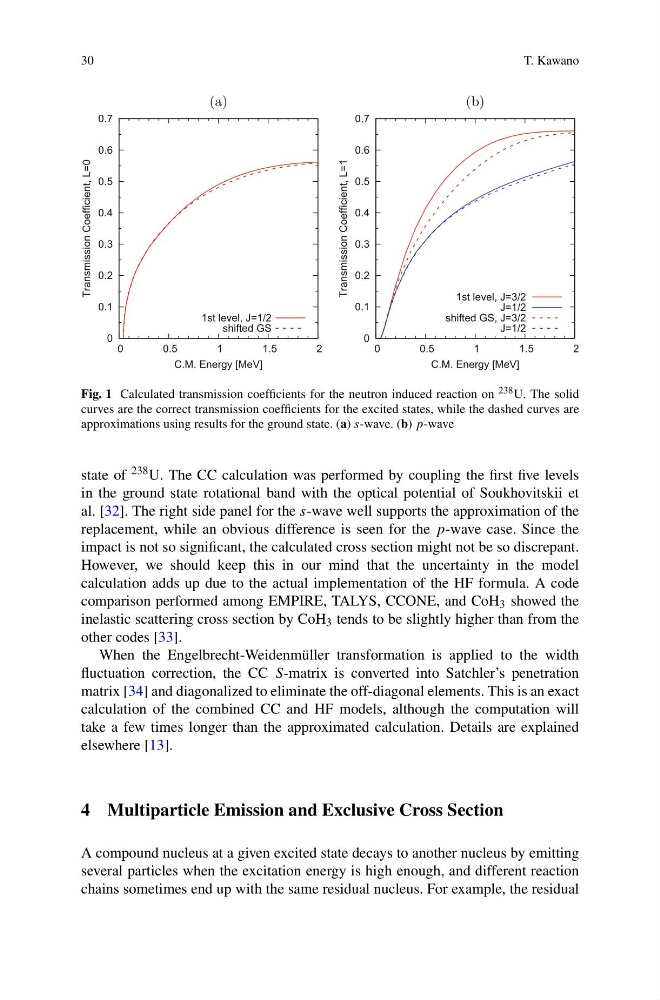
Fig. 1 Calculated transmission coefficients for the neutron induced reaction on 238 U. The solid
curves are the correct transmission coefficients for the excited states, while the dashed curves are
approximations using results for the ground state. (a) s-wave. (b) p-wave
state of 238 U. The CC calculation was performed by coupling the first five levels
in the ground state rotational band with the optical potential of Soukhovitskii et
al. [32]. The right side panel for the s-wave well supports the approximation of the
replacement, while an obvious difference is seen for the p-wave case. Since the
impact is not so significant, the calculated cross section might not be so discrepant.
However, we should keep this in our mind that the uncertainty in the model
calculation adds up due to the actual implementation of the HF formula. A code
comparison performed among EMPIRE, TALYS, CCONE, and CoH 3 showed the
inelastic scattering cross section by CoH 3 tends to be slightly higher than from the
other codes [33].
When the Engelbrecht-Weidenmüller transformation is applied to the width
fluctuation correction, the CC S-matrix is converted into Satchler’s penetration
matrix [34] and diagonalized to eliminate the off-diagonal elements. This is an exact
calculation of the combined CC and HF models, although the computation will
take a few times longer than the approximated calculation. Details are explained
elsewhere [13].
4 Multiparticle Emission and Exclusive Cross Section
A compound nucleus at a given excited state decays to another nucleus by emitting
several particles when the excitation energy is high enough, and different reaction
chains sometimes end up with the same residual nucleus. For example, the residual
T. Kawano
(a)
)
b
(
0
0.1
0.2
0.3
0.4
0.5
0.6
0.7
0
0.5
1
1.5
2
Transmission Coefficient, L=0
C.M. Energy [MeV]
1st level, J=1/2
shifted GS
0
0.1
0.2
0.3
0.4
0.5
0.6
0.7
0
0.5
1
1.5
2
Transmission Coefficient, L=1
C.M. Energy [MeV]
1st level, J=3/2
J=1/2
shifted GS, J=3/2
J=1/2
Fig. 1 Calculated transmission coefficients for the neutron induced reaction on 238 U. The solid
curves are the correct transmission coefficients for the excited states, while the dashed curves are
approximations using results for the ground state. (a) s-wave. (b) p-wave
state of 238 U. The CC calculation was performed by coupling the first five levels
in the ground state rotational band with the optical potential of Soukhovitskii et
al. [32]. The right side panel for the s-wave well supports the approximation of the
replacement, while an obvious difference is seen for the p-wave case. Since the
impact is not so significant, the calculated cross section might not be so discrepant.
However, we should keep this in our mind that the uncertainty in the model
calculation adds up due to the actual implementation of the HF formula. A code
comparison performed among EMPIRE, TALYS, CCONE, and CoH 3 showed the
inelastic scattering cross section by CoH 3 tends to be slightly higher than from the
other codes [33].
When the Engelbrecht-Weidenmüller transformation is applied to the width
fluctuation correction, the CC S-matrix is converted into Satchler’s penetration
matrix [34] and diagonalized to eliminate the off-diagonal elements. This is an exact
calculation of the combined CC and HF models, although the computation will
take a few times longer than the approximated calculation. Details are explained
elsewhere [13].
4 Multiparticle Emission and Exclusive Cross Section
A compound nucleus at a given excited state decays to another nucleus by emitting
several particles when the excitation energy is high enough, and different reaction
chains sometimes end up with the same residual nucleus. For example, the residual