

Capabilities of the NIFFTE FissionTPC
303
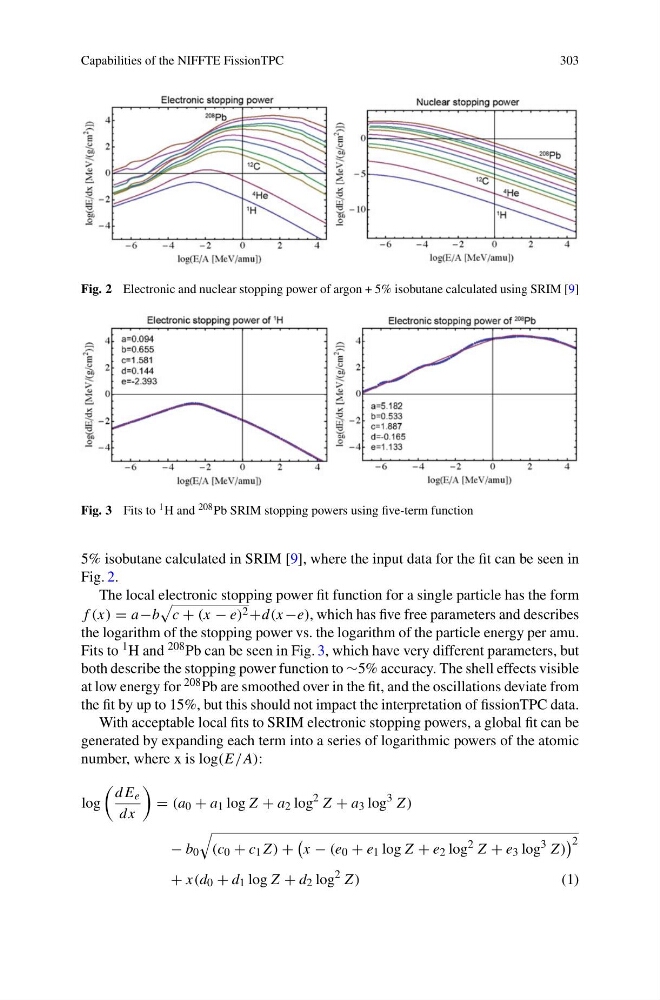
Fig. 2 Electronic and nuclear stopping power of argon + 5% isobutane calculated using SRIM [9]
Fig. 3 Fits to 1 H and 208 Pb SRIM stopping powers using five-term function
5% isobutane calculated in SRIM [9], where the input data for the fit can be seen in
Fig. 2.
The local electronic stopping power fit function for a single particle has the form
f (x) = a−b
c + (x − e) 2 +d(x−e), which has five free parameters and describes
the logarithm of the stopping power vs. the logarithm of the particle energy per amu.
Fits to 1 H and 208 Pb can be seen in Fig. 3, which have very different parameters, but
both describe the stopping power function to ∼5% accuracy. The shell effects visible
at low energy for 208 Pb are smoothed over in the fit, and the oscillations deviate from
the fit by up to 15%, but this should not impact the interpretation of fissionTPC data.
With acceptable local fits to SRIM electronic stopping powers, a global fit can be
generated by expanding each term into a series of logarithmic powers of the atomic
number, where x is log(E/A):
log
dE e
dx
= (a 0 + a 1 log Z + a 2 log
2 Z + a 3 log
3 Z)
− b 0
(c 0 + c 1 Z) +
x − (e 0 + e 1 log Z + e 2 log
2 Z + e 3 log
3 Z)
2
+ x(d 0 + d 1 log Z + d 2 log
2 Z)
(1)
303
Fig. 2 Electronic and nuclear stopping power of argon + 5% isobutane calculated using SRIM [9]
Fig. 3 Fits to 1 H and 208 Pb SRIM stopping powers using five-term function
5% isobutane calculated in SRIM [9], where the input data for the fit can be seen in
Fig. 2.
The local electronic stopping power fit function for a single particle has the form
f (x) = a−b
c + (x − e) 2 +d(x−e), which has five free parameters and describes
the logarithm of the stopping power vs. the logarithm of the particle energy per amu.
Fits to 1 H and 208 Pb can be seen in Fig. 3, which have very different parameters, but
both describe the stopping power function to ∼5% accuracy. The shell effects visible
at low energy for 208 Pb are smoothed over in the fit, and the oscillations deviate from
the fit by up to 15%, but this should not impact the interpretation of fissionTPC data.
With acceptable local fits to SRIM electronic stopping powers, a global fit can be
generated by expanding each term into a series of logarithmic powers of the atomic
number, where x is log(E/A):
log
dE e
dx
= (a 0 + a 1 log Z + a 2 log
2 Z + a 3 log
3 Z)
− b 0
(c 0 + c 1 Z) +
x − (e 0 + e 1 log Z + e 2 log
2 Z + e 3 log
3 Z)
2
+ x(d 0 + d 1 log Z + d 2 log
2 Z)
(1)