

282
N. Schunck et al.
0
100
200
Q 20 [b]
0.00
0.02
0.04
0.06
0.08
0.10
B
22
T = 0.00
Λ = 0.3
Λ = 0.5
Λ = 0.7
Λ = 0.9
Λ = 1.1
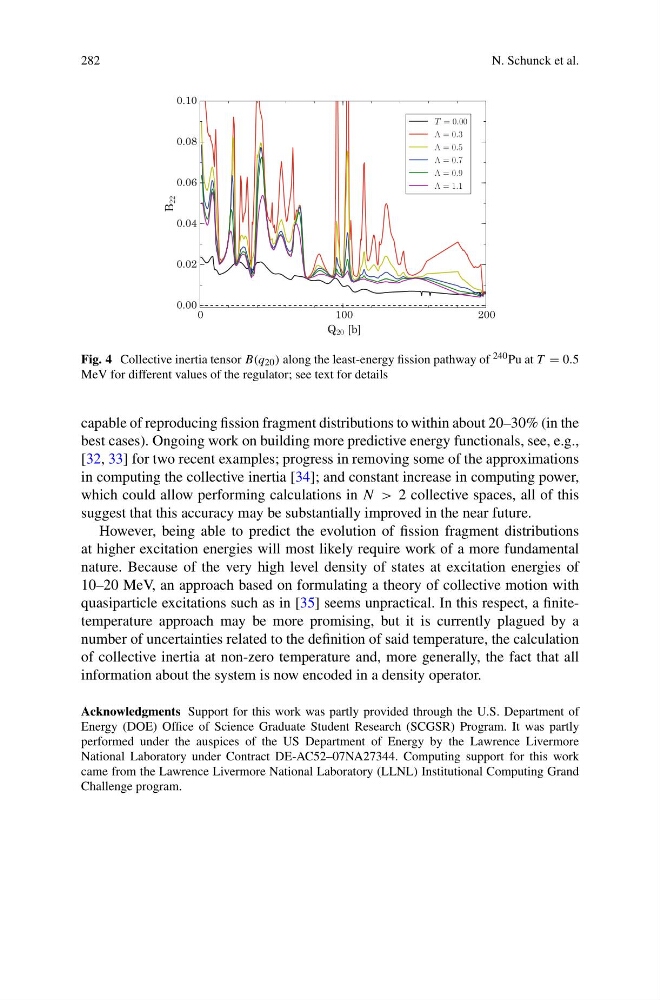
Fig. 4 Collective inertia tensor B(q 20 ) along the least-energy fission pathway of 240 Pu at T = 0.5
MeV for different values of the regulator; see text for details
capable of reproducing fission fragment distributions to within about 20–30% (in the
best cases). Ongoing work on building more predictive energy functionals, see, e.g.,
[32, 33] for two recent examples; progress in removing some of the approximations
in computing the collective inertia [34]; and constant increase in computing power,
which could allow performing calculations in N > 2 collective spaces, all of this
suggest that this accuracy may be substantially improved in the near future.
However, being able to predict the evolution of fission fragment distributions
at higher excitation energies will most likely require work of a more fundamental
nature. Because of the very high level density of states at excitation energies of
10–20 MeV, an approach based on formulating a theory of collective motion with
quasiparticle excitations such as in [35] seems unpractical. In this respect, a finitetemperature approach may be more promising, but it is currently plagued by a
number of uncertainties related to the definition of said temperature, the calculation
of collective inertia at non-zero temperature and, more generally, the fact that all
information about the system is now encoded in a density operator.
Acknowledgments Support for this work was partly provided through the U.S. Department of
Energy (DOE) Office of Science Graduate Student Research (SCGSR) Program. It was partly
performed under the auspices of the US Department of Energy by the Lawrence Livermore
National Laboratory under Contract DE-AC52–07NA27344. Computing support for this work
came from the Lawrence Livermore National Laboratory (LLNL) Institutional Computing Grand
Challenge program.
N. Schunck et al.
0
100
200
Q 20 [b]
0.00
0.02
0.04
0.06
0.08
0.10
B
22
T = 0.00
Λ = 0.3
Λ = 0.5
Λ = 0.7
Λ = 0.9
Λ = 1.1
Fig. 4 Collective inertia tensor B(q 20 ) along the least-energy fission pathway of 240 Pu at T = 0.5
MeV for different values of the regulator; see text for details
capable of reproducing fission fragment distributions to within about 20–30% (in the
best cases). Ongoing work on building more predictive energy functionals, see, e.g.,
[32, 33] for two recent examples; progress in removing some of the approximations
in computing the collective inertia [34]; and constant increase in computing power,
which could allow performing calculations in N > 2 collective spaces, all of this
suggest that this accuracy may be substantially improved in the near future.
However, being able to predict the evolution of fission fragment distributions
at higher excitation energies will most likely require work of a more fundamental
nature. Because of the very high level density of states at excitation energies of
10–20 MeV, an approach based on formulating a theory of collective motion with
quasiparticle excitations such as in [35] seems unpractical. In this respect, a finitetemperature approach may be more promising, but it is currently plagued by a
number of uncertainties related to the definition of said temperature, the calculation
of collective inertia at non-zero temperature and, more generally, the fact that all
information about the system is now encoded in a density operator.
Acknowledgments Support for this work was partly provided through the U.S. Department of
Energy (DOE) Office of Science Graduate Student Research (SCGSR) Program. It was partly
performed under the auspices of the US Department of Energy by the Lawrence Livermore
National Laboratory under Contract DE-AC52–07NA27344. Computing support for this work
came from the Lawrence Livermore National Laboratory (LLNL) Institutional Computing Grand
Challenge program.