

Microscopic Calculation of Fission Fragment Mass Distributions at Increasing. . .
281
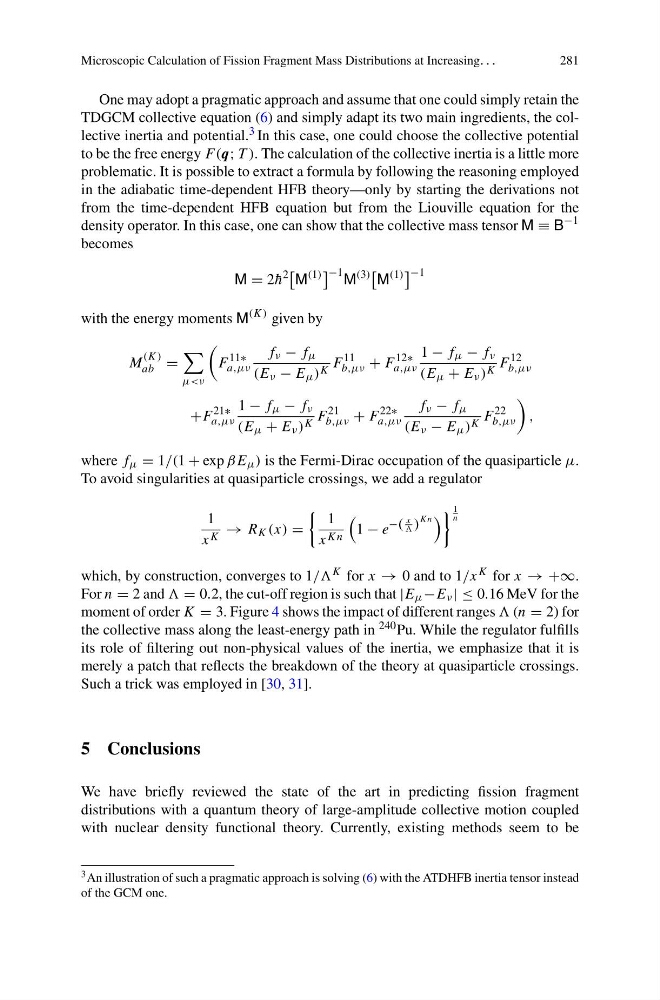
One may adopt a pragmatic approach and assume that one could simply retain the
TDGCM collective equation (6) and simply adapt its two main ingredients, the collective inertia and potential. 3 In this case, one could choose the collective potential
to be the free energy F (q; T ). The calculation of the collective inertia is a little more
problematic. It is possible to extract a formula by following the reasoning employed
in the adiabatic time-dependent HFB theory—only by starting the derivations not
from the time-dependent HFB equation but from the Liouville equation for the
density operator. In this case, one can show that the collective mass tensor M ≡ B
−1
becomes
M = 2 ¯
h
2
M
(1)
−1 M
(3)
M
(1)
−1
with the energy moments M
(K) given by
M
(K)
ab =
μ<ν
F
11∗
a,μν
f ν − f μ
(E ν − E μ ) K F
11
b,μν + F
12∗
a,μν
1 − f μ − f ν
(E μ + E ν ) K F
12
b,μν
+F
21∗
a,μν
1 − f μ − f ν
(E μ + E ν ) K F
21
b,μν + F
22∗
a,μν
f ν − f μ
(E ν − E μ ) K F
22
b,μν
,
where f μ = 1/(1 + exp βE μ ) is the Fermi-Dirac occupation of the quasiparticle μ.
To avoid singularities at quasiparticle crossings, we add a regulator
1
x K → R K (x) =
1
x Kn
1 − e
−(
x
)
Kn
1
n
which, by construction, converges to 1// K for x → 0 and to 1/x K for x → +∞.
For n = 2 and = 0.2, the cut-off region is such that |E μ −E ν | ≤ 0.16 MeV for the
moment of order K = 3. Figure 4 shows the impact of different ranges (n = 2) for
the collective mass along the least-energy path in 240 Pu. While the regulator fulfills
its role of filtering out non-physical values of the inertia, we emphasize that it is
merely a patch that reflects the breakdown of the theory at quasiparticle crossings.
Such a trick was employed in [30, 31].
5 Conclusions
We have briefly reviewed the state of the art in predicting fission fragment
distributions with a quantum theory of large-amplitude collective motion coupled
with nuclear density functional theory. Currently, existing methods seem to be
3 An illustration of such a pragmatic approach is solving (6) with the ATDHFB inertia tensor instead
of the GCM one.
281
One may adopt a pragmatic approach and assume that one could simply retain the
TDGCM collective equation (6) and simply adapt its two main ingredients, the collective inertia and potential. 3 In this case, one could choose the collective potential
to be the free energy F (q; T ). The calculation of the collective inertia is a little more
problematic. It is possible to extract a formula by following the reasoning employed
in the adiabatic time-dependent HFB theory—only by starting the derivations not
from the time-dependent HFB equation but from the Liouville equation for the
density operator. In this case, one can show that the collective mass tensor M ≡ B
−1
becomes
M = 2 ¯
h
2
M
(1)
−1 M
(3)
M
(1)
−1
with the energy moments M
(K) given by
M
(K)
ab =
μ<ν
F
11∗
a,μν
f ν − f μ
(E ν − E μ ) K F
11
b,μν + F
12∗
a,μν
1 − f μ − f ν
(E μ + E ν ) K F
12
b,μν
+F
21∗
a,μν
1 − f μ − f ν
(E μ + E ν ) K F
21
b,μν + F
22∗
a,μν
f ν − f μ
(E ν − E μ ) K F
22
b,μν
,
where f μ = 1/(1 + exp βE μ ) is the Fermi-Dirac occupation of the quasiparticle μ.
To avoid singularities at quasiparticle crossings, we add a regulator
1
x K → R K (x) =
1
x Kn
1 − e
−(
x
)
Kn
1
n
which, by construction, converges to 1// K for x → 0 and to 1/x K for x → +∞.
For n = 2 and = 0.2, the cut-off region is such that |E μ −E ν | ≤ 0.16 MeV for the
moment of order K = 3. Figure 4 shows the impact of different ranges (n = 2) for
the collective mass along the least-energy path in 240 Pu. While the regulator fulfills
its role of filtering out non-physical values of the inertia, we emphasize that it is
merely a patch that reflects the breakdown of the theory at quasiparticle crossings.
Such a trick was employed in [30, 31].
5 Conclusions
We have briefly reviewed the state of the art in predicting fission fragment
distributions with a quantum theory of large-amplitude collective motion coupled
with nuclear density functional theory. Currently, existing methods seem to be
3 An illustration of such a pragmatic approach is solving (6) with the ATDHFB inertia tensor instead
of the GCM one.