

280
N. Schunck et al.
4 Open Problems
It is straightforward to solve the finite-temperature HFB equation and compute a
PES at finite temperature. This provides an appealing template to describe fission
at increasing excitation energies. However, several problems appear in such an
approach. First, the connection between the experimental value of the excitation
energy and the actual value of the temperature T that one must set to solve the
finite-temperature HFB equation is ill-defined. This problem was first discussed
qualitatively in [20]. Following several studies [27, 28] that showed that fission
is an example of over-damped collective motion, it has been argued in [28] that
the collective motion is entropy-driven and that the effective potential energy
surface should be F (q) = E int (q, T ) − T (q)S(q) with the deformation-dependent
temperature adjusted so that the intrinsic energy matches the experimental value.
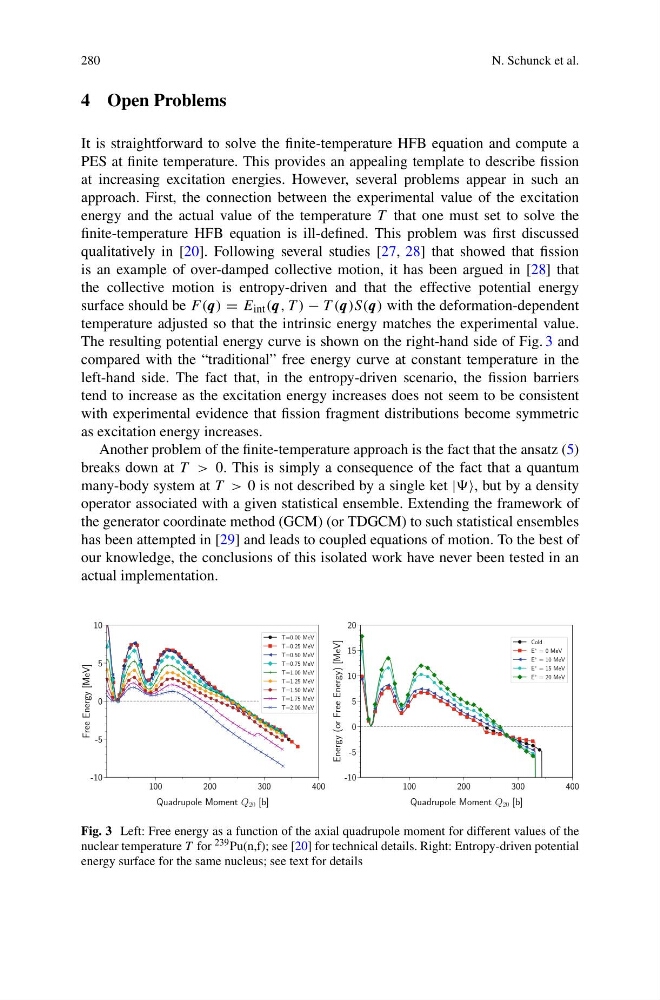
The resulting potential energy curve is shown on the right-hand side of Fig. 3 and
compared with the “traditional” free energy curve at constant temperature in the
left-hand side. The fact that, in the entropy-driven scenario, the fission barriers
tend to increase as the excitation energy increases does not seem to be consistent
with experimental evidence that fission fragment distributions become symmetric
as excitation energy increases.
Another problem of the finite-temperature approach is the fact that the ansatz (5)
breaks down at T > 0. This is simply a consequence of the fact that a quantum
many-body system at T > 0 is not described by a single ket |, but by a density
operator associated with a given statistical ensemble. Extending the framework of
the generator coordinate method (GCM) (or TDGCM) to such statistical ensembles
has been attempted in [29] and leads to coupled equations of motion. To the best of
our knowledge, the conclusions of this isolated work have never been tested in an
actual implementation.
100
200
300
400
Quadrupole Moment Q 20 [b]
-10
-5
0
5
10
Free Energy [MeV]
T=0.00 MeV
T=0.25 MeV
T=0.50 MeV
T=0.75 MeV
T=1.00 MeV
T=1.25 MeV
T=1.50 MeV
T=1.75 MeV
T=2.00 MeV
100
200
300
400
Quadrupole Moment Q 20 [b]
-10
-5
0
5
10
15
20
Energy (or Free Energy) [MeV]
Cold
E ∗ = 0 MeV
E ∗ = 10 MeV
E ∗ = 15 MeV
E ∗ = 20 MeV
Fig. 3 Left: Free energy as a function of the axial quadrupole moment for different values of the
nuclear temperature T for 239 Pu(n,f); see [20] for technical details. Right: Entropy-driven potential
energy surface for the same nucleus; see text for details
N. Schunck et al.
4 Open Problems
It is straightforward to solve the finite-temperature HFB equation and compute a
PES at finite temperature. This provides an appealing template to describe fission
at increasing excitation energies. However, several problems appear in such an
approach. First, the connection between the experimental value of the excitation
energy and the actual value of the temperature T that one must set to solve the
finite-temperature HFB equation is ill-defined. This problem was first discussed
qualitatively in [20]. Following several studies [27, 28] that showed that fission
is an example of over-damped collective motion, it has been argued in [28] that
the collective motion is entropy-driven and that the effective potential energy
surface should be F (q) = E int (q, T ) − T (q)S(q) with the deformation-dependent
temperature adjusted so that the intrinsic energy matches the experimental value.
The resulting potential energy curve is shown on the right-hand side of Fig. 3 and
compared with the “traditional” free energy curve at constant temperature in the
left-hand side. The fact that, in the entropy-driven scenario, the fission barriers
tend to increase as the excitation energy increases does not seem to be consistent
with experimental evidence that fission fragment distributions become symmetric
as excitation energy increases.
Another problem of the finite-temperature approach is the fact that the ansatz (5)
breaks down at T > 0. This is simply a consequence of the fact that a quantum
many-body system at T > 0 is not described by a single ket |, but by a density
operator associated with a given statistical ensemble. Extending the framework of
the generator coordinate method (GCM) (or TDGCM) to such statistical ensembles
has been attempted in [29] and leads to coupled equations of motion. To the best of
our knowledge, the conclusions of this isolated work have never been tested in an
actual implementation.
100
200
300
400
Quadrupole Moment Q 20 [b]
-10
-5
0
5
10
Free Energy [MeV]
T=0.00 MeV
T=0.25 MeV
T=0.50 MeV
T=0.75 MeV
T=1.00 MeV
T=1.25 MeV
T=1.50 MeV
T=1.75 MeV
T=2.00 MeV
100
200
300
400
Quadrupole Moment Q 20 [b]
-10
-5
0
5
10
15
20
Energy (or Free Energy) [MeV]
Cold
E ∗ = 0 MeV
E ∗ = 10 MeV
E ∗ = 15 MeV
E ∗ = 20 MeV
Fig. 3 Left: Free energy as a function of the axial quadrupole moment for different values of the
nuclear temperature T for 239 Pu(n,f); see [20] for technical details. Right: Entropy-driven potential
energy surface for the same nucleus; see text for details