

Microscopic Calculation of Fission Fragment Mass Distributions at Increasing. . .
279
Wheeler (HW) equation. The HW equation is an integral equation that is not
solvable analytically. The Gaussian overlap approximation (GOA) allows converting it into a collective, Schrödinger-like equation for a function g(q, t) that plays
the role of the probability amplitude,
i ¯
h
∂g(q, t)
∂t
=
⎡
⎣ −
¯
h 2
2
ij
∂
∂q i
B ij (q)
∂
∂q j
+ V (q)
⎤
⎦ g(q, t),
(6)
where B ≡ B ij (q) is the collective inertia tensor, and V (q) the collective potential.
The latter contains zero-point energy corrections [12]. We refer to [1] for additional
discussion about the calculation of the collective inertia. From the solution of (6), we
can extract the flux of probability through the scission line, which allows to compute
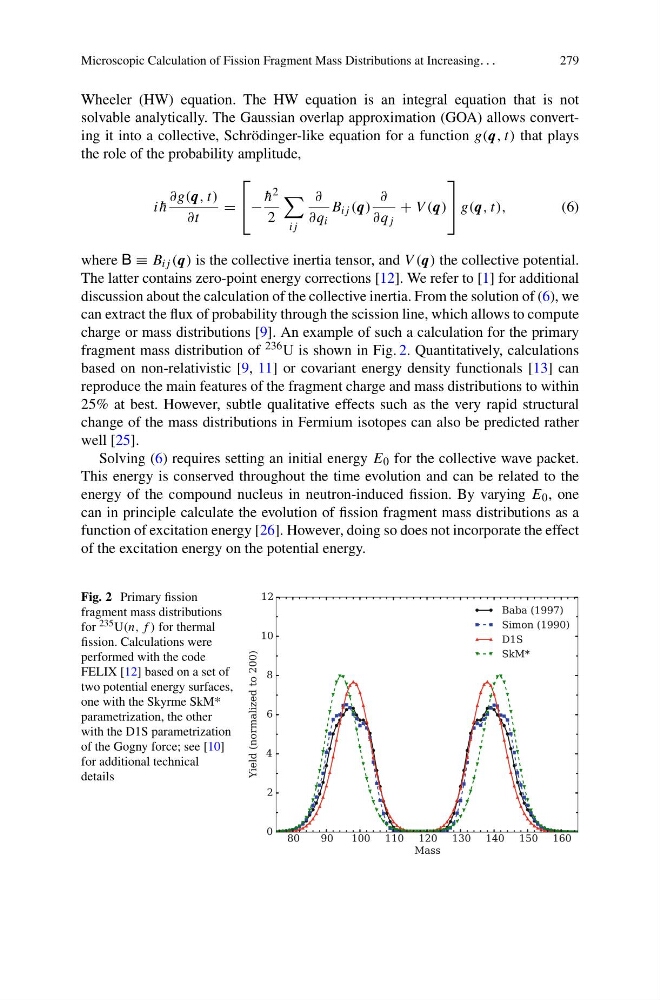
charge or mass distributions [9]. An example of such a calculation for the primary
fragment mass distribution of 236 U is shown in Fig. 2. Quantitatively, calculations
based on non-relativistic [9, 11] or covariant energy density functionals [13] can
reproduce the main features of the fragment charge and mass distributions to within
25% at best. However, subtle qualitative effects such as the very rapid structural
change of the mass distributions in Fermium isotopes can also be predicted rather
well [25].
Solving (6) requires setting an initial energy E 0 for the collective wave packet.
This energy is conserved throughout the time evolution and can be related to the
energy of the compound nucleus in neutron-induced fission. By varying E 0 , one
can in principle calculate the evolution of fission fragment mass distributions as a
function of excitation energy [26]. However, doing so does not incorporate the effect
of the excitation energy on the potential energy.
Fig. 2 Primary fission
fragment mass distributions
for 235 U(n, f ) for thermal
fission. Calculations were
performed with the code
FELIX [12] based on a set of
two potential energy surfaces,
one with the Skyrme SkM*
parametrization, the other
with the D1S parametrization
of the Gogny force; see [10]
for additional technical
details
279
Wheeler (HW) equation. The HW equation is an integral equation that is not
solvable analytically. The Gaussian overlap approximation (GOA) allows converting it into a collective, Schrödinger-like equation for a function g(q, t) that plays
the role of the probability amplitude,
i ¯
h
∂g(q, t)
∂t
=
⎡
⎣ −
¯
h 2
2
ij
∂
∂q i
B ij (q)
∂
∂q j
+ V (q)
⎤
⎦ g(q, t),
(6)
where B ≡ B ij (q) is the collective inertia tensor, and V (q) the collective potential.
The latter contains zero-point energy corrections [12]. We refer to [1] for additional
discussion about the calculation of the collective inertia. From the solution of (6), we
can extract the flux of probability through the scission line, which allows to compute
charge or mass distributions [9]. An example of such a calculation for the primary
fragment mass distribution of 236 U is shown in Fig. 2. Quantitatively, calculations
based on non-relativistic [9, 11] or covariant energy density functionals [13] can
reproduce the main features of the fragment charge and mass distributions to within
25% at best. However, subtle qualitative effects such as the very rapid structural
change of the mass distributions in Fermium isotopes can also be predicted rather
well [25].
Solving (6) requires setting an initial energy E 0 for the collective wave packet.
This energy is conserved throughout the time evolution and can be related to the
energy of the compound nucleus in neutron-induced fission. By varying E 0 , one
can in principle calculate the evolution of fission fragment mass distributions as a
function of excitation energy [26]. However, doing so does not incorporate the effect
of the excitation energy on the potential energy.
Fig. 2 Primary fission
fragment mass distributions
for 235 U(n, f ) for thermal
fission. Calculations were
performed with the code
FELIX [12] based on a set of
two potential energy surfaces,
one with the Skyrme SkM*
parametrization, the other
with the D1S parametrization
of the Gogny force; see [10]
for additional technical
details