

278
N. Schunck et al.
0
200
400
600
Q 20 [b]
0
20
40
60
80
Q
30 [b
3/2
]
236 U, T = 0 MeV
0
6
12
18
24
30
36
42
48
54
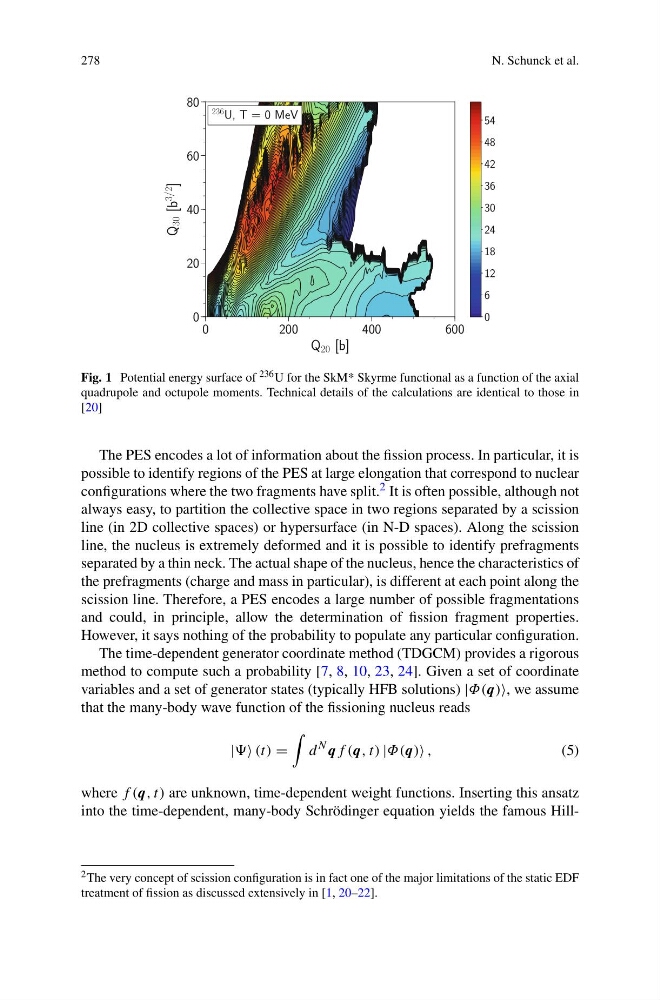
Fig. 1 Potential energy surface of 236 U for the SkM* Skyrme functional as a function of the axial
quadrupole and octupole moments. Technical details of the calculations are identical to those in
[20]
The PES encodes a lot of information about the fission process. In particular, it is
possible to identify regions of the PES at large elongation that correspond to nuclear
configurations where the two fragments have split. 2 It is often possible, although not
always easy, to partition the collective space in two regions separated by a scission
line (in 2D collective spaces) or hypersurface (in N-D spaces). Along the scission
line, the nucleus is extremely deformed and it is possible to identify prefragments
separated by a thin neck. The actual shape of the nucleus, hence the characteristics of
the prefragments (charge and mass in particular), is different at each point along the
scission line. Therefore, a PES encodes a large number of possible fragmentations
and could, in principle, allow the determination of fission fragment properties.
However, it says nothing of the probability to populate any particular configuration.
The time-dependent generator coordinate method (TDGCM) provides a rigorous
method to compute such a probability [7, 8, 10, 23, 24]. Given a set of coordinate
variables and a set of generator states (typically HFB solutions) |Φ(q), we assume
that the many-body wave function of the fissioning nucleus reads
| (t) =
d
N qf (q, t) |Φ(q) ,
(5)
where f (q, t) are unknown, time-dependent weight functions. Inserting this ansatz
into the time-dependent, many-body Schrödinger equation yields the famous Hill2 The very concept of scission configuration is in fact one of the major limitations of the static EDF
treatment of fission as discussed extensively in [1, 20–22].
N. Schunck et al.
0
200
400
600
Q 20 [b]
0
20
40
60
80
Q
30 [b
3/2
]
236 U, T = 0 MeV
0
6
12
18
24
30
36
42
48
54
Fig. 1 Potential energy surface of 236 U for the SkM* Skyrme functional as a function of the axial
quadrupole and octupole moments. Technical details of the calculations are identical to those in
[20]
The PES encodes a lot of information about the fission process. In particular, it is
possible to identify regions of the PES at large elongation that correspond to nuclear
configurations where the two fragments have split. 2 It is often possible, although not
always easy, to partition the collective space in two regions separated by a scission
line (in 2D collective spaces) or hypersurface (in N-D spaces). Along the scission
line, the nucleus is extremely deformed and it is possible to identify prefragments
separated by a thin neck. The actual shape of the nucleus, hence the characteristics of
the prefragments (charge and mass in particular), is different at each point along the
scission line. Therefore, a PES encodes a large number of possible fragmentations
and could, in principle, allow the determination of fission fragment properties.
However, it says nothing of the probability to populate any particular configuration.
The time-dependent generator coordinate method (TDGCM) provides a rigorous
method to compute such a probability [7, 8, 10, 23, 24]. Given a set of coordinate
variables and a set of generator states (typically HFB solutions) |Φ(q), we assume
that the many-body wave function of the fissioning nucleus reads
| (t) =
d
N qf (q, t) |Φ(q) ,
(5)
where f (q, t) are unknown, time-dependent weight functions. Inserting this ansatz
into the time-dependent, many-body Schrödinger equation yields the famous Hill2 The very concept of scission configuration is in fact one of the major limitations of the static EDF
treatment of fission as discussed extensively in [1, 20–22].