

Towards More Predictive Nuclear Reaction Modelling
9
4 Nuclear Reaction Model Ingredients
The models described in the previous section require specific ingredients depending
on the outgoing channel under consideration. To be more precise, the OM only
provides transmission coefficient for outgoing particle decay to a well-defined level
of the residual nucleus. However, it does not enable to deal with the particle decay in
the residual nucleus levels’ continuum, with photon emission, and does not provide
either any fission decay probability. These three situations require supplementary
particular approximations that we now discuss.
4.1 Particle Decay in the Continuum
When the projectile energy is large enough, the compound nucleus can decay by
emitting a particle in the residual levels’ continuum. This continuum has to be
accounted for because it is well known that beyond a given excitation energy it
is impossible to describe nuclear excited levels individually. In such cases, a nuclear
level density (NLD) has to be introduced and the transmission coefficients entering
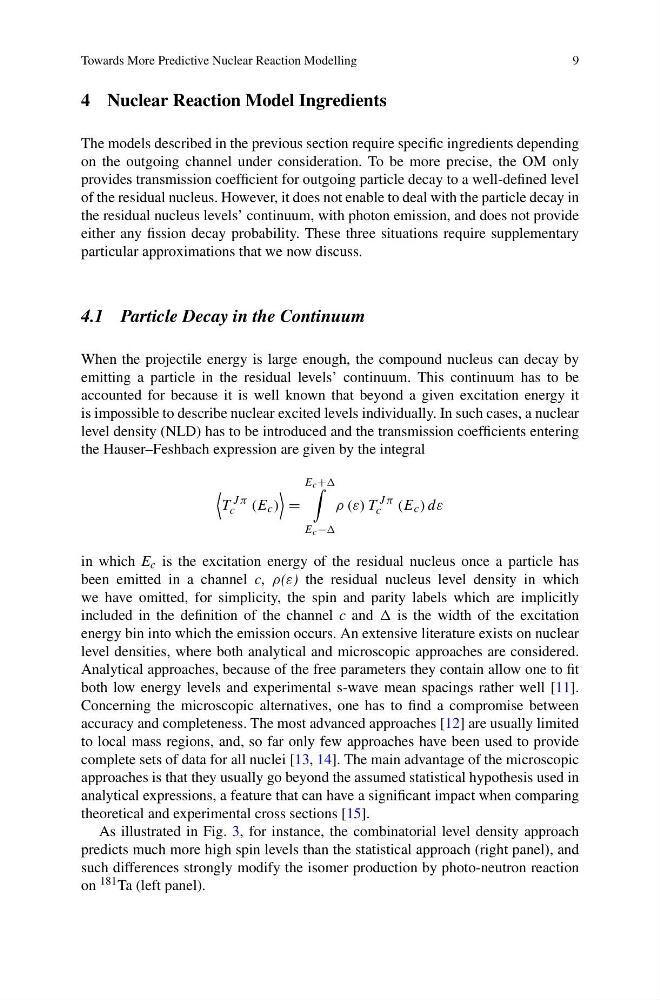
the Hauser–Feshbach expression are given by the integral
T
J π
c (E c )
=
E c +
E c −
ρ (ε) T
J π
c (E c ) dε
in which E c is the excitation energy of the residual nucleus once a particle has
been emitted in a channel c, ρ(ε) the residual nucleus level density in which
we have omitted, for simplicity, the spin and parity labels which are implicitly
included in the definition of the channel c and is the width of the excitation
energy bin into which the emission occurs. An extensive literature exists on nuclear
level densities, where both analytical and microscopic approaches are considered.
Analytical approaches, because of the free parameters they contain allow one to fit
both low energy levels and experimental s-wave mean spacings rather well [11].
Concerning the microscopic alternatives, one has to find a compromise between
accuracy and completeness. The most advanced approaches [12] are usually limited
to local mass regions, and, so far only few approaches have been used to provide
complete sets of data for all nuclei [13, 14]. The main advantage of the microscopic
approaches is that they usually go beyond the assumed statistical hypothesis used in
analytical expressions, a feature that can have a significant impact when comparing
theoretical and experimental cross sections [15].
As illustrated in Fig. 3, for instance, the combinatorial level density approach
predicts much more high spin levels than the statistical approach (right panel), and
such differences strongly modify the isomer production by photo-neutron reaction
on 181 Ta (left panel).
9
4 Nuclear Reaction Model Ingredients
The models described in the previous section require specific ingredients depending
on the outgoing channel under consideration. To be more precise, the OM only
provides transmission coefficient for outgoing particle decay to a well-defined level
of the residual nucleus. However, it does not enable to deal with the particle decay in
the residual nucleus levels’ continuum, with photon emission, and does not provide
either any fission decay probability. These three situations require supplementary
particular approximations that we now discuss.
4.1 Particle Decay in the Continuum
When the projectile energy is large enough, the compound nucleus can decay by
emitting a particle in the residual levels’ continuum. This continuum has to be
accounted for because it is well known that beyond a given excitation energy it
is impossible to describe nuclear excited levels individually. In such cases, a nuclear
level density (NLD) has to be introduced and the transmission coefficients entering
the Hauser–Feshbach expression are given by the integral
T
J π
c (E c )
=
E c +
E c −
ρ (ε) T
J π
c (E c ) dε
in which E c is the excitation energy of the residual nucleus once a particle has
been emitted in a channel c, ρ(ε) the residual nucleus level density in which
we have omitted, for simplicity, the spin and parity labels which are implicitly
included in the definition of the channel c and is the width of the excitation
energy bin into which the emission occurs. An extensive literature exists on nuclear
level densities, where both analytical and microscopic approaches are considered.
Analytical approaches, because of the free parameters they contain allow one to fit
both low energy levels and experimental s-wave mean spacings rather well [11].
Concerning the microscopic alternatives, one has to find a compromise between
accuracy and completeness. The most advanced approaches [12] are usually limited
to local mass regions, and, so far only few approaches have been used to provide
complete sets of data for all nuclei [13, 14]. The main advantage of the microscopic
approaches is that they usually go beyond the assumed statistical hypothesis used in
analytical expressions, a feature that can have a significant impact when comparing
theoretical and experimental cross sections [15].
As illustrated in Fig. 3, for instance, the combinatorial level density approach
predicts much more high spin levels than the statistical approach (right panel), and
such differences strongly modify the isomer production by photo-neutron reaction
on 181 Ta (left panel).