

10
S. Hilaire and S. Goriely
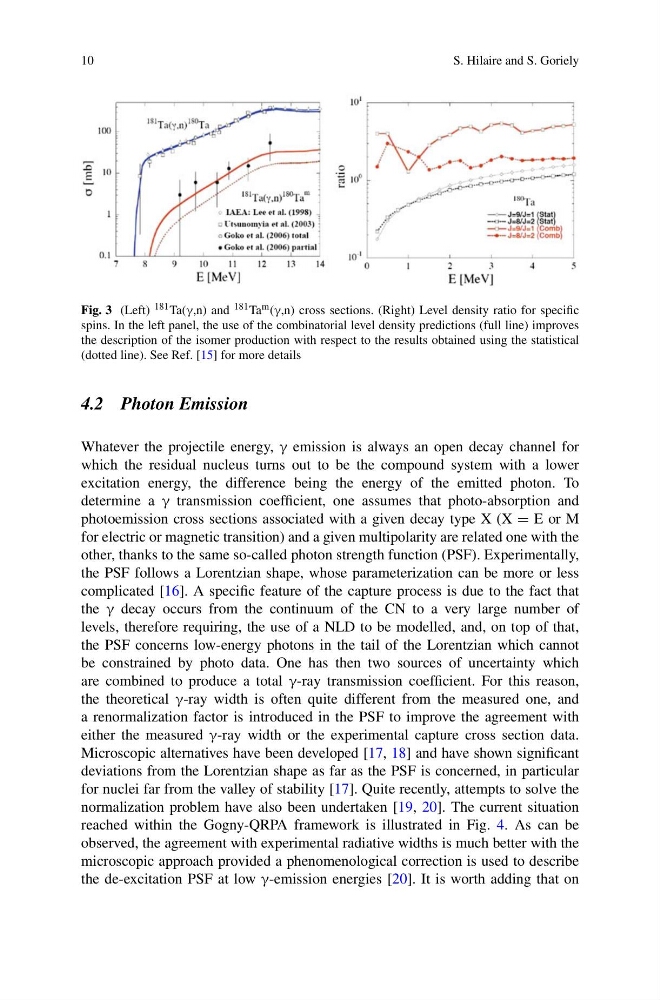
Fig. 3 (Left) 181 Ta(γ,n) and 181 Ta m (γ,n) cross sections. (Right) Level density ratio for specific
spins. In the left panel, the use of the combinatorial level density predictions (full line) improves
the description of the isomer production with respect to the results obtained using the statistical
(dotted line). See Ref. [15] for more details
4.2 Photon Emission
Whatever the projectile energy, γ emission is always an open decay channel for
which the residual nucleus turns out to be the compound system with a lower
excitation energy, the difference being the energy of the emitted photon. To
determine a γ transmission coefficient, one assumes that photo-absorption and
photoemission cross sections associated with a given decay type X (X = E or M
for electric or magnetic transition) and a given multipolarity are related one with the
other, thanks to the same so-called photon strength function (PSF). Experimentally,
the PSF follows a Lorentzian shape, whose parameterization can be more or less
complicated [16]. A specific feature of the capture process is due to the fact that
the γ decay occurs from the continuum of the CN to a very large number of
levels, therefore requiring, the use of a NLD to be modelled, and, on top of that,
the PSF concerns low-energy photons in the tail of the Lorentzian which cannot
be constrained by photo data. One has then two sources of uncertainty which
are combined to produce a total γ-ray transmission coefficient. For this reason,
the theoretical γ-ray width is often quite different from the measured one, and
a renormalization factor is introduced in the PSF to improve the agreement with
either the measured γ-ray width or the experimental capture cross section data.
Microscopic alternatives have been developed [17, 18] and have shown significant
deviations from the Lorentzian shape as far as the PSF is concerned, in particular
for nuclei far from the valley of stability [17]. Quite recently, attempts to solve the
normalization problem have also been undertaken [19, 20]. The current situation
reached within the Gogny-QRPA framework is illustrated in Fig. 4. As can be
observed, the agreement with experimental radiative widths is much better with the
microscopic approach provided a phenomenological correction is used to describe
the de-excitation PSF at low γ-emission energies [20]. It is worth adding that on
S. Hilaire and S. Goriely
Fig. 3 (Left) 181 Ta(γ,n) and 181 Ta m (γ,n) cross sections. (Right) Level density ratio for specific
spins. In the left panel, the use of the combinatorial level density predictions (full line) improves
the description of the isomer production with respect to the results obtained using the statistical
(dotted line). See Ref. [15] for more details
4.2 Photon Emission
Whatever the projectile energy, γ emission is always an open decay channel for
which the residual nucleus turns out to be the compound system with a lower
excitation energy, the difference being the energy of the emitted photon. To
determine a γ transmission coefficient, one assumes that photo-absorption and
photoemission cross sections associated with a given decay type X (X = E or M
for electric or magnetic transition) and a given multipolarity are related one with the
other, thanks to the same so-called photon strength function (PSF). Experimentally,
the PSF follows a Lorentzian shape, whose parameterization can be more or less
complicated [16]. A specific feature of the capture process is due to the fact that
the γ decay occurs from the continuum of the CN to a very large number of
levels, therefore requiring, the use of a NLD to be modelled, and, on top of that,
the PSF concerns low-energy photons in the tail of the Lorentzian which cannot
be constrained by photo data. One has then two sources of uncertainty which
are combined to produce a total γ-ray transmission coefficient. For this reason,
the theoretical γ-ray width is often quite different from the measured one, and
a renormalization factor is introduced in the PSF to improve the agreement with
either the measured γ-ray width or the experimental capture cross section data.
Microscopic alternatives have been developed [17, 18] and have shown significant
deviations from the Lorentzian shape as far as the PSF is concerned, in particular
for nuclei far from the valley of stability [17]. Quite recently, attempts to solve the
normalization problem have also been undertaken [19, 20]. The current situation
reached within the Gogny-QRPA framework is illustrated in Fig. 4. As can be
observed, the agreement with experimental radiative widths is much better with the
microscopic approach provided a phenomenological correction is used to describe
the de-excitation PSF at low γ-emission energies [20]. It is worth adding that on