

8
S. Hilaire and S. Goriely
recent experimental measurements seem to show that such quantum mechanical
approaches are unavoidable if one aim at improving the predictive power [8].
3.4 The Compound Nucleus Model
Beyond the fact that optical and pre-equilibrium models contribute to the emission
of particles, they are also those which determine the initial conditions of the last
model of the chain of Fig. 2: the CN model. Starting from such initial conditions,
the CN model then uses the statistical hypothesis stating that the decay in a given
outgoing channel depends on the ratio of the probability to decay in this specific
channel with respect to all possible decay probabilities. This approximation, which
consists in considering that the decay of the CN does not keep track of the CN
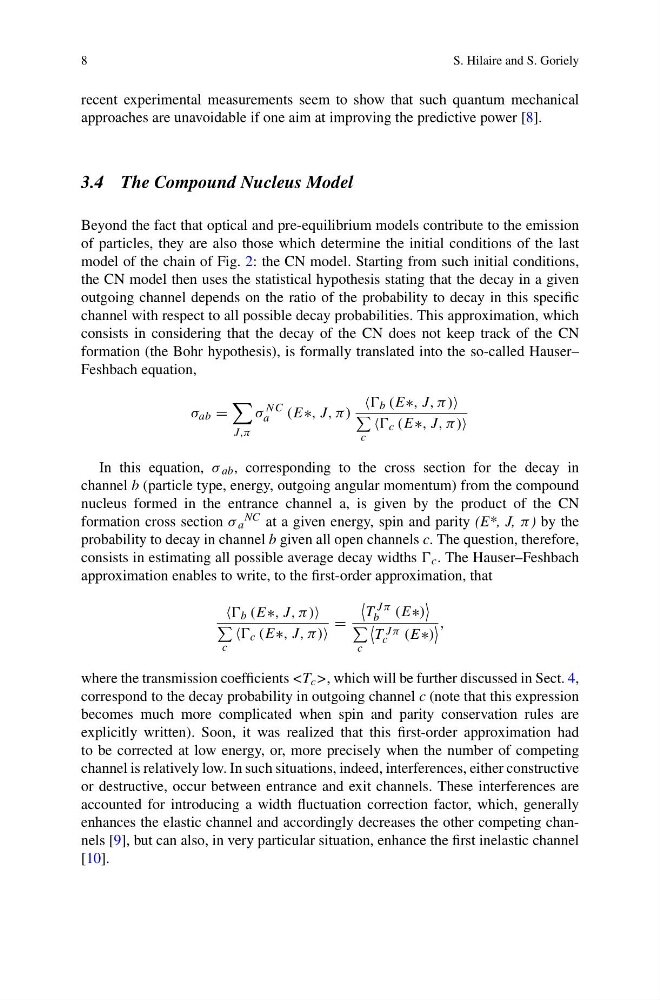
formation (the Bohr hypothesis), is formally translated into the so-called Hauser–
Feshbach equation,
σ ab =
J,π
σ
NC
a
(E∗, J, π)
b (E∗, J, π)
c
c (E∗, J, π)
In this equation, σ ab , corresponding to the cross section for the decay in
channel b (particle type, energy, outgoing angular momentum) from the compound
nucleus formed in the entrance channel a, is given by the product of the CN
formation cross section σ a
NC at a given energy, spin and parity (E*, J, π ) by the
probability to decay in channel b given all open channels c. The question, therefore,
consists in estimating all possible average decay widths c . The Hauser–Feshbach
approximation enables to write, to the first-order approximation, that
b (E∗, J, π)
c
c (E∗, J, π)
=
T J π
b (E∗)
c
T J π
c (E∗)
,
where the transmission coefficients, which will be further discussed in Sect. 4,
correspond to the decay probability in outgoing channel c (note that this expression
becomes much more complicated when spin and parity conservation rules are
explicitly written). Soon, it was realized that this first-order approximation had
to be corrected at low energy, or, more precisely when the number of competing
channel is relatively low. In such situations, indeed, interferences, either constructive
or destructive, occur between entrance and exit channels. These interferences are
accounted for introducing a width fluctuation correction factor, which, generally
enhances the elastic channel and accordingly decreases the other competing channels [9], but can also, in very particular situation, enhance the first inelastic channel
[10].
S. Hilaire and S. Goriely
recent experimental measurements seem to show that such quantum mechanical
approaches are unavoidable if one aim at improving the predictive power [8].
3.4 The Compound Nucleus Model
Beyond the fact that optical and pre-equilibrium models contribute to the emission
of particles, they are also those which determine the initial conditions of the last
model of the chain of Fig. 2: the CN model. Starting from such initial conditions,
the CN model then uses the statistical hypothesis stating that the decay in a given
outgoing channel depends on the ratio of the probability to decay in this specific
channel with respect to all possible decay probabilities. This approximation, which
consists in considering that the decay of the CN does not keep track of the CN
formation (the Bohr hypothesis), is formally translated into the so-called Hauser–
Feshbach equation,
σ ab =
J,π
σ
NC
a
(E∗, J, π)
b (E∗, J, π)
c
c (E∗, J, π)
In this equation, σ ab , corresponding to the cross section for the decay in
channel b (particle type, energy, outgoing angular momentum) from the compound
nucleus formed in the entrance channel a, is given by the product of the CN
formation cross section σ a
NC at a given energy, spin and parity (E*, J, π ) by the
probability to decay in channel b given all open channels c. The question, therefore,
consists in estimating all possible average decay widths c . The Hauser–Feshbach
approximation enables to write, to the first-order approximation, that
b (E∗, J, π)
c
c (E∗, J, π)
=
T J π
b (E∗)
c
T J π
c (E∗)
,
where the transmission coefficients
correspond to the decay probability in outgoing channel c (note that this expression
becomes much more complicated when spin and parity conservation rules are
explicitly written). Soon, it was realized that this first-order approximation had
to be corrected at low energy, or, more precisely when the number of competing
channel is relatively low. In such situations, indeed, interferences, either constructive
or destructive, occur between entrance and exit channels. These interferences are
accounted for introducing a width fluctuation correction factor, which, generally
enhances the elastic channel and accordingly decreases the other competing channels [9], but can also, in very particular situation, enhance the first inelastic channel
[10].