

Nuclear Level Densities
99
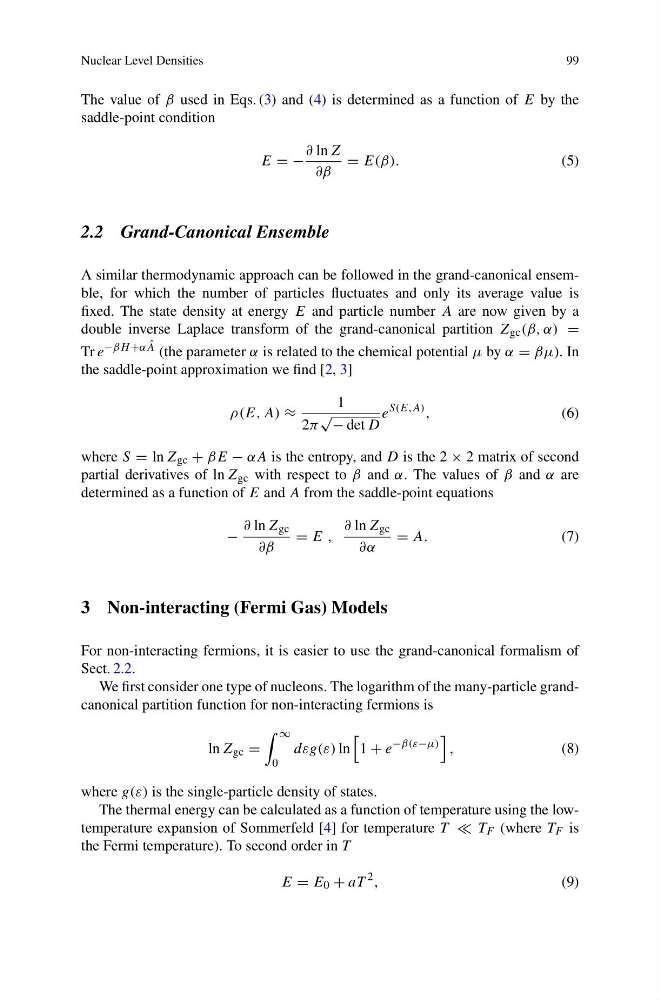
The value of β used in Eqs. (3) and (4) is determined as a function of E by the
saddle-point condition
E = −
∂ ln Z
∂β
= E(β).
(5)
2.2 Grand-Canonical Ensemble
A similar thermodynamic approach can be followed in the grand-canonical ensemble, for which the number of particles fluctuates and only its average value is
fixed. The state density at energy E and particle number A are now given by a
double inverse Laplace transform of the grand-canonical partition Z gc (β, α) =
Tr e −βH +α ˆ
A (the parameter α is related to the chemical potential μ by α = βμ). In
the saddle-point approximation we find [2, 3]
ρ(E, A) ≈
1
2π
√ − det D
e
S(E,A) ,
(6)
where S = ln Z gc + βE − αA is the entropy, and D is the 2 × 2 matrix of second
partial derivatives of ln Z gc with respect to β and α. The values of β and α are
determined as a function of E and A from the saddle-point equations
−
∂ ln Z gc
∂β
= E ,
∂ ln Z gc
∂α
= A.
(7)
3 Non-interacting (Fermi Gas) Models
For non-interacting fermions, it is easier to use the grand-canonical formalism of
Sect. 2.2.
We first consider one type of nucleons. The logarithm of the many-particle grandcanonical partition function for non-interacting fermions is
ln Z gc =
∞
0
dεg(ε) ln
1 + e
−β(ε−μ)
,
(8)
where g(ε) is the single-particle density of states.
The thermal energy can be calculated as a function of temperature using the lowtemperature expansion of Sommerfeld [4] for temperature T T F (where T F is
the Fermi temperature). To second order in T
E = E 0 + aT
2 ,
(9)
99
The value of β used in Eqs. (3) and (4) is determined as a function of E by the
saddle-point condition
E = −
∂ ln Z
∂β
= E(β).
(5)
2.2 Grand-Canonical Ensemble
A similar thermodynamic approach can be followed in the grand-canonical ensemble, for which the number of particles fluctuates and only its average value is
fixed. The state density at energy E and particle number A are now given by a
double inverse Laplace transform of the grand-canonical partition Z gc (β, α) =
Tr e −βH +α ˆ
A (the parameter α is related to the chemical potential μ by α = βμ). In
the saddle-point approximation we find [2, 3]
ρ(E, A) ≈
1
2π
√ − det D
e
S(E,A) ,
(6)
where S = ln Z gc + βE − αA is the entropy, and D is the 2 × 2 matrix of second
partial derivatives of ln Z gc with respect to β and α. The values of β and α are
determined as a function of E and A from the saddle-point equations
−
∂ ln Z gc
∂β
= E ,
∂ ln Z gc
∂α
= A.
(7)
3 Non-interacting (Fermi Gas) Models
For non-interacting fermions, it is easier to use the grand-canonical formalism of
Sect. 2.2.
We first consider one type of nucleons. The logarithm of the many-particle grandcanonical partition function for non-interacting fermions is
ln Z gc =
∞
0
dεg(ε) ln
1 + e
−β(ε−μ)
,
(8)
where g(ε) is the single-particle density of states.
The thermal energy can be calculated as a function of temperature using the lowtemperature expansion of Sommerfeld [4] for temperature T T F (where T F is
the Fermi temperature). To second order in T
E = E 0 + aT
2 ,
(9)