

100
Y. Alhassid
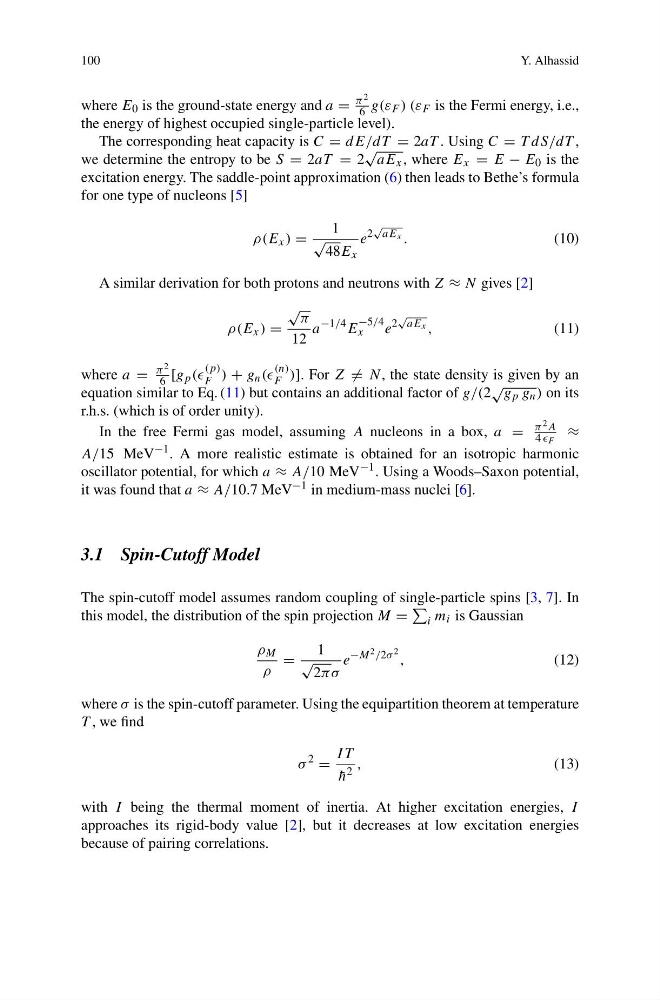
where E 0 is the ground-state energy and a =
π 2
6 g(ε F ) (ε F is the Fermi energy, i.e.,
the energy of highest occupied single-particle level).
The corresponding heat capacity is C = dE/dT = 2aT . Using C = T dS/dT ,
we determine the entropy to be S = 2aT = 2
√
aE x , where E x = E − E 0 is the
excitation energy. The saddle-point approximation (6) then leads to Bethe’s formula
for one type of nucleons [5]
ρ(E x ) =
1
√
48E x
e
2
√
aE x .
(10)
A similar derivation for both protons and neutrons with Z ≈ N gives [2]
ρ(E x ) =
√
π
12
a
−1/4 E
−5/4
x
e
2
√
aE x ,
(11)
where a =
π 2
6 [g p ((
(p)
F ) + g n ((
(n)
F )]. For Z = N, the state density is given by an
equation similar to Eq. (11) but contains an additional factor of g/(2
√ g p g n ) on its
r.h.s. (which is of order unity).
In the free Fermi gas model, assuming A nucleons in a box, a =
π 2 A
4 F
≈
A/15 MeV
−1 . A more realistic estimate is obtained for an isotropic harmonic
oscillator potential, for which a ≈ A/10 MeV
−1 . Using a Woods–Saxon potential,
it was found that a ≈ A/10.7 MeV −1 in medium-mass nuclei [6].
3.1 Spin-Cutoff Model
The spin-cutoff model assumes random coupling of single-particle spins [3, 7]. In
this model, the distribution of the spin projection M =
i m i is Gaussian
ρ M
ρ
=
1
√
2πσ
e
−M 2 /2σ 2 ,
(12)
where σ is the spin-cutoff parameter. Using the equipartition theorem at temperature
T , we find
σ
2
=
I T
¯
h 2 ,
(13)
with I being the thermal moment of inertia. At higher excitation energies, I
approaches its rigid-body value [2], but it decreases at low excitation energies
because of pairing correlations.
Y. Alhassid
where E 0 is the ground-state energy and a =
π 2
6 g(ε F ) (ε F is the Fermi energy, i.e.,
the energy of highest occupied single-particle level).
The corresponding heat capacity is C = dE/dT = 2aT . Using C = T dS/dT ,
we determine the entropy to be S = 2aT = 2
√
aE x , where E x = E − E 0 is the
excitation energy. The saddle-point approximation (6) then leads to Bethe’s formula
for one type of nucleons [5]
ρ(E x ) =
1
√
48E x
e
2
√
aE x .
(10)
A similar derivation for both protons and neutrons with Z ≈ N gives [2]
ρ(E x ) =
√
π
12
a
−1/4 E
−5/4
x
e
2
√
aE x ,
(11)
where a =
π 2
6 [g p ((
(p)
F ) + g n ((
(n)
F )]. For Z = N, the state density is given by an
equation similar to Eq. (11) but contains an additional factor of g/(2
√ g p g n ) on its
r.h.s. (which is of order unity).
In the free Fermi gas model, assuming A nucleons in a box, a =
π 2 A
4 F
≈
A/15 MeV
−1 . A more realistic estimate is obtained for an isotropic harmonic
oscillator potential, for which a ≈ A/10 MeV
−1 . Using a Woods–Saxon potential,
it was found that a ≈ A/10.7 MeV −1 in medium-mass nuclei [6].
3.1 Spin-Cutoff Model
The spin-cutoff model assumes random coupling of single-particle spins [3, 7]. In
this model, the distribution of the spin projection M =
i m i is Gaussian
ρ M
ρ
=
1
√
2πσ
e
−M 2 /2σ 2 ,
(12)
where σ is the spin-cutoff parameter. Using the equipartition theorem at temperature
T , we find
σ
2
=
I T
¯
h 2 ,
(13)
with I being the thermal moment of inertia. At higher excitation energies, I
approaches its rigid-body value [2], but it decreases at low excitation energies
because of pairing correlations.