

98
Y. Alhassid
The outline of this brief review is as follows. In Sect. 2 we discuss the thermodynamics approach for calculating level densities, which is based on calculation
of the nuclear partition function at finite temperature. In Sect. 3 we discuss the
level density of non-interacting fermions, known as the Fermi gas level density,
and simple models for the spin and parity distributions. In Sect. 4 we summarize
experimental methods used to measure level densities. In Sect. 5 we review the main
empirical models for level densities, namely, the back-shifted Fermi gas model, the
constant-temperature formula and the composite (Gilbert–Cameron) formula. We
then describe the major microscopic approaches for calculating level densities. In
Sect. 6 we discuss the mean-field approximation and the combinatorial method.
Methods based on the configuration-interaction (CI) shell model that take into
account correlations beyond the mean field are discussed in Sects. 7.1 and 7.2. In
Sect. 7.1 we discuss spectral averaging theory, which is based on the calculation
of moments of the Hamiltonian. In Sect. 7.2 we review the auxiliary-field quantum
Monte Carlo (AFMC) method for calculating level densities and its applications.
2 Thermodynamics Approach
2.1 Canonical Ensemble
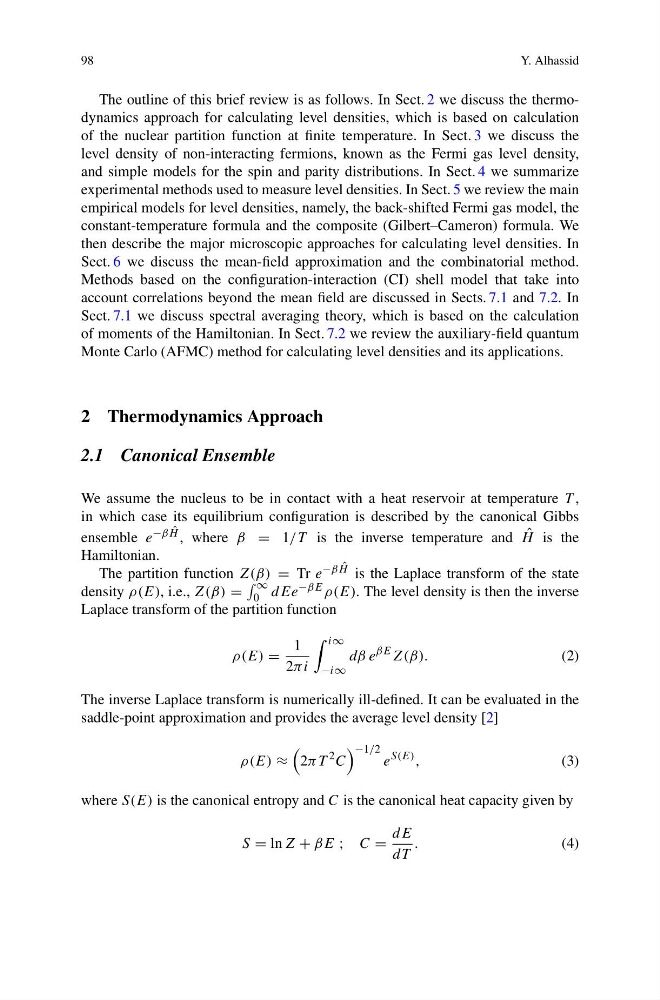
We assume the nucleus to be in contact with a heat reservoir at temperature T ,
in which case its equilibrium configuration is described by the canonical Gibbs
ensemble e −β ˆ
H , where β = 1/T is the inverse temperature and ˆ
H is the
Hamiltonian.
The partition function Z(β) = Tr e −β ˆ
H is the Laplace transform of the state
density ρ(E), i.e., Z(β) =
∞
0 dEe −βE ρ(E). The level density is then the inverse
Laplace transform of the partition function
ρ(E) =
1
2πi
i∞
−i∞
dβ e
βE Z(β).
(2)
The inverse Laplace transform is numerically ill-defined. It can be evaluated in the
saddle-point approximation and provides the average level density [2]
ρ(E) ≈
2πT
2 C
−1/2
e
S(E) ,
(3)
where S(E) is the canonical entropy and C is the canonical heat capacity given by
S = ln Z + βE ; C =
dE
dT
.
(4)
Y. Alhassid
The outline of this brief review is as follows. In Sect. 2 we discuss the thermodynamics approach for calculating level densities, which is based on calculation
of the nuclear partition function at finite temperature. In Sect. 3 we discuss the
level density of non-interacting fermions, known as the Fermi gas level density,
and simple models for the spin and parity distributions. In Sect. 4 we summarize
experimental methods used to measure level densities. In Sect. 5 we review the main
empirical models for level densities, namely, the back-shifted Fermi gas model, the
constant-temperature formula and the composite (Gilbert–Cameron) formula. We
then describe the major microscopic approaches for calculating level densities. In
Sect. 6 we discuss the mean-field approximation and the combinatorial method.
Methods based on the configuration-interaction (CI) shell model that take into
account correlations beyond the mean field are discussed in Sects. 7.1 and 7.2. In
Sect. 7.1 we discuss spectral averaging theory, which is based on the calculation
of moments of the Hamiltonian. In Sect. 7.2 we review the auxiliary-field quantum
Monte Carlo (AFMC) method for calculating level densities and its applications.
2 Thermodynamics Approach
2.1 Canonical Ensemble
We assume the nucleus to be in contact with a heat reservoir at temperature T ,
in which case its equilibrium configuration is described by the canonical Gibbs
ensemble e −β ˆ
H , where β = 1/T is the inverse temperature and ˆ
H is the
Hamiltonian.
The partition function Z(β) = Tr e −β ˆ
H is the Laplace transform of the state
density ρ(E), i.e., Z(β) =
∞
0 dEe −βE ρ(E). The level density is then the inverse
Laplace transform of the partition function
ρ(E) =
1
2πi
i∞
−i∞
dβ e
βE Z(β).
(2)
The inverse Laplace transform is numerically ill-defined. It can be evaluated in the
saddle-point approximation and provides the average level density [2]
ρ(E) ≈
2πT
2 C
−1/2
e
S(E) ,
(3)
where S(E) is the canonical entropy and C is the canonical heat capacity given by
S = ln Z + βE ; C =
dE
dT
.
(4)