

3 Dynamics of Spray Granulation in Continuously …
91
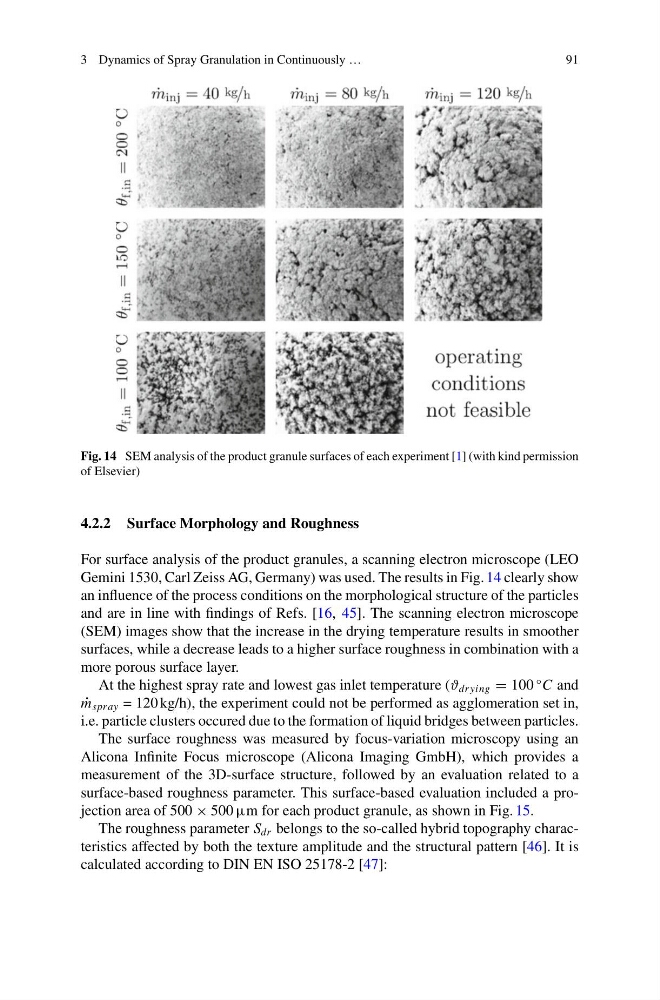
Fig. 14 SEM analysis of the product granule surfaces of each experiment [1] (with kind permission
of Elsevier)
4.2.2 Surface Morphology and Roughness
For surface analysis of the product granules, a scanning electron microscope (LEO
Gemini 1530, Carl Zeiss AG, Germany) was used. The results in Fig. 14 clearly show
an influence of the process conditions on the morphological structure of the particles
and are in line with findings of Refs. [16, 45]. The scanning electron microscope
(SEM) images show that the increase in the drying temperature results in smoother
surfaces, while a decrease leads to a higher surface roughness in combination with a
more porous surface layer.
At the highest spray rate and lowest gas inlet temperature (ϑ dr ying = 100
◦ C and
˙
m spray = 120 kg/h), the experiment could not be performed as agglomeration set in,
i.e. particle clusters occured due to the formation of liquid bridges between particles.
The surface roughness was measured by focus-variation microscopy using an
Alicona Infinite Focus microscope (Alicona Imaging GmbH), which provides a
measurement of the 3D-surface structure, followed by an evaluation related to a
surface-based roughness parameter. This surface-based evaluation included a projection area of 500 × 500 µm for each product granule, as shown in Fig. 15.
The roughness parameter S dr belongs to the so-called hybrid topography characteristics affected by both the texture amplitude and the structural pattern [46]. It is
calculated according to DIN EN ISO 25178-2 [47]:
91
Fig. 14 SEM analysis of the product granule surfaces of each experiment [1] (with kind permission
of Elsevier)
4.2.2 Surface Morphology and Roughness
For surface analysis of the product granules, a scanning electron microscope (LEO
Gemini 1530, Carl Zeiss AG, Germany) was used. The results in Fig. 14 clearly show
an influence of the process conditions on the morphological structure of the particles
and are in line with findings of Refs. [16, 45]. The scanning electron microscope
(SEM) images show that the increase in the drying temperature results in smoother
surfaces, while a decrease leads to a higher surface roughness in combination with a
more porous surface layer.
At the highest spray rate and lowest gas inlet temperature (ϑ dr ying = 100
◦ C and
˙
m spray = 120 kg/h), the experiment could not be performed as agglomeration set in,
i.e. particle clusters occured due to the formation of liquid bridges between particles.
The surface roughness was measured by focus-variation microscopy using an
Alicona Infinite Focus microscope (Alicona Imaging GmbH), which provides a
measurement of the 3D-surface structure, followed by an evaluation related to a
surface-based roughness parameter. This surface-based evaluation included a projection area of 500 × 500 µm for each product granule, as shown in Fig. 15.
The roughness parameter S dr belongs to the so-called hybrid topography characteristics affected by both the texture amplitude and the structural pattern [46]. It is
calculated according to DIN EN ISO 25178-2 [47]: