

90
C. Neugebauer et al.
a switch-off criterion was used that stopped the measurement when the reduction
in weight was less than 0.01 mg/s or a total measuring time of 10 min was reached.
Due to the hydrophilic character of sodium benzoate the particle moisture content
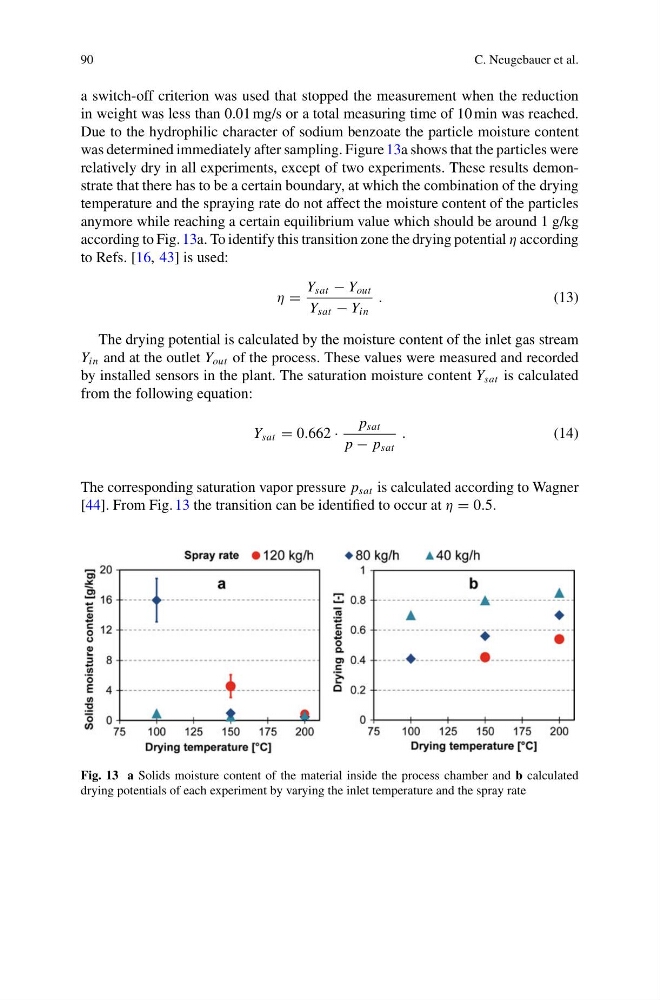
was determined immediately after sampling. Figure 13a shows that the particles were
relatively dry in all experiments, except of two experiments. These results demonstrate that there has to be a certain boundary, at which the combination of the drying
temperature and the spraying rate do not affect the moisture content of the particles
anymore while reaching a certain equilibrium value which should be around 1 g/kg
according to Fig. 13a. To identify this transition zone the drying potential η according
to Refs. [16, 43] is used:
η =
Y sat − Y out
Y sat − Y in
.
(13)
The drying potential is calculated by the moisture content of the inlet gas stream
Y in and at the outlet Y out of the process. These values were measured and recorded
by installed sensors in the plant. The saturation moisture content Y sat is calculated
from the following equation:
Y sat = 0.662 ·
p sat
p − p sat
.
(14)
The corresponding saturation vapor pressure p sat is calculated according to Wagner
[44]. From Fig. 13 the transition can be identified to occur at η = 0.5.
Fig. 13 a Solids moisture content of the material inside the process chamber and b calculated
drying potentials of each experiment by varying the inlet temperature and the spray rate
C. Neugebauer et al.
a switch-off criterion was used that stopped the measurement when the reduction
in weight was less than 0.01 mg/s or a total measuring time of 10 min was reached.
Due to the hydrophilic character of sodium benzoate the particle moisture content
was determined immediately after sampling. Figure 13a shows that the particles were
relatively dry in all experiments, except of two experiments. These results demonstrate that there has to be a certain boundary, at which the combination of the drying
temperature and the spraying rate do not affect the moisture content of the particles
anymore while reaching a certain equilibrium value which should be around 1 g/kg
according to Fig. 13a. To identify this transition zone the drying potential η according
to Refs. [16, 43] is used:
η =
Y sat − Y out
Y sat − Y in
.
(13)
The drying potential is calculated by the moisture content of the inlet gas stream
Y in and at the outlet Y out of the process. These values were measured and recorded
by installed sensors in the plant. The saturation moisture content Y sat is calculated
from the following equation:
Y sat = 0.662 ·
p sat
p − p sat
.
(14)
The corresponding saturation vapor pressure p sat is calculated according to Wagner
[44]. From Fig. 13 the transition can be identified to occur at η = 0.5.
Fig. 13 a Solids moisture content of the material inside the process chamber and b calculated
drying potentials of each experiment by varying the inlet temperature and the spray rate