

2 Dynamic Modelling of Reactive Fluidized Bed Systems Using …
57
(single core of Intel
® Core™ i7-6800 K) could simulate the dynamic plant operation
faster than real-time.
3.1 Movement of the Bed Mass Inside the System
When CH 4 is added as fuel to the FR, the volumetric gas flow will be increased,
because one CH 4 molecule reacts with the OC to one CO and two H 2 molecules. A
higher gas flow leads to an increase of the bubble volume fraction in the bed. Since
the height in the bubbling bed is limited to the standpipe height, the bed holdup
decreases at higher velocities. Due to the interconnected reactors, a velocity change
in one unit will lead to a rearrangement of the solids distribution in the whole system.
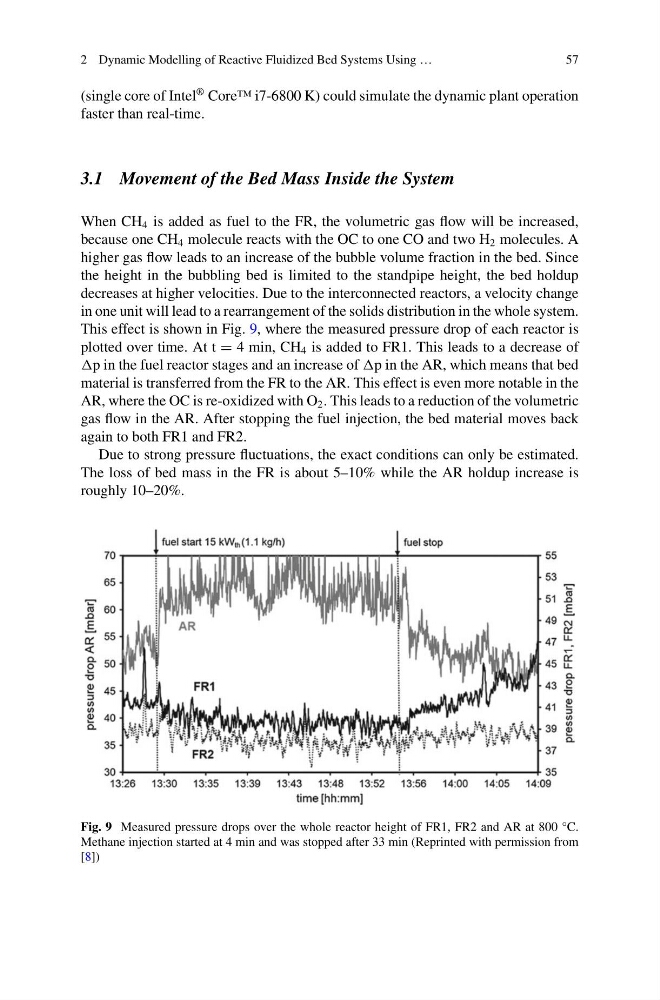
This effect is shown in Fig. 9, where the measured pressure drop of each reactor is
plotted over time. At t = 4 min, CH 4 is added to FR1. This leads to a decrease of
p in the fuel reactor stages and an increase of p in the AR, which means that bed
material is transferred from the FR to the AR. This effect is even more notable in the
AR, where the OC is re-oxidized with O 2 . This leads to a reduction of the volumetric
gas flow in the AR. After stopping the fuel injection, the bed material moves back
again to both FR1 and FR2.
Due to strong pressure fluctuations, the exact conditions can only be estimated.
The loss of bed mass in the FR is about 5–10% while the AR holdup increase is
roughly 10–20%.
Fig. 9 Measured pressure drops over the whole reactor height of FR1, FR2 and AR at 800 °C.
Methane injection started at 4 min and was stopped after 33 min (Reprinted with permission from
[8])
57
(single core of Intel
® Core™ i7-6800 K) could simulate the dynamic plant operation
faster than real-time.
3.1 Movement of the Bed Mass Inside the System
When CH 4 is added as fuel to the FR, the volumetric gas flow will be increased,
because one CH 4 molecule reacts with the OC to one CO and two H 2 molecules. A
higher gas flow leads to an increase of the bubble volume fraction in the bed. Since
the height in the bubbling bed is limited to the standpipe height, the bed holdup
decreases at higher velocities. Due to the interconnected reactors, a velocity change
in one unit will lead to a rearrangement of the solids distribution in the whole system.
This effect is shown in Fig. 9, where the measured pressure drop of each reactor is
plotted over time. At t = 4 min, CH 4 is added to FR1. This leads to a decrease of
p in the fuel reactor stages and an increase of p in the AR, which means that bed
material is transferred from the FR to the AR. This effect is even more notable in the
AR, where the OC is re-oxidized with O 2 . This leads to a reduction of the volumetric
gas flow in the AR. After stopping the fuel injection, the bed material moves back
again to both FR1 and FR2.
Due to strong pressure fluctuations, the exact conditions can only be estimated.
The loss of bed mass in the FR is about 5–10% while the AR holdup increase is
roughly 10–20%.
Fig. 9 Measured pressure drops over the whole reactor height of FR1, FR2 and AR at 800 °C.
Methane injection started at 4 min and was stopped after 33 min (Reprinted with permission from
[8])