

17 A Framework for Dynamic Simulation of Interconnected …
607
structure. It can be done on two structural levels: (1) as the top parameter—the
whole tree is defined for each time point; (2) as the bottom parameter—each value
of the tree is distributed over time. For the Dyssol simulation system, the second
approach was selected. Each record of the tree data structure is a time-dependent
mass fraction of material, which has a selected combination of parameters. Since
many parameters vary only slightly over time, some optimizations can be applied
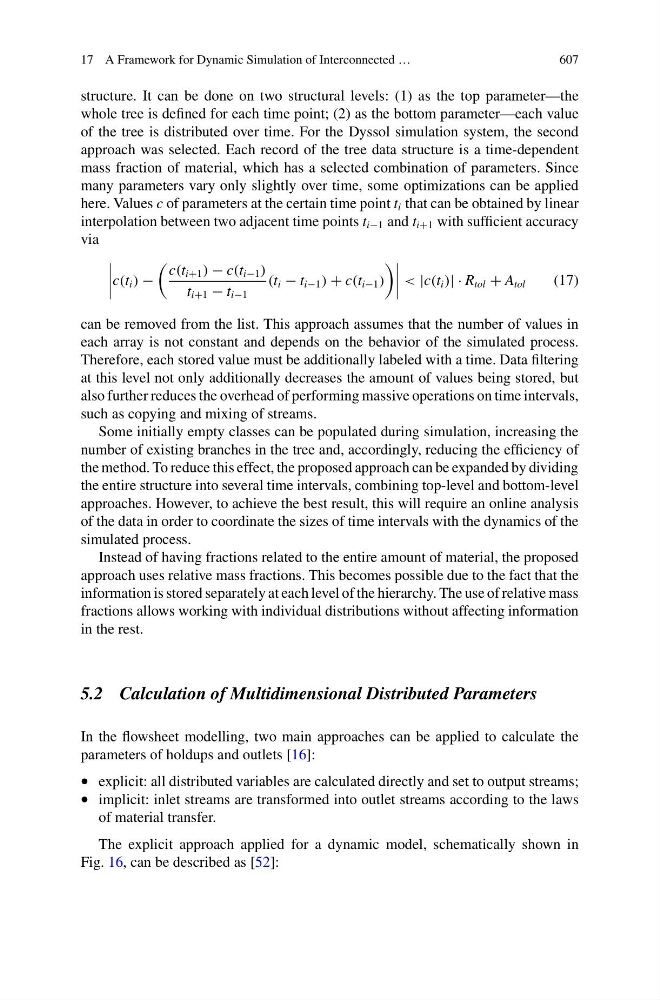
here. Values c of parameters at the certain time point t i that can be obtained by linear
interpolation between two adjacent time points t i−1 and t i+1 with sufficient accuracy
via
c(t i ) −
c(t i+1 ) − c(t i−1 )
t i+1 − t i−1
(t i − t i−1 ) + c(t i−1 )
< |c(t i )| · R tol + A tol
(17)
can be removed from the list. This approach assumes that the number of values in
each array is not constant and depends on the behavior of the simulated process.
Therefore, each stored value must be additionally labeled with a time. Data filtering
at this level not only additionally decreases the amount of values being stored, but
also further reduces the overhead of performing massive operations on time intervals,
such as copying and mixing of streams.
Some initially empty classes can be populated during simulation, increasing the
number of existing branches in the tree and, accordingly, reducing the efficiency of
the method. To reduce this effect, the proposed approach can be expanded by dividing
the entire structure into several time intervals, combining top-level and bottom-level
approaches. However, to achieve the best result, this will require an online analysis
of the data in order to coordinate the sizes of time intervals with the dynamics of the
simulated process.
Instead of having fractions related to the entire amount of material, the proposed
approach uses relative mass fractions. This becomes possible due to the fact that the
information is stored separately at each level of the hierarchy. The use of relative mass
fractions allows working with individual distributions without affecting information
in the rest.
5.2 Calculation of Multidimensional Distributed Parameters
In the flowsheet modelling, two main approaches can be applied to calculate the
parameters of holdups and outlets [16]:
• explicit: all distributed variables are calculated directly and set to output streams;
• implicit: inlet streams are transformed into outlet streams according to the laws
of material transfer.
The explicit approach applied for a dynamic model, schematically shown in
Fig. 16, can be described as [52]:
607
structure. It can be done on two structural levels: (1) as the top parameter—the
whole tree is defined for each time point; (2) as the bottom parameter—each value
of the tree is distributed over time. For the Dyssol simulation system, the second
approach was selected. Each record of the tree data structure is a time-dependent
mass fraction of material, which has a selected combination of parameters. Since
many parameters vary only slightly over time, some optimizations can be applied
here. Values c of parameters at the certain time point t i that can be obtained by linear
interpolation between two adjacent time points t i−1 and t i+1 with sufficient accuracy
via
c(t i ) −
c(t i+1 ) − c(t i−1 )
t i+1 − t i−1
(t i − t i−1 ) + c(t i−1 )
< |c(t i )| · R tol + A tol
(17)
can be removed from the list. This approach assumes that the number of values in
each array is not constant and depends on the behavior of the simulated process.
Therefore, each stored value must be additionally labeled with a time. Data filtering
at this level not only additionally decreases the amount of values being stored, but
also further reduces the overhead of performing massive operations on time intervals,
such as copying and mixing of streams.
Some initially empty classes can be populated during simulation, increasing the
number of existing branches in the tree and, accordingly, reducing the efficiency of
the method. To reduce this effect, the proposed approach can be expanded by dividing
the entire structure into several time intervals, combining top-level and bottom-level
approaches. However, to achieve the best result, this will require an online analysis
of the data in order to coordinate the sizes of time intervals with the dynamics of the
simulated process.
Instead of having fractions related to the entire amount of material, the proposed
approach uses relative mass fractions. This becomes possible due to the fact that the
information is stored separately at each level of the hierarchy. The use of relative mass
fractions allows working with individual distributions without affecting information
in the rest.
5.2 Calculation of Multidimensional Distributed Parameters
In the flowsheet modelling, two main approaches can be applied to calculate the
parameters of holdups and outlets [16]:
• explicit: all distributed variables are calculated directly and set to output streams;
• implicit: inlet streams are transformed into outlet streams according to the laws
of material transfer.
The explicit approach applied for a dynamic model, schematically shown in
Fig. 16, can be described as [52]: