

606
V. Skorych et al.
that must be easily and efficiently accessed, treated and stored. Therefore, a special
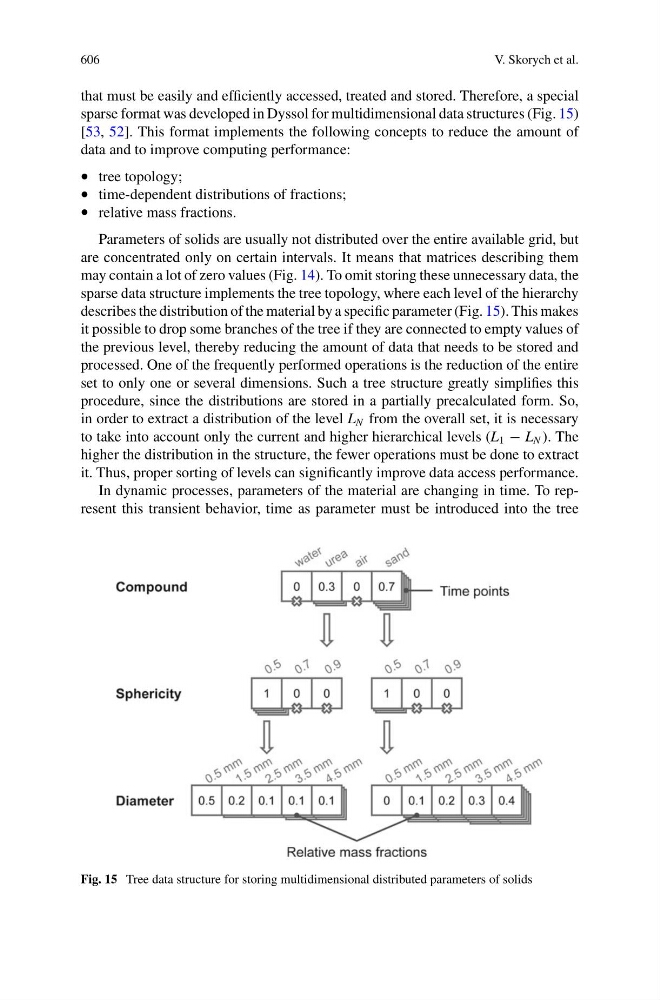
sparse format was developed in Dyssol for multidimensional data structures (Fig. 15)
[53, 52]. This format implements the following concepts to reduce the amount of
data and to improve computing performance:
• tree topology;
• time-dependent distributions of fractions;
• relative mass fractions.
Parameters of solids are usually not distributed over the entire available grid, but
are concentrated only on certain intervals. It means that matrices describing them
may contain a lot of zero values (Fig. 14). To omit storing these unnecessary data, the
sparse data structure implements the tree topology, where each level of the hierarchy
describes the distribution of the material by a specific parameter (Fig. 15). This makes
it possible to drop some branches of the tree if they are connected to empty values of
the previous level, thereby reducing the amount of data that needs to be stored and
processed. One of the frequently performed operations is the reduction of the entire
set to only one or several dimensions. Such a tree structure greatly simplifies this
procedure, since the distributions are stored in a partially precalculated form. So,
in order to extract a distribution of the level L N from the overall set, it is necessary
to take into account only the current and higher hierarchical levels (L 1 − L N ). The
higher the distribution in the structure, the fewer operations must be done to extract
it. Thus, proper sorting of levels can significantly improve data access performance.
In dynamic processes, parameters of the material are changing in time. To represent this transient behavior, time as parameter must be introduced into the tree
Fig. 15 Tree data structure for storing multidimensional distributed parameters of solids
V. Skorych et al.
that must be easily and efficiently accessed, treated and stored. Therefore, a special
sparse format was developed in Dyssol for multidimensional data structures (Fig. 15)
[53, 52]. This format implements the following concepts to reduce the amount of
data and to improve computing performance:
• tree topology;
• time-dependent distributions of fractions;
• relative mass fractions.
Parameters of solids are usually not distributed over the entire available grid, but
are concentrated only on certain intervals. It means that matrices describing them
may contain a lot of zero values (Fig. 14). To omit storing these unnecessary data, the
sparse data structure implements the tree topology, where each level of the hierarchy
describes the distribution of the material by a specific parameter (Fig. 15). This makes
it possible to drop some branches of the tree if they are connected to empty values of
the previous level, thereby reducing the amount of data that needs to be stored and
processed. One of the frequently performed operations is the reduction of the entire
set to only one or several dimensions. Such a tree structure greatly simplifies this
procedure, since the distributions are stored in a partially precalculated form. So,
in order to extract a distribution of the level L N from the overall set, it is necessary
to take into account only the current and higher hierarchical levels (L 1 − L N ). The
higher the distribution in the structure, the fewer operations must be done to extract
it. Thus, proper sorting of levels can significantly improve data access performance.
In dynamic processes, parameters of the material are changing in time. To represent this transient behavior, time as parameter must be introduced into the tree
Fig. 15 Tree data structure for storing multidimensional distributed parameters of solids