

17 A Framework for Dynamic Simulation of Interconnected …
605
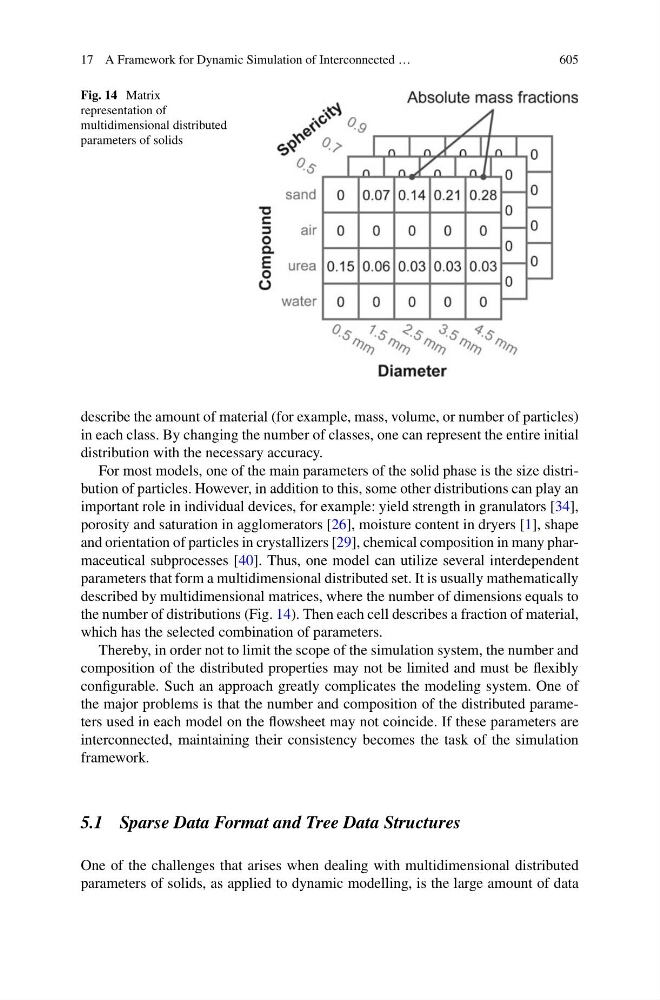
Fig. 14 Matrix
representation of
multidimensional distributed
parameters of solids
describe the amount of material (for example, mass, volume, or number of particles)
in each class. By changing the number of classes, one can represent the entire initial
distribution with the necessary accuracy.
For most models, one of the main parameters of the solid phase is the size distribution of particles. However, in addition to this, some other distributions can play an
important role in individual devices, for example: yield strength in granulators [34],
porosity and saturation in agglomerators [26], moisture content in dryers [1], shape
and orientation of particles in crystallizers [29], chemical composition in many pharmaceutical subprocesses [40]. Thus, one model can utilize several interdependent
parameters that form a multidimensional distributed set. It is usually mathematically
described by multidimensional matrices, where the number of dimensions equals to
the number of distributions (Fig. 14). Then each cell describes a fraction of material,
which has the selected combination of parameters.
Thereby, in order not to limit the scope of the simulation system, the number and
composition of the distributed properties may not be limited and must be flexibly
configurable. Such an approach greatly complicates the modeling system. One of
the major problems is that the number and composition of the distributed parameters used in each model on the flowsheet may not coincide. If these parameters are
interconnected, maintaining their consistency becomes the task of the simulation
framework.
5.1 Sparse Data Format and Tree Data Structures
One of the challenges that arises when dealing with multidimensional distributed
parameters of solids, as applied to dynamic modelling, is the large amount of data
605
Fig. 14 Matrix
representation of
multidimensional distributed
parameters of solids
describe the amount of material (for example, mass, volume, or number of particles)
in each class. By changing the number of classes, one can represent the entire initial
distribution with the necessary accuracy.
For most models, one of the main parameters of the solid phase is the size distribution of particles. However, in addition to this, some other distributions can play an
important role in individual devices, for example: yield strength in granulators [34],
porosity and saturation in agglomerators [26], moisture content in dryers [1], shape
and orientation of particles in crystallizers [29], chemical composition in many pharmaceutical subprocesses [40]. Thus, one model can utilize several interdependent
parameters that form a multidimensional distributed set. It is usually mathematically
described by multidimensional matrices, where the number of dimensions equals to
the number of distributions (Fig. 14). Then each cell describes a fraction of material,
which has the selected combination of parameters.
Thereby, in order not to limit the scope of the simulation system, the number and
composition of the distributed properties may not be limited and must be flexibly
configurable. Such an approach greatly complicates the modeling system. One of
the major problems is that the number and composition of the distributed parameters used in each model on the flowsheet may not coincide. If these parameters are
interconnected, maintaining their consistency becomes the task of the simulation
framework.
5.1 Sparse Data Format and Tree Data Structures
One of the challenges that arises when dealing with multidimensional distributed
parameters of solids, as applied to dynamic modelling, is the large amount of data