

604
V. Skorych et al.
Table 1 Model parameters for cyclone preheating process
Input top
Solid mass flow
˙
m solid
0.18 kg/h
PSD: mean diameter/standard deviation
x m /σ
1.2 mm/0.6 mm
Solids density
ρ solid
1600 kg/m 3
Input bottom
Gas mass flow
˙
m gas
3.6 kg/h
Gas temperature
T gas
300 K
Cyclone 1–5
Cyclone outer diameter/total height/cylinder height
d out /h tot /h cyl
2 m/1 m/0.1 m
Dip leg diameter/height
d dip /h dip
0.01 m/0.4 m
Entry width/height
b e /h e
0.4 m/0.3 m
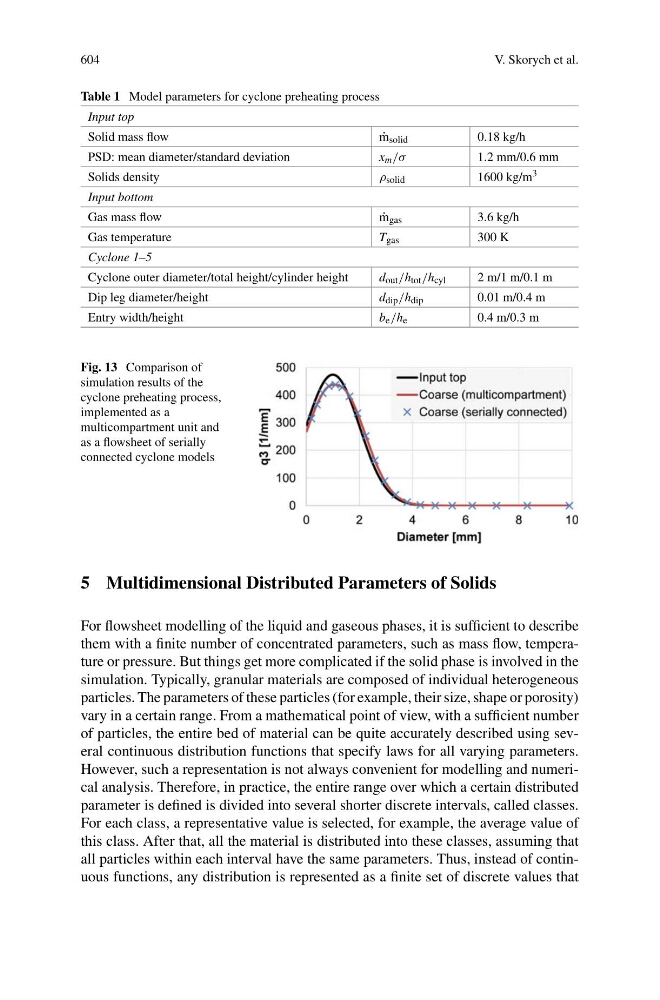
Fig. 13 Comparison of
simulation results of the
cyclone preheating process,
implemented as a
multicompartment unit and
as a flowsheet of serially
connected cyclone models
5 Multidimensional Distributed Parameters of Solids
For flowsheet modelling of the liquid and gaseous phases, it is sufficient to describe
them with a finite number of concentrated parameters, such as mass flow, temperature or pressure. But things get more complicated if the solid phase is involved in the
simulation. Typically, granular materials are composed of individual heterogeneous
particles. The parameters of these particles (for example, their size, shape or porosity)
vary in a certain range. From a mathematical point of view, with a sufficient number
of particles, the entire bed of material can be quite accurately described using several continuous distribution functions that specify laws for all varying parameters.
However, such a representation is not always convenient for modelling and numerical analysis. Therefore, in practice, the entire range over which a certain distributed
parameter is defined is divided into several shorter discrete intervals, called classes.
For each class, a representative value is selected, for example, the average value of
this class. After that, all the material is distributed into these classes, assuming that
all particles within each interval have the same parameters. Thus, instead of continuous functions, any distribution is represented as a finite set of discrete values that
V. Skorych et al.
Table 1 Model parameters for cyclone preheating process
Input top
Solid mass flow
˙
m solid
0.18 kg/h
PSD: mean diameter/standard deviation
x m /σ
1.2 mm/0.6 mm
Solids density
ρ solid
1600 kg/m 3
Input bottom
Gas mass flow
˙
m gas
3.6 kg/h
Gas temperature
T gas
300 K
Cyclone 1–5
Cyclone outer diameter/total height/cylinder height
d out /h tot /h cyl
2 m/1 m/0.1 m
Dip leg diameter/height
d dip /h dip
0.01 m/0.4 m
Entry width/height
b e /h e
0.4 m/0.3 m
Fig. 13 Comparison of
simulation results of the
cyclone preheating process,
implemented as a
multicompartment unit and
as a flowsheet of serially
connected cyclone models
5 Multidimensional Distributed Parameters of Solids
For flowsheet modelling of the liquid and gaseous phases, it is sufficient to describe
them with a finite number of concentrated parameters, such as mass flow, temperature or pressure. But things get more complicated if the solid phase is involved in the
simulation. Typically, granular materials are composed of individual heterogeneous
particles. The parameters of these particles (for example, their size, shape or porosity)
vary in a certain range. From a mathematical point of view, with a sufficient number
of particles, the entire bed of material can be quite accurately described using several continuous distribution functions that specify laws for all varying parameters.
However, such a representation is not always convenient for modelling and numerical analysis. Therefore, in practice, the entire range over which a certain distributed
parameter is defined is divided into several shorter discrete intervals, called classes.
For each class, a representative value is selected, for example, the average value of
this class. After that, all the material is distributed into these classes, assuming that
all particles within each interval have the same parameters. Thus, instead of continuous functions, any distribution is represented as a finite set of discrete values that