

17 A Framework for Dynamic Simulation of Interconnected …
603
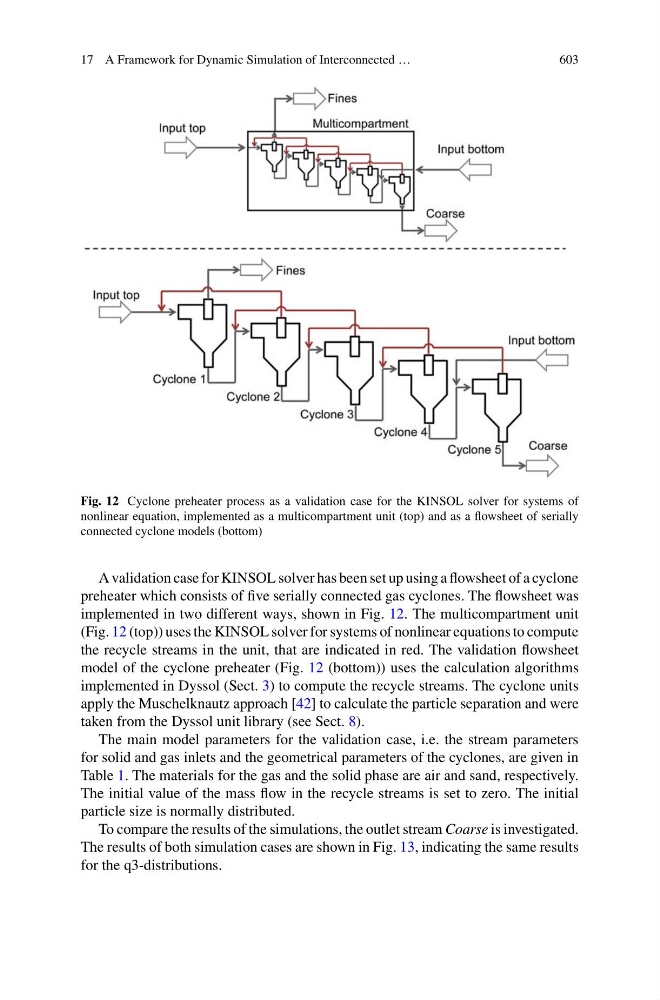
Fig. 12 Cyclone preheater process as a validation case for the KINSOL solver for systems of
nonlinear equation, implemented as a multicompartment unit (top) and as a flowsheet of serially
connected cyclone models (bottom)
A validation case for KINSOL solver has been set up using a flowsheet of a cyclone
preheater which consists of five serially connected gas cyclones. The flowsheet was
implemented in two different ways, shown in Fig. 12. The multicompartment unit
(Fig. 12 (top)) uses the KINSOL solver for systems of nonlinear equations to compute
the recycle streams in the unit, that are indicated in red. The validation flowsheet
model of the cyclone preheater (Fig. 12 (bottom)) uses the calculation algorithms
implemented in Dyssol (Sect. 3) to compute the recycle streams. The cyclone units
apply the Muschelknautz approach [42] to calculate the particle separation and were
taken from the Dyssol unit library (see Sect. 8).
The main model parameters for the validation case, i.e. the stream parameters
for solid and gas inlets and the geometrical parameters of the cyclones, are given in
Table 1. The materials for the gas and the solid phase are air and sand, respectively.
The initial value of the mass flow in the recycle streams is set to zero. The initial
particle size is normally distributed.
To compare the results of the simulations, the outlet stream Coarse is investigated.
The results of both simulation cases are shown in Fig. 13, indicating the same results
for the q3-distributions.
603
Fig. 12 Cyclone preheater process as a validation case for the KINSOL solver for systems of
nonlinear equation, implemented as a multicompartment unit (top) and as a flowsheet of serially
connected cyclone models (bottom)
A validation case for KINSOL solver has been set up using a flowsheet of a cyclone
preheater which consists of five serially connected gas cyclones. The flowsheet was
implemented in two different ways, shown in Fig. 12. The multicompartment unit
(Fig. 12 (top)) uses the KINSOL solver for systems of nonlinear equations to compute
the recycle streams in the unit, that are indicated in red. The validation flowsheet
model of the cyclone preheater (Fig. 12 (bottom)) uses the calculation algorithms
implemented in Dyssol (Sect. 3) to compute the recycle streams. The cyclone units
apply the Muschelknautz approach [42] to calculate the particle separation and were
taken from the Dyssol unit library (see Sect. 8).
The main model parameters for the validation case, i.e. the stream parameters
for solid and gas inlets and the geometrical parameters of the cyclones, are given in
Table 1. The materials for the gas and the solid phase are air and sand, respectively.
The initial value of the mass flow in the recycle streams is set to zero. The initial
particle size is normally distributed.
To compare the results of the simulations, the outlet stream Coarse is investigated.
The results of both simulation cases are shown in Fig. 13, indicating the same results
for the q3-distributions.