

602
V. Skorych et al.
iterations and the value for the Anderson acceleration. The model variables may be
automatically scaled to accommodate possibly different ranges of their values. Once
solved, the final values of the variables are stored into a system buffer for reutilization
as initial values in following time steps.
4.3 Application Examples
The DAE solver has been utilized in several models from the Dyssol unit library.
For example, in [54], it was used as part of the solution of the population balance
equation of the agglomeration process. There an approach based on the separable
approximation of the agglomeration kernel using the adaptive cross approximation
method was proposed. Applying the fast Fourier transformation (FFT) to the obtained
equations, it is possible to significantly speed up the calculation of agglomeration
PBE. The IDA solver was consistently applied to solve the resulting equation in the
form
∂n(v, t)
∂t
= B agg (n, v, t) − D agg (n, v, t) + ˙
n in (t) − ˙
n out (t),
(16)
where v is the volume of particles; n(v, t) is the number density function; B agg
and D agg are the birth and death rates of particles calculated using the FFT solver;
˙
n in (t) and ˙
n out (t) are the number density distributions of inlet and outlet streams
correspondingly.
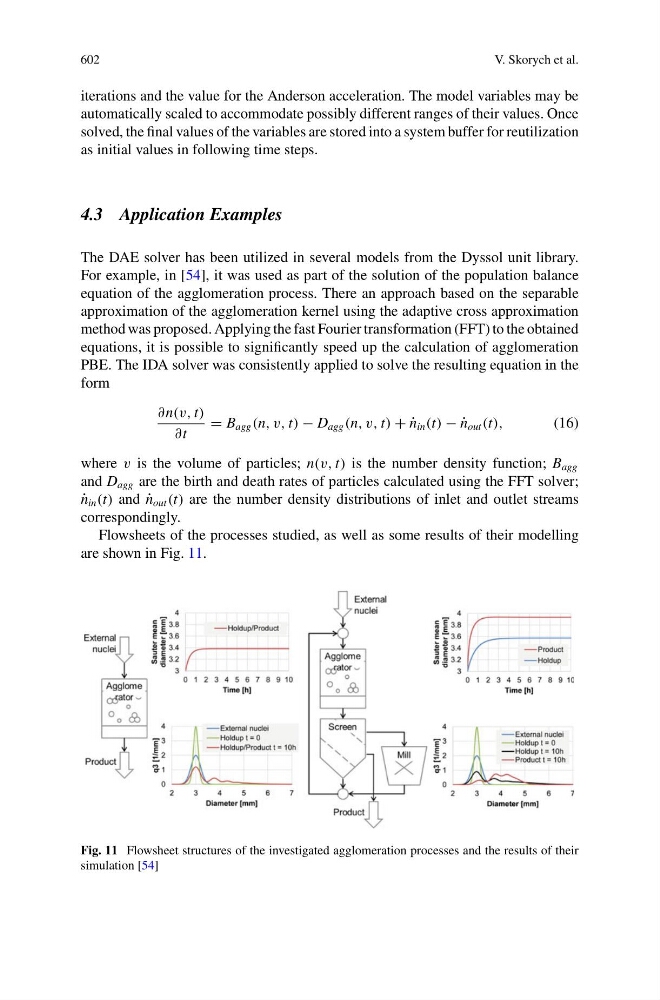
Flowsheets of the processes studied, as well as some results of their modelling
are shown in Fig. 11.
Fig. 11 Flowsheet structures of the investigated agglomeration processes and the results of their
simulation [54]
V. Skorych et al.
iterations and the value for the Anderson acceleration. The model variables may be
automatically scaled to accommodate possibly different ranges of their values. Once
solved, the final values of the variables are stored into a system buffer for reutilization
as initial values in following time steps.
4.3 Application Examples
The DAE solver has been utilized in several models from the Dyssol unit library.
For example, in [54], it was used as part of the solution of the population balance
equation of the agglomeration process. There an approach based on the separable
approximation of the agglomeration kernel using the adaptive cross approximation
method was proposed. Applying the fast Fourier transformation (FFT) to the obtained
equations, it is possible to significantly speed up the calculation of agglomeration
PBE. The IDA solver was consistently applied to solve the resulting equation in the
form
∂n(v, t)
∂t
= B agg (n, v, t) − D agg (n, v, t) + ˙
n in (t) − ˙
n out (t),
(16)
where v is the volume of particles; n(v, t) is the number density function; B agg
and D agg are the birth and death rates of particles calculated using the FFT solver;
˙
n in (t) and ˙
n out (t) are the number density distributions of inlet and outlet streams
correspondingly.
Flowsheets of the processes studied, as well as some results of their modelling
are shown in Fig. 11.
Fig. 11 Flowsheet structures of the investigated agglomeration processes and the results of their
simulation [54]