

566
M. Spinola et al.
4.3 Ostwald Ripening: Minimization of Standard Deviation
In this example a different synthesis process will be considered where not only growth
dynamics were altered but also another optimization goal compared to Sects. 4.1 and
4.2 was aimed to reach. Even though a simplified Ostwald ripening mechanism of
particles is taken into account, it describes more complex growth of particles than in
the two previous examples. This is due to the fast ripening dynamics. The process
was started with a given monomodal PSD q 0 with mean particle size of 2 nm. During
the process, the rate u in of particles with a PSD q in is added which corresponds to
the initial PSD q 0 .
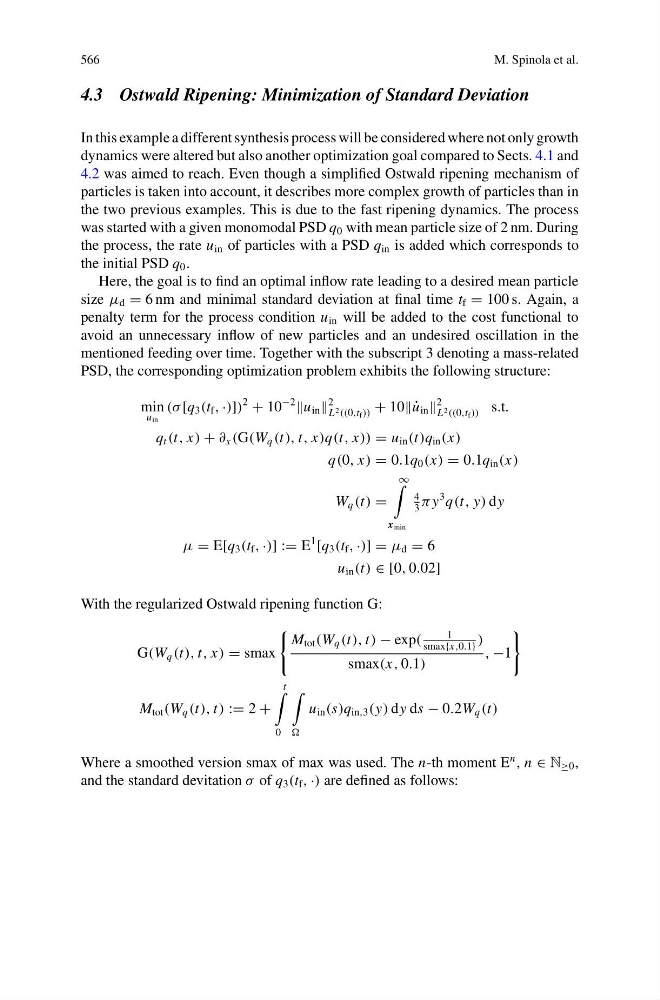
Here, the goal is to find an optimal inflow rate leading to a desired mean particle
size μ d = 6 nm and minimal standard deviation at final time t f = 100 s. Again, a
penalty term for the process condition u in will be added to the cost functional to
avoid an unnecessary inflow of new particles and an undesired oscillation in the
mentioned feeding over time. Together with the subscript 3 denoting a mass-related
PSD, the corresponding optimization problem exhibits the following structure:
min
u in
(σ [q 3 (t f , ·)])
2
+ 10
−2
u in
2
L 2 ((0,t f )) + 10 ˙
u in
2
L 2 ((0,t f )) s.t.
q t (t, x) + ∂ x (G(W q (t), t, x)q(t, x)) = u in (t)q in (x)
q(0, x) = 0.1q 0 (x) = 0.1q in (x)
W q (t) =
∞
x min
4
3
π y
3 q(t, y) dy
μ = E[q 3 (t f , ·)] := E
1
[q 3 (t f , ·)] = μ d = 6
u in (t) ∈ [0, 0.02]
With the regularized Ostwald ripening function G:
G(W q (t), t, x) = smax
M tot (W q (t), t) − exp(
1
smax{x,0.1}
)
smax(x, 0.1)
, −1
M tot (W q (t), t) := 2 +
t
0
u in (s)q in,3 (y) dy ds − 0.2W q (t)
Where a smoothed version smax of max was used. The n-th moment E
n , n ∈ N ≥0 ,
and the standard devitation σ of q 3 (t f , ·) are defined as follows:
M. Spinola et al.
4.3 Ostwald Ripening: Minimization of Standard Deviation
In this example a different synthesis process will be considered where not only growth
dynamics were altered but also another optimization goal compared to Sects. 4.1 and
4.2 was aimed to reach. Even though a simplified Ostwald ripening mechanism of
particles is taken into account, it describes more complex growth of particles than in
the two previous examples. This is due to the fast ripening dynamics. The process
was started with a given monomodal PSD q 0 with mean particle size of 2 nm. During
the process, the rate u in of particles with a PSD q in is added which corresponds to
the initial PSD q 0 .
Here, the goal is to find an optimal inflow rate leading to a desired mean particle
size μ d = 6 nm and minimal standard deviation at final time t f = 100 s. Again, a
penalty term for the process condition u in will be added to the cost functional to
avoid an unnecessary inflow of new particles and an undesired oscillation in the
mentioned feeding over time. Together with the subscript 3 denoting a mass-related
PSD, the corresponding optimization problem exhibits the following structure:
min
u in
(σ [q 3 (t f , ·)])
2
+ 10
−2
u in
2
L 2 ((0,t f )) + 10 ˙
u in
2
L 2 ((0,t f )) s.t.
q t (t, x) + ∂ x (G(W q (t), t, x)q(t, x)) = u in (t)q in (x)
q(0, x) = 0.1q 0 (x) = 0.1q in (x)
W q (t) =
∞
x min
4
3
π y
3 q(t, y) dy
μ = E[q 3 (t f , ·)] := E
1
[q 3 (t f , ·)] = μ d = 6
u in (t) ∈ [0, 0.02]
With the regularized Ostwald ripening function G:
G(W q (t), t, x) = smax
M tot (W q (t), t) − exp(
1
smax{x,0.1}
)
smax(x, 0.1)
, −1
M tot (W q (t), t) := 2 +
t
0
u in (s)q in,3 (y) dy ds − 0.2W q (t)
Where a smoothed version smax of max was used. The n-th moment E
n , n ∈ N ≥0 ,
and the standard devitation σ of q 3 (t f , ·) are defined as follows: