

15 Compartmental Population Balances by Means of Monte Carlo Methods
529
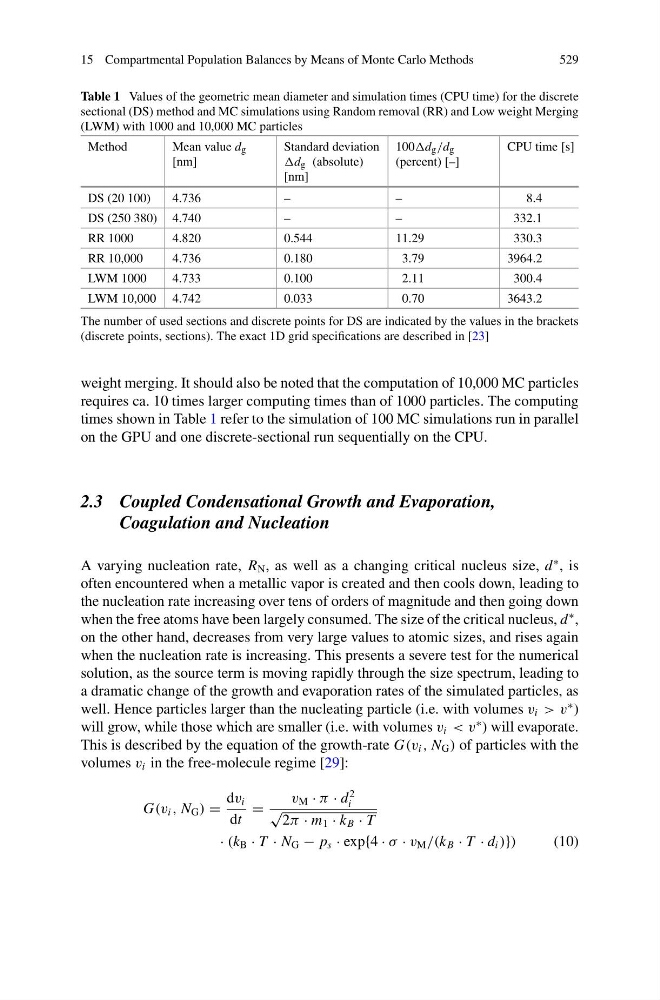
Table 1 Values of the geometric mean diameter and simulation times (CPU time) for the discrete
sectional (DS) method and MC simulations using Random removal (RR) and Low weight Merging
(LWM) with 1000 and 10,000 MC particles
Method
Mean value d g
[nm]
Standard deviation
d g (absolute)
[nm]
100d g /d g
(percent) [–]
CPU time [s]
DS (20 100)
4.736
–
–
8.4
DS (250 380) 4.740
–
–
332.1
RR 1000
4.820
0.544
11.29
330.3
RR 10,000
4.736
0.180
3.79
3964.2
LWM 1000
4.733
0.100
2.11
300.4
LWM 10,000 4.742
0.033
0.70
3643.2
The number of used sections and discrete points for DS are indicated by the values in the brackets
(discrete points, sections). The exact 1D grid specifications are described in [23]
weight merging. It should also be noted that the computation of 10,000 MC particles
requires ca. 10 times larger computing times than of 1000 particles. The computing
times shown in Table 1 refer to the simulation of 100 MC simulations run in parallel
on the GPU and one discrete-sectional run sequentially on the CPU.
2.3 Coupled Condensational Growth and Evaporation,
Coagulation and Nucleation
A varying nucleation rate, R N , as well as a changing critical nucleus size, d
∗ , is
often encountered when a metallic vapor is created and then cools down, leading to
the nucleation rate increasing over tens of orders of magnitude and then going down
when the free atoms have been largely consumed. The size of the critical nucleus, d
∗ ,
on the other hand, decreases from very large values to atomic sizes, and rises again
when the nucleation rate is increasing. This presents a severe test for the numerical
solution, as the source term is moving rapidly through the size spectrum, leading to
a dramatic change of the growth and evaporation rates of the simulated particles, as
well. Hence particles larger than the nucleating particle (i.e. with volumes v i > v
∗ )
will grow, while those which are smaller (i.e. with volumes v i < v
∗ ) will evaporate.
This is described by the equation of the growth-rate G(v i , N G ) of particles with the
volumes v i in the free-molecule regime [29]:
G(v i , N G ) =
dv i
dt
=
v M · π · d
2
i
√
2π · m 1 · k B · T
· (k B · T · N G − p s · exp{4 · σ · v M /(k B · T · d i )})
(10)
529
Table 1 Values of the geometric mean diameter and simulation times (CPU time) for the discrete
sectional (DS) method and MC simulations using Random removal (RR) and Low weight Merging
(LWM) with 1000 and 10,000 MC particles
Method
Mean value d g
[nm]
Standard deviation
d g (absolute)
[nm]
100d g /d g
(percent) [–]
CPU time [s]
DS (20 100)
4.736
–
–
8.4
DS (250 380) 4.740
–
–
332.1
RR 1000
4.820
0.544
11.29
330.3
RR 10,000
4.736
0.180
3.79
3964.2
LWM 1000
4.733
0.100
2.11
300.4
LWM 10,000 4.742
0.033
0.70
3643.2
The number of used sections and discrete points for DS are indicated by the values in the brackets
(discrete points, sections). The exact 1D grid specifications are described in [23]
weight merging. It should also be noted that the computation of 10,000 MC particles
requires ca. 10 times larger computing times than of 1000 particles. The computing
times shown in Table 1 refer to the simulation of 100 MC simulations run in parallel
on the GPU and one discrete-sectional run sequentially on the CPU.
2.3 Coupled Condensational Growth and Evaporation,
Coagulation and Nucleation
A varying nucleation rate, R N , as well as a changing critical nucleus size, d
∗ , is
often encountered when a metallic vapor is created and then cools down, leading to
the nucleation rate increasing over tens of orders of magnitude and then going down
when the free atoms have been largely consumed. The size of the critical nucleus, d
∗ ,
on the other hand, decreases from very large values to atomic sizes, and rises again
when the nucleation rate is increasing. This presents a severe test for the numerical
solution, as the source term is moving rapidly through the size spectrum, leading to
a dramatic change of the growth and evaporation rates of the simulated particles, as
well. Hence particles larger than the nucleating particle (i.e. with volumes v i > v
∗ )
will grow, while those which are smaller (i.e. with volumes v i < v
∗ ) will evaporate.
This is described by the equation of the growth-rate G(v i , N G ) of particles with the
volumes v i in the free-molecule regime [29]:
G(v i , N G ) =
dv i
dt
=
v M · π · d
2
i
√
2π · m 1 · k B · T
· (k B · T · N G − p s · exp{4 · σ · v M /(k B · T · d i )})
(10)