

530
G. Kotalczyk and F. E. Kruis
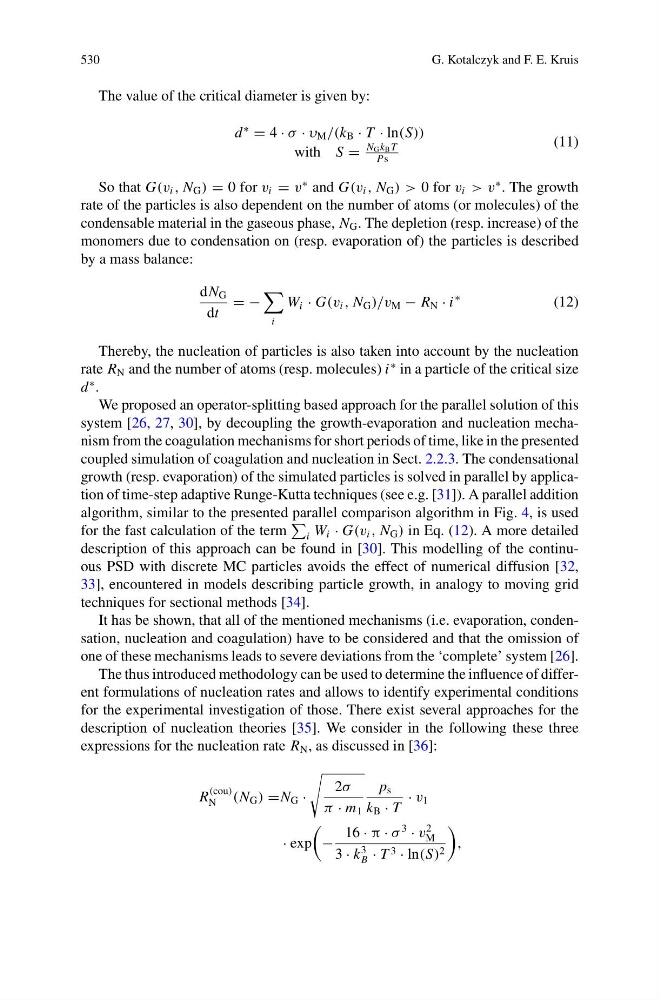
The value of the critical diameter is given by:
d
∗
= 4 · σ · υ M /(k B · T · ln(S))
with S =
N G k B T
Ps
(11)
So that G(v i , N G ) = 0 for v i = v
∗ and G(v i , N G ) > 0 for v i > v
∗ . The growth
rate of the particles is also dependent on the number of atoms (or molecules) of the
condensable material in the gaseous phase, N G . The depletion (resp. increase) of the
monomers due to condensation on (resp. evaporation of) the particles is described
by a mass balance:
dN G
dt
= −
i
W i · G(v i , N G )/v M − R N · i
∗
(12)
Thereby, the nucleation of particles is also taken into account by the nucleation
rate R N and the number of atoms (resp. molecules) i
∗ in a particle of the critical size
d
∗ .
We proposed an operator-splitting based approach for the parallel solution of this
system [26, 27, 30], by decoupling the growth-evaporation and nucleation mechanism from the coagulation mechanisms for short periods of time, like in the presented
coupled simulation of coagulation and nucleation in Sect. 2.2.3. The condensational
growth (resp. evaporation) of the simulated particles is solved in parallel by application of time-step adaptive Runge-Kutta techniques (see e.g. [31]). A parallel addition
algorithm, similar to the presented parallel comparison algorithm in Fig. 4, is used
for the fast calculation of the term
i W i · G(v i , N G ) in Eq. (12). A more detailed
description of this approach can be found in [30]. This modelling of the continuous PSD with discrete MC particles avoids the effect of numerical diffusion [32,
33], encountered in models describing particle growth, in analogy to moving grid
techniques for sectional methods [34].
It has be shown, that all of the mentioned mechanisms (i.e. evaporation, condensation, nucleation and coagulation) have to be considered and that the omission of
one of these mechanisms leads to severe deviations from the ‘complete’ system [26].
The thus introduced methodology can be used to determine the influence of different formulations of nucleation rates and allows to identify experimental conditions
for the experimental investigation of those. There exist several approaches for the
description of nucleation theories [35]. We consider in the following these three
expressions for the nucleation rate R N , as discussed in [36]:
R
(cou)
N
(N G ) =N G ·
2σ
π · m 1
p s
k B · T
· v 1
· exp
−
16 · π · σ
3
· v
2
M
3 · k
3
B · T 3 · ln(S) 2
,
G. Kotalczyk and F. E. Kruis
The value of the critical diameter is given by:
d
∗
= 4 · σ · υ M /(k B · T · ln(S))
with S =
N G k B T
Ps
(11)
So that G(v i , N G ) = 0 for v i = v
∗ and G(v i , N G ) > 0 for v i > v
∗ . The growth
rate of the particles is also dependent on the number of atoms (or molecules) of the
condensable material in the gaseous phase, N G . The depletion (resp. increase) of the
monomers due to condensation on (resp. evaporation of) the particles is described
by a mass balance:
dN G
dt
= −
i
W i · G(v i , N G )/v M − R N · i
∗
(12)
Thereby, the nucleation of particles is also taken into account by the nucleation
rate R N and the number of atoms (resp. molecules) i
∗ in a particle of the critical size
d
∗ .
We proposed an operator-splitting based approach for the parallel solution of this
system [26, 27, 30], by decoupling the growth-evaporation and nucleation mechanism from the coagulation mechanisms for short periods of time, like in the presented
coupled simulation of coagulation and nucleation in Sect. 2.2.3. The condensational
growth (resp. evaporation) of the simulated particles is solved in parallel by application of time-step adaptive Runge-Kutta techniques (see e.g. [31]). A parallel addition
algorithm, similar to the presented parallel comparison algorithm in Fig. 4, is used
for the fast calculation of the term
i W i · G(v i , N G ) in Eq. (12). A more detailed
description of this approach can be found in [30]. This modelling of the continuous PSD with discrete MC particles avoids the effect of numerical diffusion [32,
33], encountered in models describing particle growth, in analogy to moving grid
techniques for sectional methods [34].
It has be shown, that all of the mentioned mechanisms (i.e. evaporation, condensation, nucleation and coagulation) have to be considered and that the omission of
one of these mechanisms leads to severe deviations from the ‘complete’ system [26].
The thus introduced methodology can be used to determine the influence of different formulations of nucleation rates and allows to identify experimental conditions
for the experimental investigation of those. There exist several approaches for the
description of nucleation theories [35]. We consider in the following these three
expressions for the nucleation rate R N , as discussed in [36]:
R
(cou)
N
(N G ) =N G ·
2σ
π · m 1
p s
k B · T
· v 1
· exp
−
16 · π · σ
3
· v
2
M
3 · k
3
B · T 3 · ln(S) 2
,