

528
G. Kotalczyk and F. E. Kruis
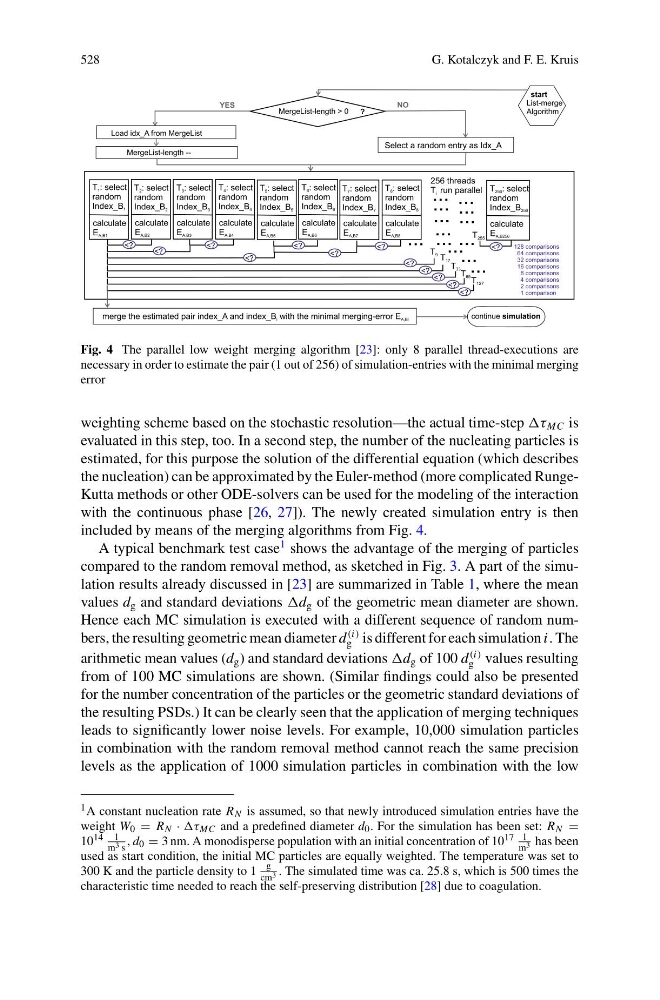
Fig. 4 The parallel low weight merging algorithm [23]: only 8 parallel thread-executions are
necessary in order to estimate the pair (1 out of 256) of simulation-entries with the minimal merging
error
weighting scheme based on the stochastic resolution—the actual time-step τ MC is
evaluated in this step, too. In a second step, the number of the nucleating particles is
estimated, for this purpose the solution of the differential equation (which describes
the nucleation) can be approximated by the Euler-method (more complicated RungeKutta methods or other ODE-solvers can be used for the modeling of the interaction
with the continuous phase [26, 27]). The newly created simulation entry is then
included by means of the merging algorithms from Fig. 4.
A typical benchmark test case
1 shows the advantage of the merging of particles
compared to the random removal method, as sketched in Fig. 3. A part of the simulation results already discussed in [23] are summarized in Table 1, where the mean
values d g and standard deviations g of the geometric mean diameter are shown.
Hence each MC simulation is executed with a different sequence of random numbers, the resulting geometric mean diameter d
(i)
g is different for each simulation i. The
arithmetic mean values (d g ) and standard deviations g of 100 d
(i)
g values resulting
from of 100 MC simulations are shown. (Similar findings could also be presented
for the number concentration of the particles or the geometric standard deviations of
the resulting PSDs.) It can be clearly seen that the application of merging techniques
leads to significantly lower noise levels. For example, 10,000 simulation particles
in combination with the random removal method cannot reach the same precision
levels as the application of 1000 simulation particles in combination with the low
1 A constant nucleation rate R N is assumed, so that newly introduced simulation entries have the
weight W 0 = R N · τ MC and a predefined diameter d 0 . For the simulation has been set: R N =
10 14 1
m 3 s
, d 0 = 3 nm. A monodisperse population with an initial concentration of 10 17 1
m 3 has been
used as start condition, the initial MC particles are equally weighted. The temperature was set to
300 K and the particle density to 1
g
cm 3 . The simulated time was ca. 25.8 s, which is 500 times the
characteristic time needed to reach the self-preserving distribution [28] due to coagulation.
G. Kotalczyk and F. E. Kruis
Fig. 4 The parallel low weight merging algorithm [23]: only 8 parallel thread-executions are
necessary in order to estimate the pair (1 out of 256) of simulation-entries with the minimal merging
error
weighting scheme based on the stochastic resolution—the actual time-step τ MC is
evaluated in this step, too. In a second step, the number of the nucleating particles is
estimated, for this purpose the solution of the differential equation (which describes
the nucleation) can be approximated by the Euler-method (more complicated RungeKutta methods or other ODE-solvers can be used for the modeling of the interaction
with the continuous phase [26, 27]). The newly created simulation entry is then
included by means of the merging algorithms from Fig. 4.
A typical benchmark test case
1 shows the advantage of the merging of particles
compared to the random removal method, as sketched in Fig. 3. A part of the simulation results already discussed in [23] are summarized in Table 1, where the mean
values d g and standard deviations g of the geometric mean diameter are shown.
Hence each MC simulation is executed with a different sequence of random numbers, the resulting geometric mean diameter d
(i)
g is different for each simulation i. The
arithmetic mean values (d g ) and standard deviations g of 100 d
(i)
g values resulting
from of 100 MC simulations are shown. (Similar findings could also be presented
for the number concentration of the particles or the geometric standard deviations of
the resulting PSDs.) It can be clearly seen that the application of merging techniques
leads to significantly lower noise levels. For example, 10,000 simulation particles
in combination with the random removal method cannot reach the same precision
levels as the application of 1000 simulation particles in combination with the low
1 A constant nucleation rate R N is assumed, so that newly introduced simulation entries have the
weight W 0 = R N · τ MC and a predefined diameter d 0 . For the simulation has been set: R N =
10 14 1
m 3 s
, d 0 = 3 nm. A monodisperse population with an initial concentration of 10 17 1
m 3 has been
used as start condition, the initial MC particles are equally weighted. The temperature was set to
300 K and the particle density to 1
g
cm 3 . The simulated time was ca. 25.8 s, which is 500 times the
characteristic time needed to reach the self-preserving distribution [28] due to coagulation.