

15 Compartmental Population Balances by Means of Monte Carlo Methods
527
This is the most simple assumption which should hold true for most of the physical
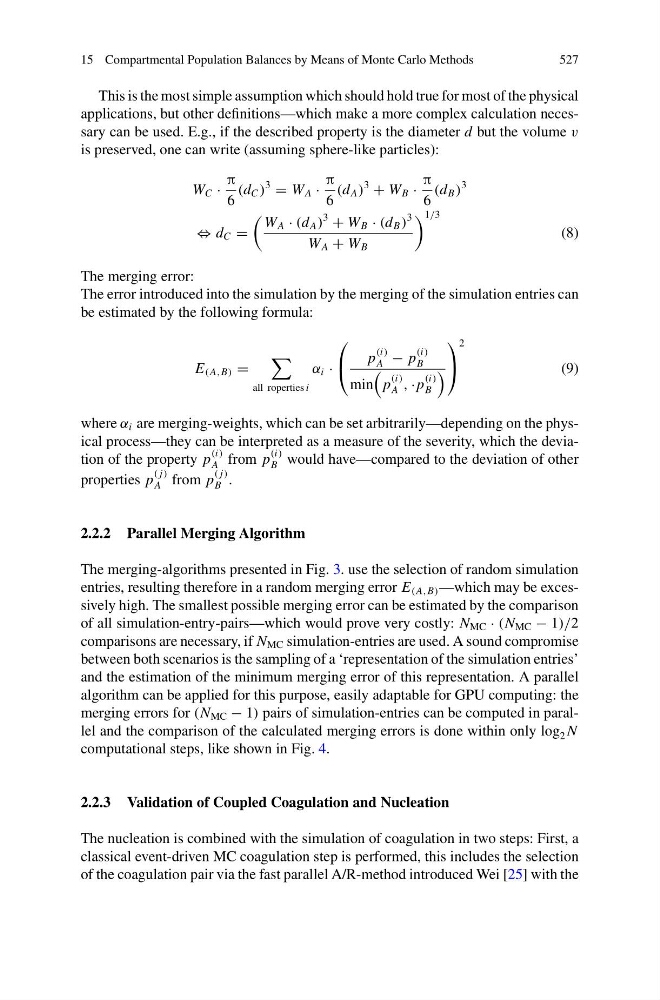
applications, but other definitions—which make a more complex calculation necessary can be used. E.g., if the described property is the diameter d but the volume v
is preserved, one can write (assuming sphere-like particles):
W C ·
π
6
(d C )
3
= W A ·
π
6
(d A )
3
+ W B ·
π
6
(d B )
3
⇔ d C =
W A · (d A )
3
+ W B · (d B )
3
W A + W B
1/3
(8)
The merging error:
The error introduced into the simulation by the merging of the simulation entries can
be estimated by the following formula:
E (A,B) =
all roperties i
α i ·
⎛
⎝ p
(i)
A − p
(i)
B
min
p
(i)
A , · p
(i)
B
⎞
⎠
2
(9)
where α i are merging-weights, which can be set arbitrarily—depending on the physical process—they can be interpreted as a measure of the severity, which the deviation of the property p
(i)
A from p
(i)
B would have—compared to the deviation of other
properties p
( j)
A from p
( j)
B .
2.2.2 Parallel Merging Algorithm
The merging-algorithms presented in Fig. 3. use the selection of random simulation
entries, resulting therefore in a random merging error E (A,B) —which may be excessively high. The smallest possible merging error can be estimated by the comparison
of all simulation-entry-pairs—which would prove very costly: N MC · (N MC − 1)/2
comparisons are necessary, if N MC simulation-entries are used. A sound compromise
between both scenarios is the sampling of a ‘representation of the simulation entries’
and the estimation of the minimum merging error of this representation. A parallel
algorithm can be applied for this purpose, easily adaptable for GPU computing: the
merging errors for (N MC − 1) pairs of simulation-entries can be computed in parallel and the comparison of the calculated merging errors is done within only log 2 N
computational steps, like shown in Fig. 4.
2.2.3 Validation of Coupled Coagulation and Nucleation
The nucleation is combined with the simulation of coagulation in two steps: First, a
classical event-driven MC coagulation step is performed, this includes the selection
of the coagulation pair via the fast parallel A/R-method introduced Wei [25] with the
527
This is the most simple assumption which should hold true for most of the physical
applications, but other definitions—which make a more complex calculation necessary can be used. E.g., if the described property is the diameter d but the volume v
is preserved, one can write (assuming sphere-like particles):
W C ·
π
6
(d C )
3
= W A ·
π
6
(d A )
3
+ W B ·
π
6
(d B )
3
⇔ d C =
W A · (d A )
3
+ W B · (d B )
3
W A + W B
1/3
(8)
The merging error:
The error introduced into the simulation by the merging of the simulation entries can
be estimated by the following formula:
E (A,B) =
all roperties i
α i ·
⎛
⎝ p
(i)
A − p
(i)
B
min
p
(i)
A , · p
(i)
B
⎞
⎠
2
(9)
where α i are merging-weights, which can be set arbitrarily—depending on the physical process—they can be interpreted as a measure of the severity, which the deviation of the property p
(i)
A from p
(i)
B would have—compared to the deviation of other
properties p
( j)
A from p
( j)
B .
2.2.2 Parallel Merging Algorithm
The merging-algorithms presented in Fig. 3. use the selection of random simulation
entries, resulting therefore in a random merging error E (A,B) —which may be excessively high. The smallest possible merging error can be estimated by the comparison
of all simulation-entry-pairs—which would prove very costly: N MC · (N MC − 1)/2
comparisons are necessary, if N MC simulation-entries are used. A sound compromise
between both scenarios is the sampling of a ‘representation of the simulation entries’
and the estimation of the minimum merging error of this representation. A parallel
algorithm can be applied for this purpose, easily adaptable for GPU computing: the
merging errors for (N MC − 1) pairs of simulation-entries can be computed in parallel and the comparison of the calculated merging errors is done within only log 2 N
computational steps, like shown in Fig. 4.
2.2.3 Validation of Coupled Coagulation and Nucleation
The nucleation is combined with the simulation of coagulation in two steps: First, a
classical event-driven MC coagulation step is performed, this includes the selection
of the coagulation pair via the fast parallel A/R-method introduced Wei [25] with the