

510
R. Ahrens et al.
M e (f )(t) :=
Ω int
f (m)
d int
q=1
m
e q
q d m,
(3.16)
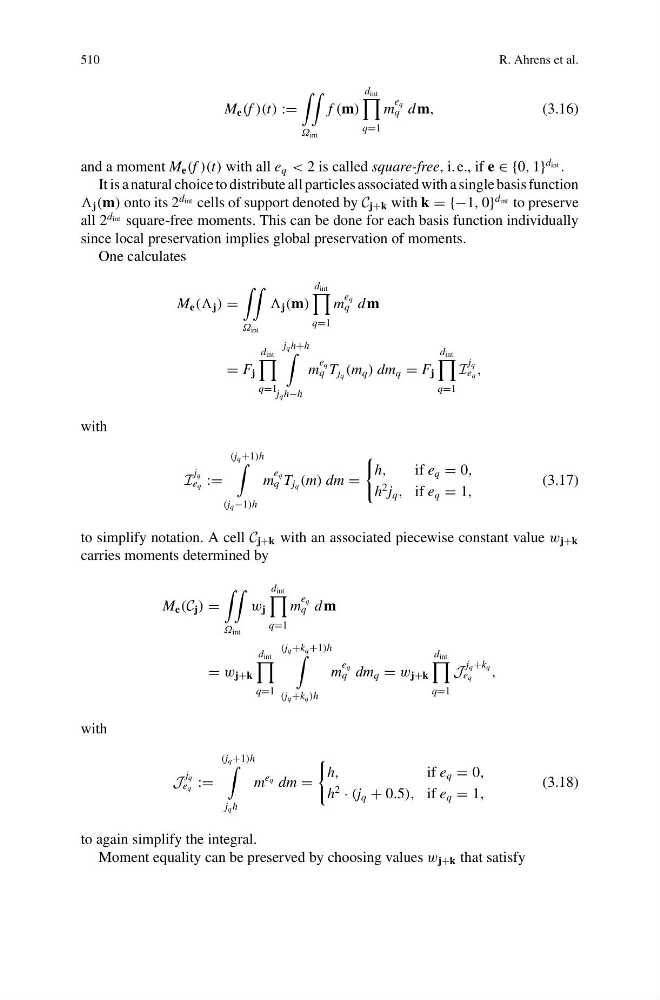
and a moment M e (f )(t) with all e q < 2 is called square-free, i. e., if e ∈ {0, 1}
d int .
It is a natural choice to distribute all particles associated with a single basis function
j (m) onto its 2
d int cells of support denoted by C j+k with k = {−1, 0}
d int to preserve
all 2
d int square-free moments. This can be done for each basis function individually
since local preservation implies global preservation of moments.
One calculates
M e (( j ) =
Ω int
j (m)
d int
q=1
m
e q
q d m
= F j
d int
q=1
j q h+h
j q h−h
m
e q
q T j q (m q ) dm q = F j
d int
q=1
I
j q
e q ,
with
I
j q
e q :=
(j q +1)h
(j q −1)h
m
e q
q T j q (m) dm =
h,
if e q = 0,
h
2 j q , if e q = 1,
(3.17)
to simplify notation. A cell C j+k with an associated piecewise constant value w j+k
carries moments determined by
M e (C j ) =
Ω int
w j
d int
q=1
m
e q
q d m
= w j+k
d int
q=1
(j q +k q +1)h
(j q +k q )h
m
e q
q dm q = w j+k
d int
q=1
J
j q +k q
e q
,
with
J
j q
e q :=
(j q +1)h
j q h
m
e q dm =
h,
if e q = 0,
h
2
· (j q + 0.5), if e q = 1,
(3.18)
to again simplify the integral.
Moment equality can be preserved by choosing values w j+k that satisfy
R. Ahrens et al.
M e (f )(t) :=
Ω int
f (m)
d int
q=1
m
e q
q d m,
(3.16)
and a moment M e (f )(t) with all e q < 2 is called square-free, i. e., if e ∈ {0, 1}
d int .
It is a natural choice to distribute all particles associated with a single basis function
j (m) onto its 2
d int cells of support denoted by C j+k with k = {−1, 0}
d int to preserve
all 2
d int square-free moments. This can be done for each basis function individually
since local preservation implies global preservation of moments.
One calculates
M e (( j ) =
Ω int
j (m)
d int
q=1
m
e q
q d m
= F j
d int
q=1
j q h+h
j q h−h
m
e q
q T j q (m q ) dm q = F j
d int
q=1
I
j q
e q ,
with
I
j q
e q :=
(j q +1)h
(j q −1)h
m
e q
q T j q (m) dm =
h,
if e q = 0,
h
2 j q , if e q = 1,
(3.17)
to simplify notation. A cell C j+k with an associated piecewise constant value w j+k
carries moments determined by
M e (C j ) =
Ω int
w j
d int
q=1
m
e q
q d m
= w j+k
d int
q=1
(j q +k q +1)h
(j q +k q )h
m
e q
q dm q = w j+k
d int
q=1
J
j q +k q
e q
,
with
J
j q
e q :=
(j q +1)h
j q h
m
e q dm =
h,
if e q = 0,
h
2
· (j q + 0.5), if e q = 1,
(3.18)
to again simplify the integral.
Moment equality can be preserved by choosing values w j+k that satisfy