

13 Morphological Modelling and Simulation …
469
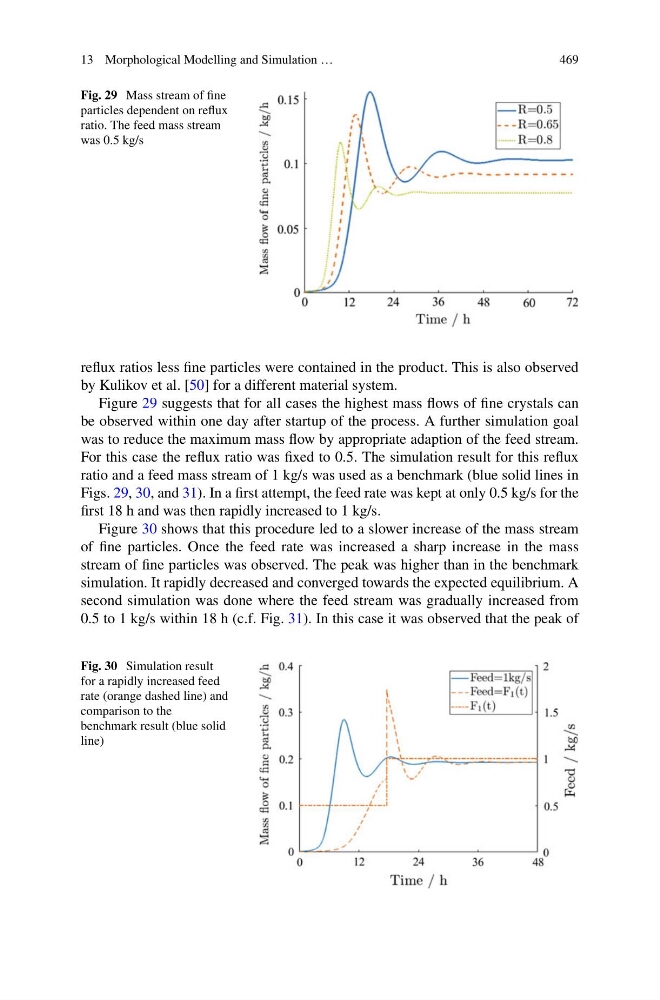
Fig. 29 Mass stream of fine
particles dependent on reflux
ratio. The feed mass stream
was 0.5 kg/s
reflux ratios less fine particles were contained in the product. This is also observed
by Kulikov et al. [50] for a different material system.
Figure 29 suggests that for all cases the highest mass flows of fine crystals can
be observed within one day after startup of the process. A further simulation goal
was to reduce the maximum mass flow by appropriate adaption of the feed stream.
For this case the reflux ratio was fixed to 0.5. The simulation result for this reflux
ratio and a feed mass stream of 1 kg/s was used as a benchmark (blue solid lines in
Figs. 29, 30, and 31). In a first attempt, the feed rate was kept at only 0.5 kg/s for the
first 18 h and was then rapidly increased to 1 kg/s.
Figure 30 shows that this procedure led to a slower increase of the mass stream
of fine particles. Once the feed rate was increased a sharp increase in the mass
stream of fine particles was observed. The peak was higher than in the benchmark
simulation. It rapidly decreased and converged towards the expected equilibrium. A
second simulation was done where the feed stream was gradually increased from
0.5 to 1 kg/s within 18 h (c.f. Fig. 31). In this case it was observed that the peak of
Fig. 30 Simulation result
for a rapidly increased feed
rate (orange dashed line) and
comparison to the
benchmark result (blue solid
line)
469
Fig. 29 Mass stream of fine
particles dependent on reflux
ratio. The feed mass stream
was 0.5 kg/s
reflux ratios less fine particles were contained in the product. This is also observed
by Kulikov et al. [50] for a different material system.
Figure 29 suggests that for all cases the highest mass flows of fine crystals can
be observed within one day after startup of the process. A further simulation goal
was to reduce the maximum mass flow by appropriate adaption of the feed stream.
For this case the reflux ratio was fixed to 0.5. The simulation result for this reflux
ratio and a feed mass stream of 1 kg/s was used as a benchmark (blue solid lines in
Figs. 29, 30, and 31). In a first attempt, the feed rate was kept at only 0.5 kg/s for the
first 18 h and was then rapidly increased to 1 kg/s.
Figure 30 shows that this procedure led to a slower increase of the mass stream
of fine particles. Once the feed rate was increased a sharp increase in the mass
stream of fine particles was observed. The peak was higher than in the benchmark
simulation. It rapidly decreased and converged towards the expected equilibrium. A
second simulation was done where the feed stream was gradually increased from
0.5 to 1 kg/s within 18 h (c.f. Fig. 31). In this case it was observed that the peak of
Fig. 30 Simulation result
for a rapidly increased feed
rate (orange dashed line) and
comparison to the
benchmark result (blue solid
line)