

460
S. Schiele et al.
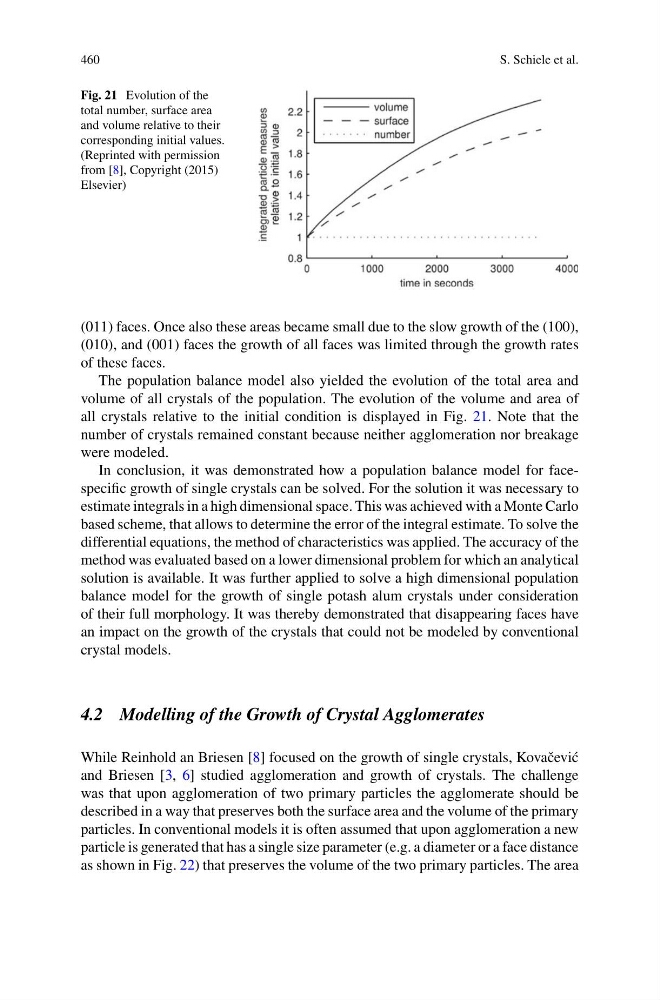
Fig. 21 Evolution of the
total number, surface area
and volume relative to their
corresponding initial values.
(Reprinted with permission
from [8], Copyright (2015)
Elsevier)
(011) faces. Once also these areas became small due to the slow growth of the (100),
(010), and (001) faces the growth of all faces was limited through the growth rates
of these faces.
The population balance model also yielded the evolution of the total area and
volume of all crystals of the population. The evolution of the volume and area of
all crystals relative to the initial condition is displayed in Fig. 21. Note that the
number of crystals remained constant because neither agglomeration nor breakage
were modeled.
In conclusion, it was demonstrated how a population balance model for facespecific growth of single crystals can be solved. For the solution it was necessary to
estimate integrals in a high dimensional space. This was achieved with a Monte Carlo
based scheme, that allows to determine the error of the integral estimate. To solve the
differential equations, the method of characteristics was applied. The accuracy of the
method was evaluated based on a lower dimensional problem for which an analytical
solution is available. It was further applied to solve a high dimensional population
balance model for the growth of single potash alum crystals under consideration
of their full morphology. It was thereby demonstrated that disappearing faces have
an impact on the growth of the crystals that could not be modeled by conventional
crystal models.
4.2 Modelling of the Growth of Crystal Agglomerates
While Reinhold an Briesen [8] focused on the growth of single crystals, Kovaˇ cevi´ c
and Briesen [3, 6] studied agglomeration and growth of crystals. The challenge
was that upon agglomeration of two primary particles the agglomerate should be
described in a way that preserves both the surface area and the volume of the primary
particles. In conventional models it is often assumed that upon agglomeration a new
particle is generated that has a single size parameter (e.g. a diameter or a face distance
as shown in Fig. 22) that preserves the volume of the two primary particles. The area
S. Schiele et al.
Fig. 21 Evolution of the
total number, surface area
and volume relative to their
corresponding initial values.
(Reprinted with permission
from [8], Copyright (2015)
Elsevier)
(011) faces. Once also these areas became small due to the slow growth of the (100),
(010), and (001) faces the growth of all faces was limited through the growth rates
of these faces.
The population balance model also yielded the evolution of the total area and
volume of all crystals of the population. The evolution of the volume and area of
all crystals relative to the initial condition is displayed in Fig. 21. Note that the
number of crystals remained constant because neither agglomeration nor breakage
were modeled.
In conclusion, it was demonstrated how a population balance model for facespecific growth of single crystals can be solved. For the solution it was necessary to
estimate integrals in a high dimensional space. This was achieved with a Monte Carlo
based scheme, that allows to determine the error of the integral estimate. To solve the
differential equations, the method of characteristics was applied. The accuracy of the
method was evaluated based on a lower dimensional problem for which an analytical
solution is available. It was further applied to solve a high dimensional population
balance model for the growth of single potash alum crystals under consideration
of their full morphology. It was thereby demonstrated that disappearing faces have
an impact on the growth of the crystals that could not be modeled by conventional
crystal models.
4.2 Modelling of the Growth of Crystal Agglomerates
While Reinhold an Briesen [8] focused on the growth of single crystals, Kovaˇ cevi´ c
and Briesen [3, 6] studied agglomeration and growth of crystals. The challenge
was that upon agglomeration of two primary particles the agglomerate should be
described in a way that preserves both the surface area and the volume of the primary
particles. In conventional models it is often assumed that upon agglomeration a new
particle is generated that has a single size parameter (e.g. a diameter or a face distance
as shown in Fig. 22) that preserves the volume of the two primary particles. The area