

450
S. Schiele et al.
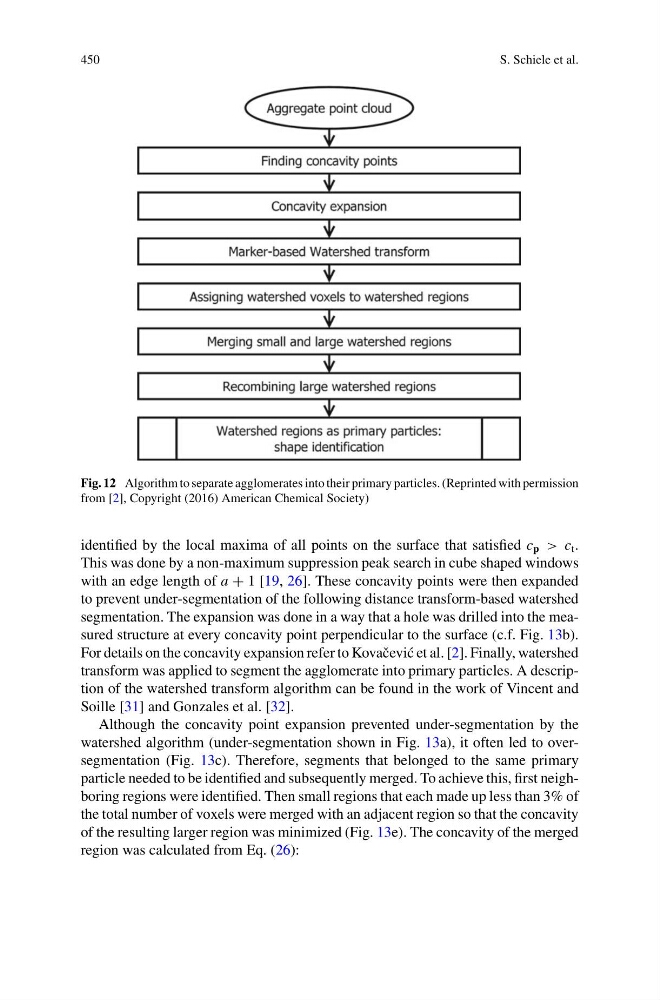
Fig. 12 Algorithm to separate agglomerates into their primary particles. (Reprinted with permission
from [2], Copyright (2016) American Chemical Society)
identified by the local maxima of all points on the surface that satisfied c p > c t .
This was done by a non-maximum suppression peak search in cube shaped windows
with an edge length of a + 1 [19, 26]. These concavity points were then expanded
to prevent under-segmentation of the following distance transform-based watershed
segmentation. The expansion was done in a way that a hole was drilled into the measured structure at every concavity point perpendicular to the surface (c.f. Fig. 13b).
For details on the concavity expansion refer to Kovaˇ cevi´ c et al. [2]. Finally, watershed
transform was applied to segment the agglomerate into primary particles. A description of the watershed transform algorithm can be found in the work of Vincent and
Soille [31] and Gonzales et al. [32].
Although the concavity point expansion prevented under-segmentation by the
watershed algorithm (under-segmentation shown in Fig. 13a), it often led to oversegmentation (Fig. 13c). Therefore, segments that belonged to the same primary
particle needed to be identified and subsequently merged. To achieve this, first neighboring regions were identified. Then small regions that each made up less than 3% of
the total number of voxels were merged with an adjacent region so that the concavity
of the resulting larger region was minimized (Fig. 13e). The concavity of the merged
region was calculated from Eq. (26):
S. Schiele et al.
Fig. 12 Algorithm to separate agglomerates into their primary particles. (Reprinted with permission
from [2], Copyright (2016) American Chemical Society)
identified by the local maxima of all points on the surface that satisfied c p > c t .
This was done by a non-maximum suppression peak search in cube shaped windows
with an edge length of a + 1 [19, 26]. These concavity points were then expanded
to prevent under-segmentation of the following distance transform-based watershed
segmentation. The expansion was done in a way that a hole was drilled into the measured structure at every concavity point perpendicular to the surface (c.f. Fig. 13b).
For details on the concavity expansion refer to Kovaˇ cevi´ c et al. [2]. Finally, watershed
transform was applied to segment the agglomerate into primary particles. A description of the watershed transform algorithm can be found in the work of Vincent and
Soille [31] and Gonzales et al. [32].
Although the concavity point expansion prevented under-segmentation by the
watershed algorithm (under-segmentation shown in Fig. 13a), it often led to oversegmentation (Fig. 13c). Therefore, segments that belonged to the same primary
particle needed to be identified and subsequently merged. To achieve this, first neighboring regions were identified. Then small regions that each made up less than 3% of
the total number of voxels were merged with an adjacent region so that the concavity
of the resulting larger region was minimized (Fig. 13e). The concavity of the merged
region was calculated from Eq. (26):