

404
E. Lukas et al.
3.6 Separation Experiments
During the course of this project, uncountable separation experiments have been
carried out. It is not the purpose of this section to discuss all corresponding results.
Interested readers can find more information in the references listed at the end of
this work, in particular in [21]. Further publications on this topic are currently under
review or being written.
In order to get insight of practical relevance, different kinds of separation
experiments have been documented, in chronological order:
• Separation based on particle size, for a variety of materials (constant air flow);
• Separation based on particle density (constant air flow);
• Separation using a pulsating air flow;
• Separation based on particle shape (constant air flow).
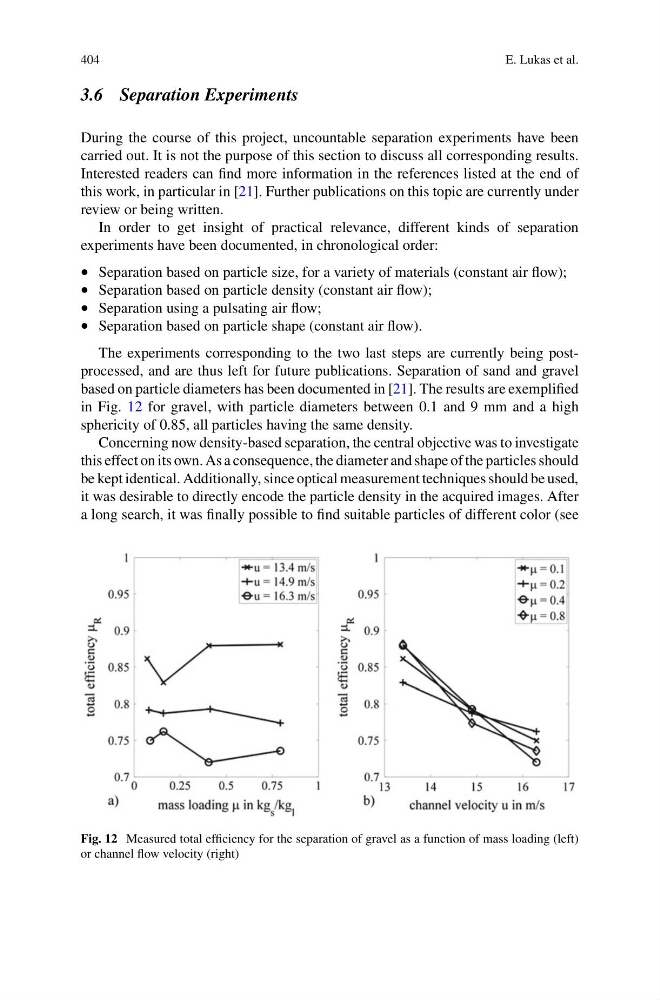
The experiments corresponding to the two last steps are currently being postprocessed, and are thus left for future publications. Separation of sand and gravel
based on particle diameters has been documented in [21]. The results are exemplified
in Fig. 12 for gravel, with particle diameters between 0.1 and 9 mm and a high
sphericity of 0.85, all particles having the same density.
Concerning now density-based separation, the central objective was to investigate
this effect on its own. As a consequence, the diameter and shape of the particles should
be kept identical. Additionally, since optical measurement techniques should be used,
it was desirable to directly encode the particle density in the acquired images. After
a long search, it was finally possible to find suitable particles of different color (see
Fig. 12 Measured total efficiency for the separation of gravel as a function of mass loading (left)
or channel flow velocity (right)
E. Lukas et al.
3.6 Separation Experiments
During the course of this project, uncountable separation experiments have been
carried out. It is not the purpose of this section to discuss all corresponding results.
Interested readers can find more information in the references listed at the end of
this work, in particular in [21]. Further publications on this topic are currently under
review or being written.
In order to get insight of practical relevance, different kinds of separation
experiments have been documented, in chronological order:
• Separation based on particle size, for a variety of materials (constant air flow);
• Separation based on particle density (constant air flow);
• Separation using a pulsating air flow;
• Separation based on particle shape (constant air flow).
The experiments corresponding to the two last steps are currently being postprocessed, and are thus left for future publications. Separation of sand and gravel
based on particle diameters has been documented in [21]. The results are exemplified
in Fig. 12 for gravel, with particle diameters between 0.1 and 9 mm and a high
sphericity of 0.85, all particles having the same density.
Concerning now density-based separation, the central objective was to investigate
this effect on its own. As a consequence, the diameter and shape of the particles should
be kept identical. Additionally, since optical measurement techniques should be used,
it was desirable to directly encode the particle density in the acquired images. After
a long search, it was finally possible to find suitable particles of different color (see
Fig. 12 Measured total efficiency for the separation of gravel as a function of mass loading (left)
or channel flow velocity (right)