

11 Experimental Study and Modelling of Particle …
403
account. Therefore, it is expected that such numerical predictions should be closer
to the experimental observations. However, depending on the employed software,
such simulations do show also some limitations. Since open-source solutions are of
course advantageous for fundamental research projects, it was decided to perform
these URANS-DEM simulations using the coupled open-source software CFDEMcoupling [19]. CFDEMcoupling combines the C++-based open-source software environments OpenFOAM (for CFD) and LIGGGHTS (for DEM). Hence, CFD and DEM
calculations rely on two separate codes. The interaction between the two calculations
is realized by exchanging relevant information with a predefined timestep. Unfortunately, advanced turbulence models like SAS are not available in CFDEMcoupling.
Looking back at the results of Sect. 3.3, the “best” model currently implemented
there is the k-ω-SST model. Even if our previous study has demonstrated that this
model leads only to weak flow fluctuations involving few large-scale vortices (at the
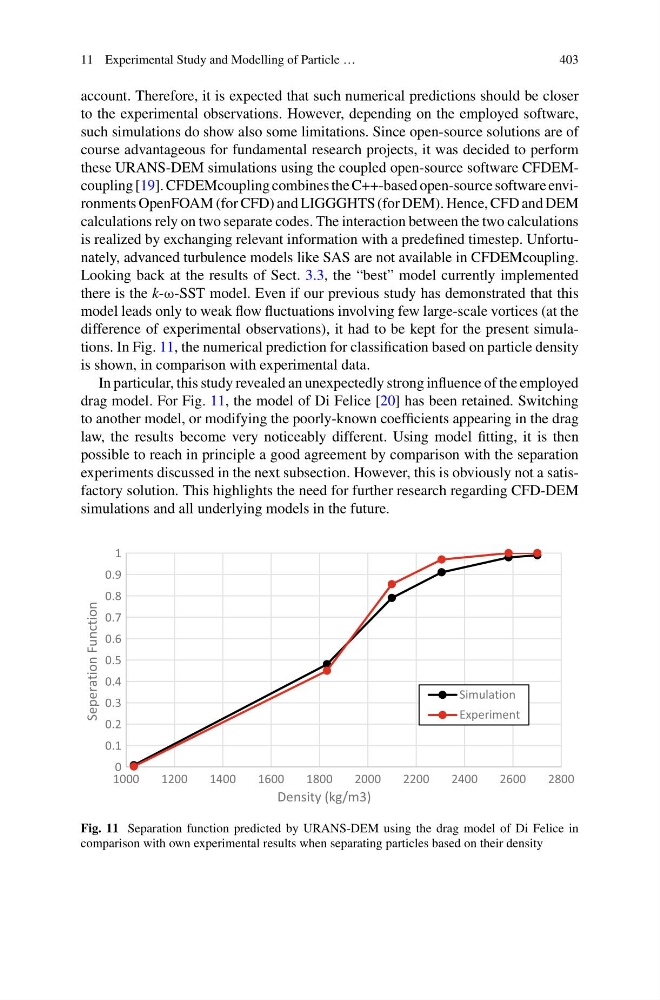
difference of experimental observations), it had to be kept for the present simulations. In Fig. 11, the numerical prediction for classification based on particle density
is shown, in comparison with experimental data.
In particular, this study revealed an unexpectedly strong influence of the employed
drag model. For Fig. 11, the model of Di Felice [20] has been retained. Switching
to another model, or modifying the poorly-known coefficients appearing in the drag
law, the results become very noticeably different. Using model fitting, it is then
possible to reach in principle a good agreement by comparison with the separation
experiments discussed in the next subsection. However, this is obviously not a satisfactory solution. This highlights the need for further research regarding CFD-DEM
simulations and all underlying models in the future.
0
0.1
0.2
0.3
0.4
0.5
0.6
0.7
0.8
0.9
1
1000
1200
1400
1600
1800
2000
2200
2400
2600
2800
Seperation Function
Density (kg/m3)
Simulation
Experiment
Fig. 11 Separation function predicted by URANS-DEM using the drag model of Di Felice in
comparison with own experimental results when separating particles based on their density
403
account. Therefore, it is expected that such numerical predictions should be closer
to the experimental observations. However, depending on the employed software,
such simulations do show also some limitations. Since open-source solutions are of
course advantageous for fundamental research projects, it was decided to perform
these URANS-DEM simulations using the coupled open-source software CFDEMcoupling [19]. CFDEMcoupling combines the C++-based open-source software environments OpenFOAM (for CFD) and LIGGGHTS (for DEM). Hence, CFD and DEM
calculations rely on two separate codes. The interaction between the two calculations
is realized by exchanging relevant information with a predefined timestep. Unfortunately, advanced turbulence models like SAS are not available in CFDEMcoupling.
Looking back at the results of Sect. 3.3, the “best” model currently implemented
there is the k-ω-SST model. Even if our previous study has demonstrated that this
model leads only to weak flow fluctuations involving few large-scale vortices (at the
difference of experimental observations), it had to be kept for the present simulations. In Fig. 11, the numerical prediction for classification based on particle density
is shown, in comparison with experimental data.
In particular, this study revealed an unexpectedly strong influence of the employed
drag model. For Fig. 11, the model of Di Felice [20] has been retained. Switching
to another model, or modifying the poorly-known coefficients appearing in the drag
law, the results become very noticeably different. Using model fitting, it is then
possible to reach in principle a good agreement by comparison with the separation
experiments discussed in the next subsection. However, this is obviously not a satisfactory solution. This highlights the need for further research regarding CFD-DEM
simulations and all underlying models in the future.
0
0.1
0.2
0.3
0.4
0.5
0.6
0.7
0.8
0.9
1
1000
1200
1400
1600
1800
2000
2200
2400
2600
2800
Seperation Function
Density (kg/m3)
Simulation
Experiment
Fig. 11 Separation function predicted by URANS-DEM using the drag model of Di Felice in
comparison with own experimental results when separating particles based on their density