

402
E. Lukas et al.
3.5 Coupled Simulations of the Particulate Flow Within
the Zigzag Channel
Again, in parallel to the experimental study discussed previously, a variety of numerical simulations have been carried out in an effort to describe the behavior of the
particles within the turbulent air flow found within the zigzag channel. Keeping in
mind, as discussed previously in Sect. 3.3, that it was already extremely challenging
to solve for the turbulent air flow without any particles, it is clear that this objective is
extremely ambitious, both regarding the needed computational resources (computing
time and memory) as well as model accuracy (availability of sufficiently accurate
numerical models).
The first attempt in the project was to couple the URANS simulation with a very
simple particle model (Discrete Particle Model, or DPM) using a one-way approach,
considering all particles as points, neglecting any influence of the particles on the
flow, and disregarding all collisions. These very strong simplifying hypotheses are
helpful to reduce computational times; however, it is clear from the start that getting
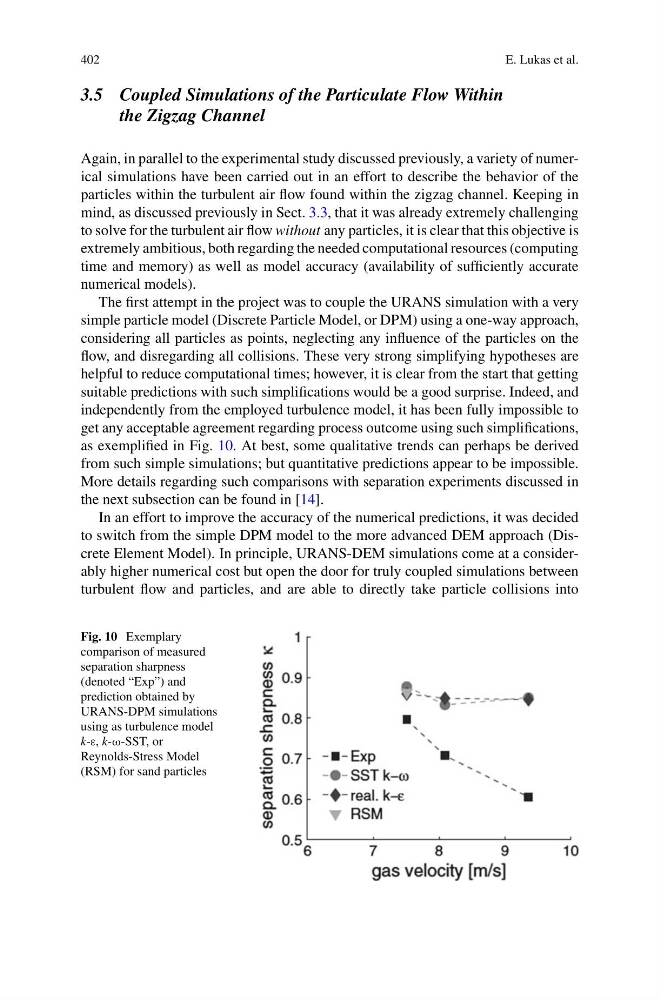
suitable predictions with such simplifications would be a good surprise. Indeed, and
independently from the employed turbulence model, it has been fully impossible to
get any acceptable agreement regarding process outcome using such simplifications,
as exemplified in Fig. 10. At best, some qualitative trends can perhaps be derived
from such simple simulations; but quantitative predictions appear to be impossible.
More details regarding such comparisons with separation experiments discussed in
the next subsection can be found in [14].
In an effort to improve the accuracy of the numerical predictions, it was decided
to switch from the simple DPM model to the more advanced DEM approach (Discrete Element Model). In principle, URANS-DEM simulations come at a considerably higher numerical cost but open the door for truly coupled simulations between
turbulent flow and particles, and are able to directly take particle collisions into
Fig. 10 Exemplary
comparison of measured
separation sharpness
(denoted “Exp”) and
prediction obtained by
URANS-DPM simulations
using as turbulence model
k-ε, k-ω-SST, or
Reynolds-Stress Model
(RSM) for sand particles
E. Lukas et al.
3.5 Coupled Simulations of the Particulate Flow Within
the Zigzag Channel
Again, in parallel to the experimental study discussed previously, a variety of numerical simulations have been carried out in an effort to describe the behavior of the
particles within the turbulent air flow found within the zigzag channel. Keeping in
mind, as discussed previously in Sect. 3.3, that it was already extremely challenging
to solve for the turbulent air flow without any particles, it is clear that this objective is
extremely ambitious, both regarding the needed computational resources (computing
time and memory) as well as model accuracy (availability of sufficiently accurate
numerical models).
The first attempt in the project was to couple the URANS simulation with a very
simple particle model (Discrete Particle Model, or DPM) using a one-way approach,
considering all particles as points, neglecting any influence of the particles on the
flow, and disregarding all collisions. These very strong simplifying hypotheses are
helpful to reduce computational times; however, it is clear from the start that getting
suitable predictions with such simplifications would be a good surprise. Indeed, and
independently from the employed turbulence model, it has been fully impossible to
get any acceptable agreement regarding process outcome using such simplifications,
as exemplified in Fig. 10. At best, some qualitative trends can perhaps be derived
from such simple simulations; but quantitative predictions appear to be impossible.
More details regarding such comparisons with separation experiments discussed in
the next subsection can be found in [14].
In an effort to improve the accuracy of the numerical predictions, it was decided
to switch from the simple DPM model to the more advanced DEM approach (Discrete Element Model). In principle, URANS-DEM simulations come at a considerably higher numerical cost but open the door for truly coupled simulations between
turbulent flow and particles, and are able to directly take particle collisions into
Fig. 10 Exemplary
comparison of measured
separation sharpness
(denoted “Exp”) and
prediction obtained by
URANS-DPM simulations
using as turbulence model
k-ε, k-ω-SST, or
Reynolds-Stress Model
(RSM) for sand particles