

11 Experimental Study and Modelling of Particle …
401
with a noticeably higher computing time, since finer grids and smaller timesteps are
required to get properly resolved features. Further studies will be necessary before
getting final statements regarding the recommended URANS turbulence model for
the ZAC.
3.4 Experimental Investigations Regarding the Particles
After having properly characterized the turbulent air flow, further experimental investigations elucidated the behavior of the particles during the separation process in the
ZAC. In order to avoid any perturbation of the system, optical measurements have
been again preferred, this time relying on shadowgraphy. This means that a background illumination is employed, and the shadows of the particles on the camera
image are post-processed to get a variety of information, like particle number density,
particle movement, particle velocity (using consecutive images), and possibly particle
shape and orientation. The main findings of these measurements have been documented extensively in [18]. Apart from delivering useful information regarding the
local particle velocity at different levels within the zigzag channel, this investigation
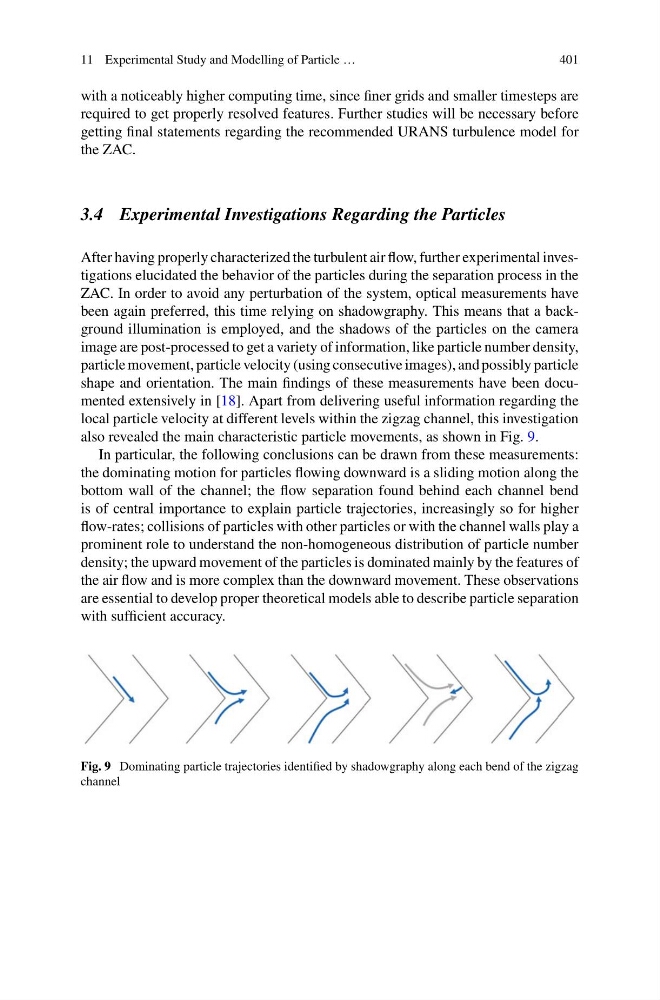
also revealed the main characteristic particle movements, as shown in Fig. 9.
In particular, the following conclusions can be drawn from these measurements:
the dominating motion for particles flowing downward is a sliding motion along the
bottom wall of the channel; the flow separation found behind each channel bend
is of central importance to explain particle trajectories, increasingly so for higher
flow-rates; collisions of particles with other particles or with the channel walls play a
prominent role to understand the non-homogeneous distribution of particle number
density; the upward movement of the particles is dominated mainly by the features of
the air flow and is more complex than the downward movement. These observations
are essential to develop proper theoretical models able to describe particle separation
with sufficient accuracy.
Fig. 9 Dominating particle trajectories identified by shadowgraphy along each bend of the zigzag
channel
401
with a noticeably higher computing time, since finer grids and smaller timesteps are
required to get properly resolved features. Further studies will be necessary before
getting final statements regarding the recommended URANS turbulence model for
the ZAC.
3.4 Experimental Investigations Regarding the Particles
After having properly characterized the turbulent air flow, further experimental investigations elucidated the behavior of the particles during the separation process in the
ZAC. In order to avoid any perturbation of the system, optical measurements have
been again preferred, this time relying on shadowgraphy. This means that a background illumination is employed, and the shadows of the particles on the camera
image are post-processed to get a variety of information, like particle number density,
particle movement, particle velocity (using consecutive images), and possibly particle
shape and orientation. The main findings of these measurements have been documented extensively in [18]. Apart from delivering useful information regarding the
local particle velocity at different levels within the zigzag channel, this investigation
also revealed the main characteristic particle movements, as shown in Fig. 9.
In particular, the following conclusions can be drawn from these measurements:
the dominating motion for particles flowing downward is a sliding motion along the
bottom wall of the channel; the flow separation found behind each channel bend
is of central importance to explain particle trajectories, increasingly so for higher
flow-rates; collisions of particles with other particles or with the channel walls play a
prominent role to understand the non-homogeneous distribution of particle number
density; the upward movement of the particles is dominated mainly by the features of
the air flow and is more complex than the downward movement. These observations
are essential to develop proper theoretical models able to describe particle separation
with sufficient accuracy.
Fig. 9 Dominating particle trajectories identified by shadowgraphy along each bend of the zigzag
channel