

400
E. Lukas et al.
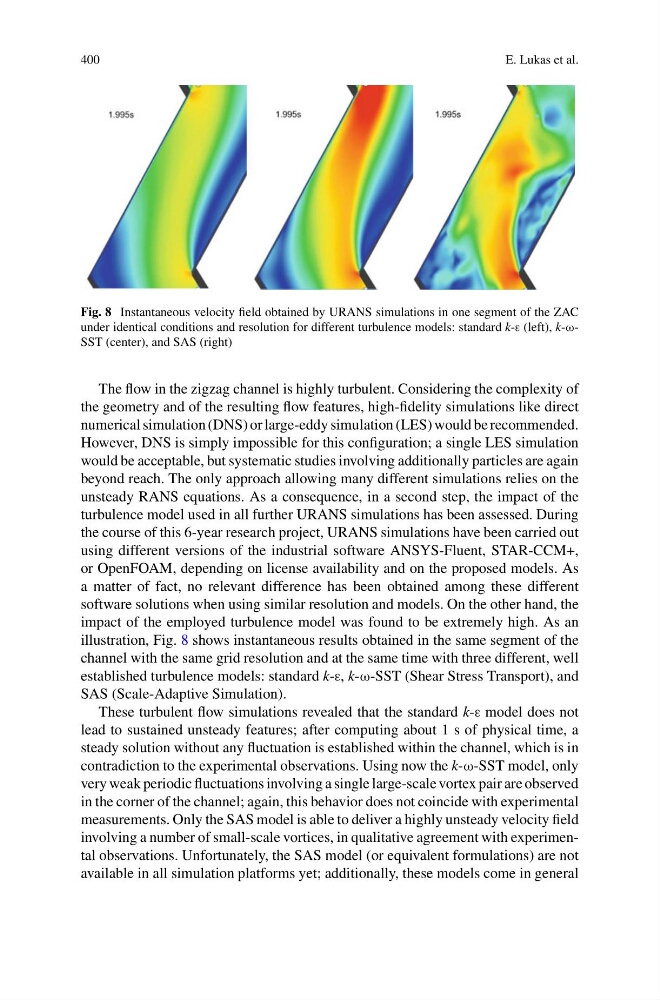
Fig. 8 Instantaneous velocity field obtained by URANS simulations in one segment of the ZAC
under identical conditions and resolution for different turbulence models: standard k-ε (left), k-ωSST (center), and SAS (right)
The flow in the zigzag channel is highly turbulent. Considering the complexity of
the geometry and of the resulting flow features, high-fidelity simulations like direct
numerical simulation (DNS) or large-eddy simulation (LES) would be recommended.
However, DNS is simply impossible for this configuration; a single LES simulation
would be acceptable, but systematic studies involving additionally particles are again
beyond reach. The only approach allowing many different simulations relies on the
unsteady RANS equations. As a consequence, in a second step, the impact of the
turbulence model used in all further URANS simulations has been assessed. During
the course of this 6-year research project, URANS simulations have been carried out
using different versions of the industrial software ANSYS-Fluent, STAR-CCM+,
or OpenFOAM, depending on license availability and on the proposed models. As
a matter of fact, no relevant difference has been obtained among these different
software solutions when using similar resolution and models. On the other hand, the
impact of the employed turbulence model was found to be extremely high. As an
illustration, Fig. 8 shows instantaneous results obtained in the same segment of the
channel with the same grid resolution and at the same time with three different, well
established turbulence models: standard k-ε, k-ω-SST (Shear Stress Transport), and
SAS (Scale-Adaptive Simulation).
These turbulent flow simulations revealed that the standard k-ε model does not
lead to sustained unsteady features; after computing about 1 s of physical time, a
steady solution without any fluctuation is established within the channel, which is in
contradiction to the experimental observations. Using now the k-ω-SST model, only
very weak periodic fluctuations involving a single large-scale vortex pair are observed
in the corner of the channel; again, this behavior does not coincide with experimental
measurements. Only the SAS model is able to deliver a highly unsteady velocity field
involving a number of small-scale vortices, in qualitative agreement with experimental observations. Unfortunately, the SAS model (or equivalent formulations) are not
available in all simulation platforms yet; additionally, these models come in general
E. Lukas et al.
Fig. 8 Instantaneous velocity field obtained by URANS simulations in one segment of the ZAC
under identical conditions and resolution for different turbulence models: standard k-ε (left), k-ωSST (center), and SAS (right)
The flow in the zigzag channel is highly turbulent. Considering the complexity of
the geometry and of the resulting flow features, high-fidelity simulations like direct
numerical simulation (DNS) or large-eddy simulation (LES) would be recommended.
However, DNS is simply impossible for this configuration; a single LES simulation
would be acceptable, but systematic studies involving additionally particles are again
beyond reach. The only approach allowing many different simulations relies on the
unsteady RANS equations. As a consequence, in a second step, the impact of the
turbulence model used in all further URANS simulations has been assessed. During
the course of this 6-year research project, URANS simulations have been carried out
using different versions of the industrial software ANSYS-Fluent, STAR-CCM+,
or OpenFOAM, depending on license availability and on the proposed models. As
a matter of fact, no relevant difference has been obtained among these different
software solutions when using similar resolution and models. On the other hand, the
impact of the employed turbulence model was found to be extremely high. As an
illustration, Fig. 8 shows instantaneous results obtained in the same segment of the
channel with the same grid resolution and at the same time with three different, well
established turbulence models: standard k-ε, k-ω-SST (Shear Stress Transport), and
SAS (Scale-Adaptive Simulation).
These turbulent flow simulations revealed that the standard k-ε model does not
lead to sustained unsteady features; after computing about 1 s of physical time, a
steady solution without any fluctuation is established within the channel, which is in
contradiction to the experimental observations. Using now the k-ω-SST model, only
very weak periodic fluctuations involving a single large-scale vortex pair are observed
in the corner of the channel; again, this behavior does not coincide with experimental
measurements. Only the SAS model is able to deliver a highly unsteady velocity field
involving a number of small-scale vortices, in qualitative agreement with experimental observations. Unfortunately, the SAS model (or equivalent formulations) are not
available in all simulation platforms yet; additionally, these models come in general